While Roderick Hudson was Henry James's second published novel (Watch and Ward being the first and serialized in The Atlantic Monthly in 1871), he always considered Roderick Hudson his "first novel". James also freely admitted that Roderick Hudson was his take on Nathaniel Hawthorne's The Marble Faun (1860).
I went into this book with my eyes wide open and ended up loving it. This is early James and is completely accessible to any and all readers. It is, in my humble opinion, a bit of a Byronic--and an almost Gothic--tale that hits on several themes. First, there's the comparison and contrast between the Old World cultural values of Europe and the New World values of the American expatriate community. Secondly, and perhaps most importantly, this novel felt very autobiographical in that both the eponymous 'Roderick Hudson' and the novel's other primary protagonist, 'Rowland Mallet', seem to represent the author at various times in his literary life. This novel really seemed to be the story of the battle--the constant tension--between the Artist and the Muse; and I have to really wonder if this really isn't Henry James pouring his heart and soul out upon every page.
We've all known artistic people like 'Roderick Hudson', and we care for 'em to the very best of our ability. Sadly though, artistic geniuses like them burn 'hot', and there's just not much that can be done; whether its a Kurt Cobain, a Jimi Hendrix, Amy Winehouse, Vincent Van Gogh, Egon Schiele, Lizzie Siddal, John Keats, or even a Dante Gabriel Rossetti. The candle burns hot, gutters, and then its out. Roderick Hudson is just such a story. Strange as it may sound, this novel pulsed and throbbed with passion and emotion like that found in the fiction of one of the Bronte sisters or even Mary Shelley.
For a 'first' novel--at least from James's perspective--this is an engaging and durable plot that completely hooks the reader. The novel also serves as a terrific travelogue as the protagonists travel throughout much of Europe highlighting the experiences of the American nouveau riche and brashness among the Old World European sensibilities. Who's right? Who's wrong? Well, you can gain some perspective on this question through reading about the experiences of Rowland Mallet and Roderick Hudson in this wonderful example of Henry James's early fiction. If you're just coming to the fiction of Henry James, Roderick Hudson is truly an excellent novel to start with.
***
Roderick Hudson
By Henry James
Penguin Classics Edition
Softcover, 398 pp.
pro se = L. "for oneself."
prose = L. 'prosa.' the ordinary language people use is speaking or writing: a prosaic style, quality, or condition.
The Journal of My Travels through the World's Great Literature
July 15, 2013
Review: "Doctor Thorne" By Anthony Trollope
Anthony Trollope's Doctor Thorne (1858) is a novel that lulls you into a state of complete and blissful immersion in Trollope's fascinating borough of Barsetshire. This is the story of a country doctor, the eponymous Doctor Thorne, and his lovely niece, Mary Thorne, and of their interactions with the landed 'Old World' gentry and the nouveau riche. While this is certainly a novel about romance, it is also a hard and critical social commentary directed at class differences and manners. This novel explores the old adage that "money is the root of all..."Frankly, I've come to realize that Anthony Trollope is simply one hell of a story-teller, and with this tale I'd swear that the shade of Jane Austen was perched over his shoulder as he wrote Doctor Thorne. It has a Dickensian cast of characters without the grotesque or patently comedic, and actually ends up leaving the reader with the sense that this was probably a fairly accurate portrayal of life in rural Victorian England.
While Doctor Thorne is included within Trollope's series, The Chronicles of Barsetshire, it stands alone quite nicely, and there are even a few characters from his later series, The Pallisers, that briefly appear in the tale. In sum, this is a terrific novel that engages the reader right from the start and then rollicks along to its very satisfying conclusion. I highly recommend Trollope's Doctor Thorne and look forward to picking this up again for a reread sometime in the future. This was solid four of five stars for me.
***
Doctor Thorne
By Anthony Trollope
Everyman's Library Edition
Hardcover, 319 pp.
Review: "The Bostonians" By Henry James
This was an interesting novel to read. In all honesty it was serious step down from the masterpiece that precedes it, i.e., The Portrait of a Lady. Having said that though, I think James perhaps intended this book to be lighter fare than Portrait. In fact, The Bostonians, written by James in 1886, is loaded with satire, irony, and a goodly number of comedic moments. The novel's plot revolves around two cousins, Olive Chancellor and Basil Ransom, and the relationship that each desires to have with a young red-headed woman of magnetic personality, Miss Verena Tarrant. Verena and Olive are both deeply involved in the suffragette movement of the 1870s in the United States. Basil Ransom is a Confederate Civil War veteran from Mississippi now trying to eke out a living as a lawyer in New York City. While the two women spend much time in the novel speechifying on their commitment to women's rights, and Basil spends much of his time jocularly refuting their positions, the novel isn't really about feminism, it is all about relationships and feelings.
While Basil's efforts at establishing a romantic romantic relationship with Verena Tarrant were really rather predictable, it was the relationship between Verena and Olive that perhaps intrigued me the most. There's an ambiguity about Olive and her motives that puzzles me still, and while it might be easy to interpret Olive's feelings for Verena as a quasi-homosexual love, I also think that interpretation might mostly miss the mark. It is my understanding that it was this novel that actually gave rise to the term "Boston Marriage" describing the relationship of two unmarried women living together.
Finally, as I sit here and process my thoughts upon completing the novel, I have come to the conclusion that both Olive and Basil use and manipulate Verena for their own purpose. Verena, in my opinion, when she is first encountered by Olive and Basil, is brimming with the "Joy of Life" and is absolutely true to herself and her own feelings. Through the course of the novel she falls prey to the machinations and manipulations of both cousins, and ultimately ends up becoming in many ways much more like each of them. And I'm not sure that this is best for Verena.
Before I settle on my final verdict for James's The Bostonians, I would like to read it again sometime. I really do think there are a lot of undertones lurking about in this tale that can only be ferreted out upon subsequent reads. This is most definitely a historical novel, and some knowledge about the suffragette movement and spiritualism of the 1870s and life in post-Civil War America would surely help the reader put many of the themes and discussion topics in context.
***
The Bostonians
By Henry James
Everyman's Library Edition
Hardcover, 442 pp.
Review: "An Eye for an Eye" By Anthony Trollope
This is my fourth Trollope, and while not the best I've read (that distinction goes to The Way We Live Now, so far), it was a good story. I have found that Trollope is a story-teller, and a very good one at that. An Eye for an Eye, written in 1879, is actually a tale that is much more characteristic of those written by Elizabeth Gaskell, Thomas Hardy or even George Eliot. An Eye for an Eye is a tragedy in every sense of the word, and you can see the tragic ending coming like an on-rushing freight train.
Without giving away too much of the plot of this slim little novel (just 201 pages), the gist of the tale revolves around a handsome young Army officer, Fred Neville, whose regiment has been recently billeted in a remote station along the Irish coast. During the course of his jaunts about the wild Irish countryside, Fred meets a beautiful young Irish Catholic woman, Kate O'Hara. Concurrent with his Army duties in Ireland, Fred is selected by his elderly uncle, Lord Scroope, to become the heir apparent and inherent the Scroope wealth, lands, and title. Suffice it to say that his uncle is not particularly interested in Fred bringing a young Irish Catholic woman back to England as the future Lady Scroope. With the dilemma of both loving the young woman and recognizing the responsibility to his family, Fred takes actions and makes promises to Kate and his uncle that creates an impossible situation that can only end badly for everyone.
In An Eye for an Eye, Trollope definitely puts his reader 'front-and-center' with many of the social issues of the day, including (1) Catholic vs Protestant, (2) Anglo vs Irish, (3) class differences, and, of course, the (4) gender and sexuality issues that dominate the relationship between Fred and Kate.
Like each of the Trollope novels I've read to date, this was an engaging and well-written story that I quite enjoyed. I guess I really don't know why I don't read Trollope more often.
***
An Eye for an Eye
By Anthony Trollope
Oxford University Press
Softcover, 256 pp.
Without giving away too much of the plot of this slim little novel (just 201 pages), the gist of the tale revolves around a handsome young Army officer, Fred Neville, whose regiment has been recently billeted in a remote station along the Irish coast. During the course of his jaunts about the wild Irish countryside, Fred meets a beautiful young Irish Catholic woman, Kate O'Hara. Concurrent with his Army duties in Ireland, Fred is selected by his elderly uncle, Lord Scroope, to become the heir apparent and inherent the Scroope wealth, lands, and title. Suffice it to say that his uncle is not particularly interested in Fred bringing a young Irish Catholic woman back to England as the future Lady Scroope. With the dilemma of both loving the young woman and recognizing the responsibility to his family, Fred takes actions and makes promises to Kate and his uncle that creates an impossible situation that can only end badly for everyone.
In An Eye for an Eye, Trollope definitely puts his reader 'front-and-center' with many of the social issues of the day, including (1) Catholic vs Protestant, (2) Anglo vs Irish, (3) class differences, and, of course, the (4) gender and sexuality issues that dominate the relationship between Fred and Kate.
Like each of the Trollope novels I've read to date, this was an engaging and well-written story that I quite enjoyed. I guess I really don't know why I don't read Trollope more often.
***
An Eye for an Eye
By Anthony Trollope
Oxford University Press
Softcover, 256 pp.
March 22, 2013
Review: "The Old Way: A Story of the First People" By Elizabeth Marshall Thomas
The Old Way: A Story of the First People is an absolutely fascinating account of the !Kung, or Ju/wasi ("The People"), people of the Kalahari Desert region of southwestern Africa. Elizabeth Marshall Thomas wrote this book in 2006, based upon the many years that she and her family spent with these amazing people starting in the early 1950s. In fact, Thomas's mother ended up publishing several anthropological monographs through Harvard University describing the !Kung hunter-gatherer lifestyle in this desolate and unforgiving landscape. Thomas herself, as a young woman, spent several years living with and getting to know the !Kung, and recorded her observations in her personal journals. Her older brother, John, spent most of his life with these people, working tirelessly on their behalf, and even married a Ju/wasi woman.
Like most people, I'd heard about the "Bushmen of the Kalahari" as a boy, but really had no idea what that meant, or really who these people were. In a nutshell, the !Kung are an ancient people that have essentially lived a nomadic Paleolithic lifestyle in the Kalahari Desert for more than 20,000 years. Interestingly too, with the recent completion of the Human Genome Project, we now know that these people are some of the most ancient and genetically diverse anatomically modern humans (i.e., Homo sapiens) on the planet. If you will, the !Kung peoples are the 'rootstock' of most of us. And as such, I think a book like that which Ms. Thomas has written is incredibly important for all of us to read and think about. In other words, this book has the capability of putting us firmly in touch with who we were, and who we are.
The !Kung also speak an incredibly ancient language--one of the African 'click' languages--a mix of phonemes and click sounds made with the palate, lips, tongue, or cheeks. Linguists believe that the click language that the !Kung speak is at least 60,000 years old, and may rank as one of humanity's oldest existing languages. In reading this book I discovered that utilizing a click language actually makes great sense when living and hunting in a dangerously hostile environment like the Kalahari, as the click sounds tend to blend in and sound more 'natural' and don't alarm prey or alert potential predators like spoken words can.
Ms. Thomas starts off talking about the relationship of these people to the 1,500 centuries, or more, of modern human existence; and up until the mid-1960s, not much had changed from the way our Paleolithic ancestors lived some 60,000-70,000 years ago. She then described the complex relationship that the !Kung had with their environment and the animals that occupied the Kalahari and that the people depended upon for meat. The heart of the book is that these were peoples that were completely connected to the habitat and ecology around them. They intimately understood the habits of all of the animals and and habitat preferences and uses for the plant species of the savannah and desert. Ms. Thomas describes in fascinating detail how plants are gathered and used among the people, marriage and the importance of lineage, how children were raised, how animals were hunted, religious and mythological beliefs, the interactions and social fabric of the family dynamic and small collections of families that lived and migrated together. There is even a whole chapter on the relationship of the !Kung with the top predators of the Kalahari, African lions, leopards, and spotted hyenas.
Inevitably though time and the new way of human life caught up to this remote corner of the world, and Thomas reports that by the 1990s most of the Bushmen, including the !Kung, had been forced off of their natural ranges and now live in government-sponsored shanty towns and have largely given up their hunter-gatherer subsistence lifestyle. And similar to what has happened to many Native American peoples in the United States, it has been a very difficult transition for many of them in trying to adapt to the new ways of 'modern' living. It made me sad to think that these people, so lovingly described and respected by Ms. Thomas in this book, really no longer exist. Sure, there are still Bushmen living in southwestern Africa near their old homelands in the Kalahari Desert, but they're not living "The Old Way" as the "First People" any longer, and that, I think, is a loss for all of humanity.
In conclusion, I highly recommend this book, and count it as a non-fiction favorite read for 2013, and is certainly a book that I will undoubtedly revisit sometime in the future.
The Old Way--A Story of the First People
By Elizabeth Marshall Thomas
Hardcover, 344 pp.
Farrar Strauss Giroux, 2006
ISBN 0374225524
***
Like most people, I'd heard about the "Bushmen of the Kalahari" as a boy, but really had no idea what that meant, or really who these people were. In a nutshell, the !Kung are an ancient people that have essentially lived a nomadic Paleolithic lifestyle in the Kalahari Desert for more than 20,000 years. Interestingly too, with the recent completion of the Human Genome Project, we now know that these people are some of the most ancient and genetically diverse anatomically modern humans (i.e., Homo sapiens) on the planet. If you will, the !Kung peoples are the 'rootstock' of most of us. And as such, I think a book like that which Ms. Thomas has written is incredibly important for all of us to read and think about. In other words, this book has the capability of putting us firmly in touch with who we were, and who we are.
The !Kung also speak an incredibly ancient language--one of the African 'click' languages--a mix of phonemes and click sounds made with the palate, lips, tongue, or cheeks. Linguists believe that the click language that the !Kung speak is at least 60,000 years old, and may rank as one of humanity's oldest existing languages. In reading this book I discovered that utilizing a click language actually makes great sense when living and hunting in a dangerously hostile environment like the Kalahari, as the click sounds tend to blend in and sound more 'natural' and don't alarm prey or alert potential predators like spoken words can.
Ms. Thomas starts off talking about the relationship of these people to the 1,500 centuries, or more, of modern human existence; and up until the mid-1960s, not much had changed from the way our Paleolithic ancestors lived some 60,000-70,000 years ago. She then described the complex relationship that the !Kung had with their environment and the animals that occupied the Kalahari and that the people depended upon for meat. The heart of the book is that these were peoples that were completely connected to the habitat and ecology around them. They intimately understood the habits of all of the animals and and habitat preferences and uses for the plant species of the savannah and desert. Ms. Thomas describes in fascinating detail how plants are gathered and used among the people, marriage and the importance of lineage, how children were raised, how animals were hunted, religious and mythological beliefs, the interactions and social fabric of the family dynamic and small collections of families that lived and migrated together. There is even a whole chapter on the relationship of the !Kung with the top predators of the Kalahari, African lions, leopards, and spotted hyenas.
Inevitably though time and the new way of human life caught up to this remote corner of the world, and Thomas reports that by the 1990s most of the Bushmen, including the !Kung, had been forced off of their natural ranges and now live in government-sponsored shanty towns and have largely given up their hunter-gatherer subsistence lifestyle. And similar to what has happened to many Native American peoples in the United States, it has been a very difficult transition for many of them in trying to adapt to the new ways of 'modern' living. It made me sad to think that these people, so lovingly described and respected by Ms. Thomas in this book, really no longer exist. Sure, there are still Bushmen living in southwestern Africa near their old homelands in the Kalahari Desert, but they're not living "The Old Way" as the "First People" any longer, and that, I think, is a loss for all of humanity.
In conclusion, I highly recommend this book, and count it as a non-fiction favorite read for 2013, and is certainly a book that I will undoubtedly revisit sometime in the future.
The Old Way--A Story of the First People
By Elizabeth Marshall Thomas
Hardcover, 344 pp.
Farrar Strauss Giroux, 2006
ISBN 0374225524
***
March 10, 2013
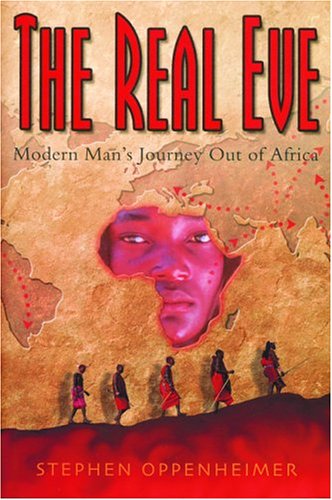
Review: "The Real Eve: Modern Man's Journey Out of Africa" By Stephen Oppenheimer
Dr. Stephen Oppenheimer's The Real Eve: Modern Man's Journey Out of Africa (2003) is absolutely one of the very best non-fiction books I've read in a few years! And I say this on several levels too. First, if you are at all interested in your own human origins, and what makes us human, you'll love this book. Second, if you're interested in paleoanthropology, and are interested in what happened after anatomically modern humans (i.e., Homo sapiens) appeared in Africa somewhere around 200,000 years ago and when did we actually become 'behaviorally modern' too, you'll love this book. Finally, if you're at all interested in how anatomically and behaviorally modern humans then spread out in the great diaspora about 80,000 years ago known as the "Out-of-Africa" dispersal, you'll love this book.
Much of this book is an incredibly compelling melding of the existing paleoanthropological, archaeological, and genetic evidence that, when combined with known ecological and climatological data, tells the story of these robust early modern humans that undertook this grand journey that completely changed the world we live in. Oppenheimer carefully presents and considers all of the available archaeological evidence and the conclusions drawn from it, and then compares it with the results of the now extensive amount of genetic research associated with maternal mitochondrial-DNA and male Y-chromosome analyses. Oppenheimer believes that we now have answers or, at a minimum, some pretty compelling hypotheses that go far in addressing questions about who these peoples were that trekked along the coasts colonizing the Near East, eastern and western Europe, India, southeast Asia and eventually even New Guinea, and Australia; while others continued 'coasting' up along the Asian-Pacific coast before turning inland and settling the hinterlands of the ice-age steppe tundra of Siberia and Mongolia. Finally, Oppenheimer addresses one of the most contentious issues in modern archaeology--that of the settling of the Americas. When did modern humans reach the Americas? Who were these early colonizers? Where did they come from? Did they come in a single wave following the end of the last ice-age, or were there multiple entries? And were the Clovis peoples really the first to arrive about 12,000 years ago?
The organization of this book in its seven chapters is simply superb too, in my opinion. Dr. Oppenheimer starts off with the fascinating discussion of our early modern human ancestors in Africa, and what it was that might have compelled them to leave Africa between 80,000 and 90,000 years ago. He then spends time describing the archaeological evidence associated with the potential routes of initial dispersal from Africa (i.e., a northern route through the Levant, or the southern route--the preferred alternative--via the Bab al Mandab at the bottom of the Red Sea and the Horn of Africa).
The second chapter is equally fascinating, and addresses the all-important question of when did anatomically modern humans become 'behaviorally modern'. This has been a vexing question to paleoanthropologists and archaeologists for some time now, and there is a considerable body of evidence out there that can be interpreted quite differently. Frankly though, I'm leaning toward agreement with Dr. Oppenheimer that the appearance of anatomically modern humans between 200,000 years and 170,000 years ago was largely concurrent with the appearance of our behavioral modernity as well. In contrast, there are many well-respected anthropologists, e.g., Richard G. Klein of Stanford University, who believe that Homo sapiens became behaviorally modern sometime around 50,000 years ago, the result of additional adaptations within the human brain. Oppenheimer and other geneticists have not yet ferreted out what this change might have been, nor does he believe that the archaeological evidence supports this theory. All in all, I found this a very thought-provoking chapter.
The remainder of the book's chapters (i.e., 3-7) focus on detailed archaeological and genetic discussions of the timing of the entries into the various regions of the world colonized by the mitochondrial 'Out-of-Africa Eve' and Y-chromosomal 'Out-of-Africa Adam' and their genetic descendants. Chapter Three describes the types of people and timing of the colonizing of eastern and western Europe. Chapter Four focuses on the colonization of India, southeast Asia and leading to humans reaching New Guinea and Australia by about 60,000 years ago (implication being you'd certainly have to have been 'behaviorally modern' to fabricate a craft that was capable of 'island-hopping' and crossing many tens of kilometers of open ocean to reach Australia!). Chapter Five looks at the types of peoples and the timing of the settling of the great interior regions of ice-age Asia and eastern Russia. Chapter Six tells the story of the impact of the last ice-age in the late-Pleistocene (i.e., the Last Glacial Maximum), that wreaked havoc on the small populations of humans scattered throughout Europe and Asia. The last chapter of the book is Oppenheimer's take on the peopling of the Americas. He's of the opinion--based upon archaeology and genetics--that the first 'Americans' arrived between 25,000 years and 22,000 years ago, and that this was followed by a re-expansion of peoples that had occupied Beringia (the huge continent that existed between 25,000-11,000 years ago and linked Asian Siberia with North American Alaska during the run up and through the Last Glacial Maximum).
'So,' you ask, 'having read this fascinating book, what's the upshot?' Well, first, I can categorically answer that we are all African! Second, I think the genetic evidence and its most parsimonious interpretations tend to validate and enhance the current "Out-of-Africa" hypothesis for the dispersal of Homo sapiens from eastern Africa around 80,000 years ago. Third, after reading this book you'll never look at another human being quite the same. You'll always be thinking about our remarkable kinship, yet more fully understanding the meaning of the differences that exist among the peoples of our world today. I think it is also important to point out that Dr. Oppenheimer has also very carefully sourced and documented the material he presents in the book with over 50 pages of end-notes. I strongly recommend reading each of the end-notes too, it made for an even more complete reading experience for me.
Dr. Oppenheimer's The Real Eve: Modern Man's Journey Out of Africa is a grand synthesis of a grand story--our own human origins and subsequent dispersal around the globe. This book is really the incredible story of how a very small group (1,000-2,000 individuals) from a total population of the approximately 20,000 Homo sapiens that occupied Africa about 80,000 years ago actually got up the gumption to strike out and explore and colonize the rest of the world over the next 40,000 years or so. Finally, don't be intimidated by the subject matter, Dr. Oppenheimer is an engaging writer and spends the time and effort to present the material in such a fashion as to be understandable by any reader. It includes loads of terrific maps and detailed charts illustrating and supporting the genetic evidence and conclusions presented in the book.
In closing, I do want to say that I consider myself more than just a casual student of topics in paleoanthropology and human origins and evolution. Over my entire adult life I have made a point of staying current with the latest information, via books and technical journal articles, on this intellectually challenging subject, and I can unhesitatingly say that I believe that this is one of the most important books that I've read associated with modern human origins. This was such a good book that I've gone ahead and found a hardcover edition for my paleoanthropology book collection, as I know that I will be diving into this book time and again in the future. I highly recommend this book, and feel entirely justified in giving this 'five stars'.
The Real Eve: Modern Man's Journey Out of Africa
By Stephen Oppenheimer
Softcover, 440 pp.
Carroll & Graf Publishing, 2004
ISBN 0-7867-1334-8
***
Much of this book is an incredibly compelling melding of the existing paleoanthropological, archaeological, and genetic evidence that, when combined with known ecological and climatological data, tells the story of these robust early modern humans that undertook this grand journey that completely changed the world we live in. Oppenheimer carefully presents and considers all of the available archaeological evidence and the conclusions drawn from it, and then compares it with the results of the now extensive amount of genetic research associated with maternal mitochondrial-DNA and male Y-chromosome analyses. Oppenheimer believes that we now have answers or, at a minimum, some pretty compelling hypotheses that go far in addressing questions about who these peoples were that trekked along the coasts colonizing the Near East, eastern and western Europe, India, southeast Asia and eventually even New Guinea, and Australia; while others continued 'coasting' up along the Asian-Pacific coast before turning inland and settling the hinterlands of the ice-age steppe tundra of Siberia and Mongolia. Finally, Oppenheimer addresses one of the most contentious issues in modern archaeology--that of the settling of the Americas. When did modern humans reach the Americas? Who were these early colonizers? Where did they come from? Did they come in a single wave following the end of the last ice-age, or were there multiple entries? And were the Clovis peoples really the first to arrive about 12,000 years ago?
The organization of this book in its seven chapters is simply superb too, in my opinion. Dr. Oppenheimer starts off with the fascinating discussion of our early modern human ancestors in Africa, and what it was that might have compelled them to leave Africa between 80,000 and 90,000 years ago. He then spends time describing the archaeological evidence associated with the potential routes of initial dispersal from Africa (i.e., a northern route through the Levant, or the southern route--the preferred alternative--via the Bab al Mandab at the bottom of the Red Sea and the Horn of Africa).
The second chapter is equally fascinating, and addresses the all-important question of when did anatomically modern humans become 'behaviorally modern'. This has been a vexing question to paleoanthropologists and archaeologists for some time now, and there is a considerable body of evidence out there that can be interpreted quite differently. Frankly though, I'm leaning toward agreement with Dr. Oppenheimer that the appearance of anatomically modern humans between 200,000 years and 170,000 years ago was largely concurrent with the appearance of our behavioral modernity as well. In contrast, there are many well-respected anthropologists, e.g., Richard G. Klein of Stanford University, who believe that Homo sapiens became behaviorally modern sometime around 50,000 years ago, the result of additional adaptations within the human brain. Oppenheimer and other geneticists have not yet ferreted out what this change might have been, nor does he believe that the archaeological evidence supports this theory. All in all, I found this a very thought-provoking chapter.
The remainder of the book's chapters (i.e., 3-7) focus on detailed archaeological and genetic discussions of the timing of the entries into the various regions of the world colonized by the mitochondrial 'Out-of-Africa Eve' and Y-chromosomal 'Out-of-Africa Adam' and their genetic descendants. Chapter Three describes the types of people and timing of the colonizing of eastern and western Europe. Chapter Four focuses on the colonization of India, southeast Asia and leading to humans reaching New Guinea and Australia by about 60,000 years ago (implication being you'd certainly have to have been 'behaviorally modern' to fabricate a craft that was capable of 'island-hopping' and crossing many tens of kilometers of open ocean to reach Australia!). Chapter Five looks at the types of peoples and the timing of the settling of the great interior regions of ice-age Asia and eastern Russia. Chapter Six tells the story of the impact of the last ice-age in the late-Pleistocene (i.e., the Last Glacial Maximum), that wreaked havoc on the small populations of humans scattered throughout Europe and Asia. The last chapter of the book is Oppenheimer's take on the peopling of the Americas. He's of the opinion--based upon archaeology and genetics--that the first 'Americans' arrived between 25,000 years and 22,000 years ago, and that this was followed by a re-expansion of peoples that had occupied Beringia (the huge continent that existed between 25,000-11,000 years ago and linked Asian Siberia with North American Alaska during the run up and through the Last Glacial Maximum).
'So,' you ask, 'having read this fascinating book, what's the upshot?' Well, first, I can categorically answer that we are all African! Second, I think the genetic evidence and its most parsimonious interpretations tend to validate and enhance the current "Out-of-Africa" hypothesis for the dispersal of Homo sapiens from eastern Africa around 80,000 years ago. Third, after reading this book you'll never look at another human being quite the same. You'll always be thinking about our remarkable kinship, yet more fully understanding the meaning of the differences that exist among the peoples of our world today. I think it is also important to point out that Dr. Oppenheimer has also very carefully sourced and documented the material he presents in the book with over 50 pages of end-notes. I strongly recommend reading each of the end-notes too, it made for an even more complete reading experience for me.
Dr. Oppenheimer's The Real Eve: Modern Man's Journey Out of Africa is a grand synthesis of a grand story--our own human origins and subsequent dispersal around the globe. This book is really the incredible story of how a very small group (1,000-2,000 individuals) from a total population of the approximately 20,000 Homo sapiens that occupied Africa about 80,000 years ago actually got up the gumption to strike out and explore and colonize the rest of the world over the next 40,000 years or so. Finally, don't be intimidated by the subject matter, Dr. Oppenheimer is an engaging writer and spends the time and effort to present the material in such a fashion as to be understandable by any reader. It includes loads of terrific maps and detailed charts illustrating and supporting the genetic evidence and conclusions presented in the book.
In closing, I do want to say that I consider myself more than just a casual student of topics in paleoanthropology and human origins and evolution. Over my entire adult life I have made a point of staying current with the latest information, via books and technical journal articles, on this intellectually challenging subject, and I can unhesitatingly say that I believe that this is one of the most important books that I've read associated with modern human origins. This was such a good book that I've gone ahead and found a hardcover edition for my paleoanthropology book collection, as I know that I will be diving into this book time and again in the future. I highly recommend this book, and feel entirely justified in giving this 'five stars'.
The Real Eve: Modern Man's Journey Out of Africa
By Stephen Oppenheimer
Softcover, 440 pp.
Carroll & Graf Publishing, 2004
ISBN 0-7867-1334-8
***
March 4, 2013
Review: "The First Human: The Race to Discover Our Earliest Ancestor" By Ann Gibbons
Ann Gibbons has written a very solid and fascinating account of the relative recent discoveries of several of our earliest human ancestors. Gibbons is a well known science writer and brings significant journalistic integrity to her story-telling, as well as significant knowledge of her subject matter. The First Human: The Race to Discover Our Earliest Ancestors (2006) is the story of the paleoanthropologists behind the incredibly important discoveries of hominin species that are currently some of the oldest yet found, and span a range of ages from 5.0 million years old to perhaps as much as 7.0 million years old.
Gibbons, in telling the story of these discoveries, necessarily focuses much of the book on the out-sized personalities (and, dare I say, egos) of the anthropologists leading the teams exploring various important fossil regions in Africa. The teams she primarily focuses on in the book include Tim White and his work in the Afar Depression of Ethiopia; Richard and Meave Leakey in the Lake Turkana region of Kenya; Martin Pickford and Brigitte Senut in the Tugen Hills of Kenya; and Michel Brunet and his team in the Djureb Desert of Chad. Each of these teams of highly professional specialists in their respective fields have significantly added to our general understanding and knowledge base associated with the very earliest hominin species found to date, including Australopithecus, Ardipithecus, and two newly identified species, Orrorin tugenensis and Sahelanthropus tchadensis.
Gibbons is quite even-handed in describing the tension and academic conflict that has arisen among some of these researchers associated with the interpretation and meaning of these important fossil discoveries and their role in understanding and explaining human evolution. Gibbons does a great job of not editorializing or letting her own emotions color the scenes she writes about, and simply factually recounts the stories of the fossil discoveries, the research science that followed, and the resultant back-and-forth academic squabbles that erupted as articles were published and discussed in various academic journals. As a serious amateur student of paleoanthropology and human evolution, I know that this is pretty much de rigueur, not only in anthropological circles, but among the scientific community as a whole. All in all, I think that a rigorous and scholarly debate is incredibly healthy and typically results in the advancement of scientific knowledge. Having said that though, and based upon my interpretation of what Gibbons presents in this book, it is my personal opinion that Martin Pickford--one of the co-discoverers of O. tugenensis--behaved simply deplorably in his much of his dealings with his peers in the academic community over many, many years.
If you're interested in reading about how scientists gear up and conduct scientific expeditions in some very inhospitable portions of the world in their on-going search for the proverbial "needle in the haystack", then I think you'll very much enjoy Ms. Gibbons, The First Human: The Race to Discover Our Earliest Ancestors. Additionally, if you're specifically interested in learning more about these new, and incredibly ancient, species that have been discovered (i.e., O. tugenensis and S. tchadensis you'll very much appreciate the detail and solid science that Ms. Gibbons provides in telling this fascinating story.
The First Human: The Race to Discover Our Earliest Ancestor
By Ann Gibbons
Softcover, 336 pp.
Anchor Books, 2006
ISBN 140007696X
***
Gibbons, in telling the story of these discoveries, necessarily focuses much of the book on the out-sized personalities (and, dare I say, egos) of the anthropologists leading the teams exploring various important fossil regions in Africa. The teams she primarily focuses on in the book include Tim White and his work in the Afar Depression of Ethiopia; Richard and Meave Leakey in the Lake Turkana region of Kenya; Martin Pickford and Brigitte Senut in the Tugen Hills of Kenya; and Michel Brunet and his team in the Djureb Desert of Chad. Each of these teams of highly professional specialists in their respective fields have significantly added to our general understanding and knowledge base associated with the very earliest hominin species found to date, including Australopithecus, Ardipithecus, and two newly identified species, Orrorin tugenensis and Sahelanthropus tchadensis.
Gibbons is quite even-handed in describing the tension and academic conflict that has arisen among some of these researchers associated with the interpretation and meaning of these important fossil discoveries and their role in understanding and explaining human evolution. Gibbons does a great job of not editorializing or letting her own emotions color the scenes she writes about, and simply factually recounts the stories of the fossil discoveries, the research science that followed, and the resultant back-and-forth academic squabbles that erupted as articles were published and discussed in various academic journals. As a serious amateur student of paleoanthropology and human evolution, I know that this is pretty much de rigueur, not only in anthropological circles, but among the scientific community as a whole. All in all, I think that a rigorous and scholarly debate is incredibly healthy and typically results in the advancement of scientific knowledge. Having said that though, and based upon my interpretation of what Gibbons presents in this book, it is my personal opinion that Martin Pickford--one of the co-discoverers of O. tugenensis--behaved simply deplorably in his much of his dealings with his peers in the academic community over many, many years.
If you're interested in reading about how scientists gear up and conduct scientific expeditions in some very inhospitable portions of the world in their on-going search for the proverbial "needle in the haystack", then I think you'll very much enjoy Ms. Gibbons, The First Human: The Race to Discover Our Earliest Ancestors. Additionally, if you're specifically interested in learning more about these new, and incredibly ancient, species that have been discovered (i.e., O. tugenensis and S. tchadensis you'll very much appreciate the detail and solid science that Ms. Gibbons provides in telling this fascinating story.
The First Human: The Race to Discover Our Earliest Ancestor
By Ann Gibbons
Softcover, 336 pp.
Anchor Books, 2006
ISBN 140007696X
***
Review: "Missing Links: In Search of Human Origins" By John Reader
This book is largely a complete rewrite of a similarly titled book that Reader first published in 1981. This lavishly illustrated book is an excellent and comprehensive survey of the history behind the search for our human origins. Mr. Reader guides the reader through the first early discoveries and interpretations of the fossils and artifacts that led the great thinkers of the 18th and 19th centuries to begin pondering our origins. From the mid-19th century on, as many of you are aware, things really take off, and significant fossil hominin discoveries are made in Europe, Asia, and then in Africa. And as we know now, it is in Africa where the cradle of humanity and all of its closest relatives are to be found.
What Mr. Reader has created in Missing Links: In Search of Human Origins (2011) is a profoundly interesting story. First, for its detailed description of the expeditions and the 'thrill of the hunt' associated with all of the fascinating fossil discoveries and interpretations of the biological evidence. Second, Reader uses the book to tell the story of the fascinating personalities (and, in some cases, huge egos) of all of the men and women involved in these searches for hominin fossils and their role in better understanding our own biological history. This is as much a story of Charles Darwin, Arthur Keith, Eugene Dubois, Raymond Dart, Robert Bloom, the Leakey family, Phillip Tobias, Don Johanson, Tim White, and Michel Brunet, and a host of others, as it is about the fossils themselves. Another important element that Reader brings to the story is the importance of the integration of many different scientific disciplines when investigating and endeavoring to piece together and tell the complicated story and timeline of our human existence over the past six to seven million years.
In some respects, this book reminded me of the second edition of Ian Tattersall's brilliant book, The Fossil Trail: How We Know What We Think We Know about Human Evolution (2008). While Tattersall's book is perhaps more technically oriented to the actual fossil evidence and biological data, Mr. Reader's is more focused on the historical elements associated with the finds and the anthropologists and anatomists doing the work. All in all, they are actually quite complementary works, and well worth having in your collection. So, whether you're a professional anthropologist or you are simply interested in better understanding your own biological and evolutionary history and origins, I highly recommend John Reader's Missing Links: In Search of Human Origins.
Missing Links: In Search of Human Origins
By John Reader
Hardcover, 538 pp.
Oxford University Press, 2011
ISBN 0199276854
What Mr. Reader has created in Missing Links: In Search of Human Origins (2011) is a profoundly interesting story. First, for its detailed description of the expeditions and the 'thrill of the hunt' associated with all of the fascinating fossil discoveries and interpretations of the biological evidence. Second, Reader uses the book to tell the story of the fascinating personalities (and, in some cases, huge egos) of all of the men and women involved in these searches for hominin fossils and their role in better understanding our own biological history. This is as much a story of Charles Darwin, Arthur Keith, Eugene Dubois, Raymond Dart, Robert Bloom, the Leakey family, Phillip Tobias, Don Johanson, Tim White, and Michel Brunet, and a host of others, as it is about the fossils themselves. Another important element that Reader brings to the story is the importance of the integration of many different scientific disciplines when investigating and endeavoring to piece together and tell the complicated story and timeline of our human existence over the past six to seven million years.
In some respects, this book reminded me of the second edition of Ian Tattersall's brilliant book, The Fossil Trail: How We Know What We Think We Know about Human Evolution (2008). While Tattersall's book is perhaps more technically oriented to the actual fossil evidence and biological data, Mr. Reader's is more focused on the historical elements associated with the finds and the anthropologists and anatomists doing the work. All in all, they are actually quite complementary works, and well worth having in your collection. So, whether you're a professional anthropologist or you are simply interested in better understanding your own biological and evolutionary history and origins, I highly recommend John Reader's Missing Links: In Search of Human Origins.
Missing Links: In Search of Human Origins
By John Reader
Hardcover, 538 pp.
Oxford University Press, 2011
ISBN 0199276854
Review: "In Search of the Neanderthals: Solving the Puzzle of Human Origins" By Christopher Stringer and Clive Gamble
I think that Christopher Stringer, along with Ian Tattersall, are my two favorite writers when it comes to reading books about paleoanthropology and our human origins. Dr. Stringer's In Search of the Neanderthals: Solving the Puzzle of Human Origins, while somewhat dated (1993), is a fascinating account of the fossil, genetic, ecological, and archaeological data associated with the Neandertals (Homo neanderthalensis) and anatomically modern humans (Homo sapiens). For many years, almost since the first Neandertal fossil was found in the mid-19th century, it has been thought that modern humans (H. sapiens) were descendants of this earlier hominin species. We now know that this is not the case. In fact, it is now clear that at one point in time--about 45,000 years ago--there may have been as many as four different and distinct human species living on Earth at the same time, including the Neandertals, modern humans, and then the very ancient Homo erectus in southeast Asia, and perhaps the diminutive hominin on the island of Flores in the Indonesian archipelago, Homo floresiensis. [Note that this doesn't take into account the status of the still mysterious "Denisovan" hominin found in one cave in Russia's Altai Mountains, and that appear to be genetically distinct from both Neandertals and anatomically modern humans!]
Much of Dr. Stringer's book focuses on describing the fossil, biological, genetic and archaeological data and evidence that actually distinguishes anatomically modern humans (i.e., us) from the Neandertal peoples. It is Stringer's contention, and that of much of the paleoanthropological community as well, that anatomically modern humans are not descended from Neandertals, but were a contemporaneous species that shared a common ancestor such as Homo heidelbergensis or Homo antecessor between them and the earlier Homo erectus.
In this book, Dr. Stringer does an excellent job of making the case for an "Out-of-Africa" dispersal for anatomically modern humans that probably began about 90,000-70,000 years ago, and by 45,000 years ago these modern humans, also known as the "Cro-Magnon", had spread into western Europe, the home of the Neandertals for 200,000+ years and ultimately displaced them. It appears that the modern behaviors (e.g., planning, art, improved stone-tool and shelter technologies, language, etc.) and tremendous environmental adaptability exhibited by these new modern peoples was probably enough to pressure the Neandertals to have to shift to small isolated enclaves at the margins of their former range across much of western and central Europe. This diminution of their range and inability to adapt ultimately led to the extinction of the Neandertals approximately 30,000-25,000 years ago.
If you're looking for a good one-volume, easy-to-read, treatment of the origins and relationship between our close cousins, the Neandertals, and ourselves, then I highly recommend this book. Additionally, this volume is profusely illustrated with a terrific collection of photographs that illustrates and supports the fossil evidence for Stringer's contention that anatomically modern humans evolved separately and apart from Neandertals. Finally, if you want the latest--state-of-the-science--information about our human origins, I strongly urge you to read Dr. Stringer's latest book, Lone Survivors: How We Came to Be the Only Humans on Earth (2012).
In Search of the Neanderthals: Solving the Puzzle of Human Origins
By Chris Stringer and Clive Gamble
Hardcover, 248 pp.
Thames & Hudson, 1993
ISBN 0500050708
***
Much of Dr. Stringer's book focuses on describing the fossil, biological, genetic and archaeological data and evidence that actually distinguishes anatomically modern humans (i.e., us) from the Neandertal peoples. It is Stringer's contention, and that of much of the paleoanthropological community as well, that anatomically modern humans are not descended from Neandertals, but were a contemporaneous species that shared a common ancestor such as Homo heidelbergensis or Homo antecessor between them and the earlier Homo erectus.
In this book, Dr. Stringer does an excellent job of making the case for an "Out-of-Africa" dispersal for anatomically modern humans that probably began about 90,000-70,000 years ago, and by 45,000 years ago these modern humans, also known as the "Cro-Magnon", had spread into western Europe, the home of the Neandertals for 200,000+ years and ultimately displaced them. It appears that the modern behaviors (e.g., planning, art, improved stone-tool and shelter technologies, language, etc.) and tremendous environmental adaptability exhibited by these new modern peoples was probably enough to pressure the Neandertals to have to shift to small isolated enclaves at the margins of their former range across much of western and central Europe. This diminution of their range and inability to adapt ultimately led to the extinction of the Neandertals approximately 30,000-25,000 years ago.
If you're looking for a good one-volume, easy-to-read, treatment of the origins and relationship between our close cousins, the Neandertals, and ourselves, then I highly recommend this book. Additionally, this volume is profusely illustrated with a terrific collection of photographs that illustrates and supports the fossil evidence for Stringer's contention that anatomically modern humans evolved separately and apart from Neandertals. Finally, if you want the latest--state-of-the-science--information about our human origins, I strongly urge you to read Dr. Stringer's latest book, Lone Survivors: How We Came to Be the Only Humans on Earth (2012).
In Search of the Neanderthals: Solving the Puzzle of Human Origins
By Chris Stringer and Clive Gamble
Hardcover, 248 pp.
Thames & Hudson, 1993
ISBN 0500050708
***
Review: "The Neanderthal's Necklace: In Search of the First Thinkers" By Juan Luis Arsuaga (translated by Andy Katt)
Juan Luis Arsuaga's The Neanderthal's Necklace: In Search of the First Thinkers (2002) is an excellent and compelling addition to my collection of paleoanthropological books. Dr. Arsuaga is a Spanish anthropologist and has spent much of his career at the famous archaeological sites at the Sierra de Atapuerca. He and his team are known for discovering the largest collection of pre-Neandertal hominins--some 2,000 human fossils, comprising maybe as many as thirty-two individuals. According to Professor Arsuaga, all of these fossils are likely an ancestral species to both the Neandertals (Homo neanderthalensis) and anatomically modern humans (Homo sapiens), and are classified as either Homo heidelbergensis or Homo antecessor. This human species occupied the Iberian peninsula and other portions of western Europe for a very long period of time, from approximately 780,000 years before present to perhaps 130,000 years before present.
What Professor Arsuaga accomplishes in this book is to eloquently tell the history of the early human species that occupied western Europe, especially the Iberian peninsula from the Middle Paleolithic through the early Upper Paleolithic and the extinction of the Neandertals. What I particularly appreciated was Dr. Arsuaga's melding of the data associated with regional climatic and ecological conditions in telling the story of these early hominin species who occupied these habitats so many millenia in our past in Spain during those fluctuating periods of extreme world-wide glaciation and interglacials. Over the years that I have been reading books and technical papers about human origins, I have come to better understand and appreciate that data and information associated with the effects of global and regional climate change and regional ecological conditions are every bit as important as the fossil and genetic evidence.
Personally, I think Professor Arsuaga's book, The Neanderthal's Necklace: In Search of the First Thinkers, is an important book and goes far in helping fill in the details about our human origins between what we currently know about the dispersal of Homo erectus from Africa between approximately 1.5-1.2 million years ago, and the arrival of fully-functioning anatomically modern humans (Homo sapiens) in western Europe about 45,000 years ago. I also strongly suggest that Professor Arsuaga's book makes an excellent companion to Clive Finlayson's relatively recent (2010) book entitled, The Humans Who Went Extinct: Why Neanderthals Died Out and We Survived. In reading both of these books, the reader will come away with a clear understanding of the role of the early hominin species in western Europe and the role that climate change and ecological conditions played in ultimately reaching the point that only one human species--Homo sapiens--remained on the planet.
The Neanderthal's Necklace: In Search of the First Thinkers
By Juan Luis Arsuaga, translated by Andy Katt
Hardcover, 320 pp.
Basic Books, 2002
ISBN 1568581874
***
What Professor Arsuaga accomplishes in this book is to eloquently tell the history of the early human species that occupied western Europe, especially the Iberian peninsula from the Middle Paleolithic through the early Upper Paleolithic and the extinction of the Neandertals. What I particularly appreciated was Dr. Arsuaga's melding of the data associated with regional climatic and ecological conditions in telling the story of these early hominin species who occupied these habitats so many millenia in our past in Spain during those fluctuating periods of extreme world-wide glaciation and interglacials. Over the years that I have been reading books and technical papers about human origins, I have come to better understand and appreciate that data and information associated with the effects of global and regional climate change and regional ecological conditions are every bit as important as the fossil and genetic evidence.
Personally, I think Professor Arsuaga's book, The Neanderthal's Necklace: In Search of the First Thinkers, is an important book and goes far in helping fill in the details about our human origins between what we currently know about the dispersal of Homo erectus from Africa between approximately 1.5-1.2 million years ago, and the arrival of fully-functioning anatomically modern humans (Homo sapiens) in western Europe about 45,000 years ago. I also strongly suggest that Professor Arsuaga's book makes an excellent companion to Clive Finlayson's relatively recent (2010) book entitled, The Humans Who Went Extinct: Why Neanderthals Died Out and We Survived. In reading both of these books, the reader will come away with a clear understanding of the role of the early hominin species in western Europe and the role that climate change and ecological conditions played in ultimately reaching the point that only one human species--Homo sapiens--remained on the planet.
The Neanderthal's Necklace: In Search of the First Thinkers
By Juan Luis Arsuaga, translated by Andy Katt
Hardcover, 320 pp.
Basic Books, 2002
ISBN 1568581874
***
Subscribe to:
Posts (Atom)