The Old Way: A Story of the First People is an absolutely fascinating account of the !Kung, or Ju/wasi ("The People"), people of the Kalahari Desert region of southwestern Africa. Elizabeth Marshall Thomas wrote this book in 2006, based upon the many years that she and her family spent with these amazing people starting in the early 1950s. In fact, Thomas's mother ended up publishing several anthropological monographs through Harvard University describing the !Kung hunter-gatherer lifestyle in this desolate and unforgiving landscape. Thomas herself, as a young woman, spent several years living with and getting to know the !Kung, and recorded her observations in her personal journals. Her older brother, John, spent most of his life with these people, working tirelessly on their behalf, and even married a Ju/wasi woman.
Like most people, I'd heard about the "Bushmen of the Kalahari" as a boy, but really had no idea what that meant, or really who these people were. In a nutshell, the !Kung are an ancient people that have essentially lived a nomadic Paleolithic lifestyle in the Kalahari Desert for more than 20,000 years. Interestingly too, with the recent completion of the Human Genome Project, we now know that these people are some of the most ancient and genetically diverse anatomically modern humans (i.e., Homo sapiens) on the planet. If you will, the !Kung peoples are the 'rootstock' of most of us. And as such, I think a book like that which Ms. Thomas has written is incredibly important for all of us to read and think about. In other words, this book has the capability of putting us firmly in touch with who we were, and who we are.
The !Kung also speak an incredibly ancient language--one of the African 'click' languages--a mix of phonemes and click sounds made with the palate, lips, tongue, or cheeks. Linguists believe that the click language that the !Kung speak is at least 60,000 years old, and may rank as one of humanity's oldest existing languages. In reading this book I discovered that utilizing a click language actually makes great sense when living and hunting in a dangerously hostile environment like the Kalahari, as the click sounds tend to blend in and sound more 'natural' and don't alarm prey or alert potential predators like spoken words can.
Ms. Thomas starts off talking about the relationship of these people to the 1,500 centuries, or more, of modern human existence; and up until the mid-1960s, not much had changed from the way our Paleolithic ancestors lived some 60,000-70,000 years ago. She then described the complex relationship that the !Kung had with their environment and the animals that occupied the Kalahari and that the people depended upon for meat. The heart of the book is that these were peoples that were completely connected to the habitat and ecology around them. They intimately understood the habits of all of the animals and and habitat preferences and uses for the plant species of the savannah and desert. Ms. Thomas describes in fascinating detail how plants are gathered and used among the people, marriage and the importance of lineage, how children were raised, how animals were hunted, religious and mythological beliefs, the interactions and social fabric of the family dynamic and small collections of families that lived and migrated together. There is even a whole chapter on the relationship of the !Kung with the top predators of the Kalahari, African lions, leopards, and spotted hyenas.
Inevitably though time and the new way of human life caught up to this remote corner of the world, and Thomas reports that by the 1990s most of the Bushmen, including the !Kung, had been forced off of their natural ranges and now live in government-sponsored shanty towns and have largely given up their hunter-gatherer subsistence lifestyle. And similar to what has happened to many Native American peoples in the United States, it has been a very difficult transition for many of them in trying to adapt to the new ways of 'modern' living. It made me sad to think that these people, so lovingly described and respected by Ms. Thomas in this book, really no longer exist. Sure, there are still Bushmen living in southwestern Africa near their old homelands in the Kalahari Desert, but they're not living "The Old Way" as the "First People" any longer, and that, I think, is a loss for all of humanity.
In conclusion, I highly recommend this book, and count it as a non-fiction favorite read for 2013, and is certainly a book that I will undoubtedly revisit sometime in the future.
The Old Way--A Story of the First People
By Elizabeth Marshall Thomas
Hardcover, 344 pp.
Farrar Strauss Giroux, 2006
ISBN 0374225524
***
pro se = L. "for oneself."
prose = L. 'prosa.' the ordinary language people use is speaking or writing: a prosaic style, quality, or condition.
The Journal of My Travels through the World's Great Literature
Showing posts with label review. Show all posts
March 22, 2013
Review: "The Old Way: A Story of the First People" By Elizabeth Marshall Thomas
February 4, 2013
Review: "Deadhouse Gates" By Steven Erikson
Deadhouse Gates is the second book in Steven Erikson’s brilliant and uber-epic ten-volume fantasy series, "The Malazan Book of the Fallen" (MBotF). I think this is now the third time I’ve read this book and it still remains one of my favorites. Deadhouse Gates is nothing short of a ‘nail-biter’ from the get-go and the pacing is utterly relentless. I have to say that Deadhouse Gates is an easier read than Erikson’s first book in the MBotF series, Gardens of the Moon, and much of that is because the reader is slowly, but surely, becoming more familiar with Erikson’s writing style and more comfortable with the unique qualities of the Malazan world that he has crafted.
In my opinion, Deadhouse Gates is a fine example of what I truly love the most about the MBotF series, and that is Erikson’s ability to make his readers empathize with the characters in his books. One thing that really impresses me about Erikson’s characters is that they are all typically people that the reader can relate to, and there are really very few, if any, characters that aren’t flawed in one fashion or another. Also, Erikson’s MBotF characters exhibit a strong dose of egalitarianism, as men and women in the books commonly occupy positions of authority and responsibility across all walks of life in the Malazan world.
Much of Deadhouse Gates occurs on the continent of “Seven Cities” and introduces a whole new cast of characters from those presented in Gardens of the Moon. Never fear though, of the multiple story arcs in Deadhouse Gates, one arc does involve a small group of characters that the reader met in Gardens of the Moon and who become quite important to the storyline in this episode. As is typical of Erikson novels in the MBotF series, there are plots and sub-plots galore swirling around throughout this 600+ page book (trade-paperback edition), and each of them is an attention-grabber, and at times contain a powerful ‘punch to the gut’.
Without giving away anything of significance away, Deadhouse Gates revolves around the rebellion of many of the subjugated peoples of the Seven Cities continent. This rebellion is known as “The Whirlwind” and is intended to rid the continent of all of the Malazan occupiers, both administrative and military. The main plot of the novel is one that just takes your breath away—that of the tactical retreat of the Malazan Seventh Army over several hundred leagues from one city to another. The Malazan Seventh is commanded by Coltaine, a Wickan Crow Clan warchief, and now a Fist (General) in the Malazan Army. Fist Coltaine and many of the other Wickan characters are some of my favorites in the entire MBotF series, and the Wickan Clans themselves—with names like “Foolish Dog Clan”, “Weasel Clan, and “Crow Clan”—reminded me of some of the Native American tribes that so effectively battled the U.S. Army in the latter half of the 19th century.
Honestly, the story of the Seventh Army’s retreat across the landscape of Seven Cities is truly nothing short of epic, as Coltaine must try and not only preserve the fighting capacity of the Seventh Army, but protect more than 50,000 refugees that his forces are endeavoring to shepherd to safety. This plot thread that weaves through much of the novel becomes known as “Coltaine’s Chain of Dogs”, a moniker of significant distinction and pride to the members of the Seventh Army, as well as the rest of the Malazan Empire. As a veteran of the military myself, there was something in this story of the “Chain of Dogs” that truly tugged at the heartstrings of my very soul, and I cannot begin to tell you how many times while reading about the desperate attempts of the Seventh Army to survive its horrifying trek across Seven Cities that I had to set the book aside for a few moments and simply let the tears roll down my cheeks. While at times a terribly tragic story, the tale of Coltaine’s “Chain of Dogs” is also one that exhibits the finest qualities of humanity—courage, compassion, comradeship, and Love.
Erikson's description of this epic journey, and the battles fought along the way, rivals any that have been written about in numerous superb non-fiction military histories. Examples that immediately come to mind include the U.S. Continental Army’s retreat from New York to Valley Forge, or Napoleon’s Grande Armee’s retreat from Russia, or Field Marshal von Manstein's strategic retreat of several German armies across the frozen steppes of southern Russia in early 1942 (after the fall of Stalingrad). Erikson’s tale of the “Chain of Dogs” in Deadhouse Gates is some of the best military fiction I’ve ever read, and should appeal to readers with even a passing interest in military or historical fiction or non-fiction.
But wait, there’s even more—So much more! Deadhouse Gates is also chock full of important plot and story lines that really help to begin to open up the full breadth and scope of the Malazan world to the reader. There are significant tie-backs to important events and happenings in Gardens of the Moon, as well as explanations of the fascinating and complex system of magic and sorcery, and loads of new information about the mythology and significance of the pantheon of gods and goddesses who occupy the Malazan world. Deadhouse Gates can perhaps be best characterized as the ‘tale of multiple journeys’, with Coltaine’s “Chain of the Dogs” being the centerpiece, but there are also the journeys of several other groups of characters that are just as meaningful to the overall plot and are very, very important to future episodes in the MBotF series.
I continue to be completely blown away with the sheer quality of the writing, the plotting, the character development, the pacing, the pathos and drama, and the sheer inventiveness and originality of the world that Erikson has created. Mr. Erikson doesn't pull his punches, this is truly some hard, bleak, and dark fiction; and it is at times viscerally tragic and profoundly sad. At the same time though, Erikson soars to heights almost unknown in fantasy fiction with his moments of triumph, success, and the joy of experiencing those fleeting instants of pure and unbridled goodness and humanity.
In closing, I highly and unhesitatingly recommend this series; and, in my opinion, Deadhouse Gates is much more than a quantum step forward from the first novel in the series, Gardens of the Moon. Deadhouse Gates was the book in the MBotF series that cemented my love affair with all things Malazan. Read Deadhouse Gates--you’ll become a believer too!
Deadhouse Gates
By Steven Erikson
Tor Books, 2005
Trade Paperback Edition, 608 pp
ISBN-0765314290
***
In my opinion, Deadhouse Gates is a fine example of what I truly love the most about the MBotF series, and that is Erikson’s ability to make his readers empathize with the characters in his books. One thing that really impresses me about Erikson’s characters is that they are all typically people that the reader can relate to, and there are really very few, if any, characters that aren’t flawed in one fashion or another. Also, Erikson’s MBotF characters exhibit a strong dose of egalitarianism, as men and women in the books commonly occupy positions of authority and responsibility across all walks of life in the Malazan world.
Much of Deadhouse Gates occurs on the continent of “Seven Cities” and introduces a whole new cast of characters from those presented in Gardens of the Moon. Never fear though, of the multiple story arcs in Deadhouse Gates, one arc does involve a small group of characters that the reader met in Gardens of the Moon and who become quite important to the storyline in this episode. As is typical of Erikson novels in the MBotF series, there are plots and sub-plots galore swirling around throughout this 600+ page book (trade-paperback edition), and each of them is an attention-grabber, and at times contain a powerful ‘punch to the gut’.
Without giving away anything of significance away, Deadhouse Gates revolves around the rebellion of many of the subjugated peoples of the Seven Cities continent. This rebellion is known as “The Whirlwind” and is intended to rid the continent of all of the Malazan occupiers, both administrative and military. The main plot of the novel is one that just takes your breath away—that of the tactical retreat of the Malazan Seventh Army over several hundred leagues from one city to another. The Malazan Seventh is commanded by Coltaine, a Wickan Crow Clan warchief, and now a Fist (General) in the Malazan Army. Fist Coltaine and many of the other Wickan characters are some of my favorites in the entire MBotF series, and the Wickan Clans themselves—with names like “Foolish Dog Clan”, “Weasel Clan, and “Crow Clan”—reminded me of some of the Native American tribes that so effectively battled the U.S. Army in the latter half of the 19th century.
Honestly, the story of the Seventh Army’s retreat across the landscape of Seven Cities is truly nothing short of epic, as Coltaine must try and not only preserve the fighting capacity of the Seventh Army, but protect more than 50,000 refugees that his forces are endeavoring to shepherd to safety. This plot thread that weaves through much of the novel becomes known as “Coltaine’s Chain of Dogs”, a moniker of significant distinction and pride to the members of the Seventh Army, as well as the rest of the Malazan Empire. As a veteran of the military myself, there was something in this story of the “Chain of Dogs” that truly tugged at the heartstrings of my very soul, and I cannot begin to tell you how many times while reading about the desperate attempts of the Seventh Army to survive its horrifying trek across Seven Cities that I had to set the book aside for a few moments and simply let the tears roll down my cheeks. While at times a terribly tragic story, the tale of Coltaine’s “Chain of Dogs” is also one that exhibits the finest qualities of humanity—courage, compassion, comradeship, and Love.
Erikson's description of this epic journey, and the battles fought along the way, rivals any that have been written about in numerous superb non-fiction military histories. Examples that immediately come to mind include the U.S. Continental Army’s retreat from New York to Valley Forge, or Napoleon’s Grande Armee’s retreat from Russia, or Field Marshal von Manstein's strategic retreat of several German armies across the frozen steppes of southern Russia in early 1942 (after the fall of Stalingrad). Erikson’s tale of the “Chain of Dogs” in Deadhouse Gates is some of the best military fiction I’ve ever read, and should appeal to readers with even a passing interest in military or historical fiction or non-fiction.
But wait, there’s even more—So much more! Deadhouse Gates is also chock full of important plot and story lines that really help to begin to open up the full breadth and scope of the Malazan world to the reader. There are significant tie-backs to important events and happenings in Gardens of the Moon, as well as explanations of the fascinating and complex system of magic and sorcery, and loads of new information about the mythology and significance of the pantheon of gods and goddesses who occupy the Malazan world. Deadhouse Gates can perhaps be best characterized as the ‘tale of multiple journeys’, with Coltaine’s “Chain of the Dogs” being the centerpiece, but there are also the journeys of several other groups of characters that are just as meaningful to the overall plot and are very, very important to future episodes in the MBotF series.
I continue to be completely blown away with the sheer quality of the writing, the plotting, the character development, the pacing, the pathos and drama, and the sheer inventiveness and originality of the world that Erikson has created. Mr. Erikson doesn't pull his punches, this is truly some hard, bleak, and dark fiction; and it is at times viscerally tragic and profoundly sad. At the same time though, Erikson soars to heights almost unknown in fantasy fiction with his moments of triumph, success, and the joy of experiencing those fleeting instants of pure and unbridled goodness and humanity.
In closing, I highly and unhesitatingly recommend this series; and, in my opinion, Deadhouse Gates is much more than a quantum step forward from the first novel in the series, Gardens of the Moon. Deadhouse Gates was the book in the MBotF series that cemented my love affair with all things Malazan. Read Deadhouse Gates--you’ll become a believer too!
Deadhouse Gates
By Steven Erikson
Tor Books, 2005
Trade Paperback Edition, 608 pp
ISBN-0765314290
***
January 22, 2013
Review: "Blood and Bone By Ian C. Esslemont (Malazan Empire #5)
Blood and Bone is far and away the best episode in Ian C. Esslemont's on-going series of "Malazan Empire" novels. For those who don't know, Esslemont and his "Malazan World" co-creater, Steven Erikson, have authored two series of books that are all interconnected and interwoven together to create, in my humble opinion, the finest fantasy series ever written. Erikson's series is ten books and is entitled "The Malazan Book of the Fallen, and with Blood and Bone, Esslemont has now completed five novels in his "Malazan Empire" series.
Blood and Bone is a tour de force on so many levels--the quality of writing, the plotting and complexity, characterization, and then the sheer significance to the entire Malazan canon. This novel grabbed me from the first page and didn't let up until the very last page--it really is that good! Both Erikson and Esslemont are known for Malazan novels that build with tension and a whole host of seemingly incongruous plot-threads, but generally about two-thirds of the way through the book a series of convergences begin to occur. This typically culminates in the 'mother of all convergences' near the end of the book, with everything coming flying together, usually in spectacular--and sometimes bloody--fashion.
Blood and Bone begins its mega-convergence pretty much from the first page and just builds like a series of monstrous waves crashing on a rocky shoreline. As I read Blood and Bone I kept thinking about Joseph Conrad's brilliant little novel Heart of Darkness, and I just have to believe that Esslemont must have also been influenced by it as he wrote this book (as well as his anthropological work in Southeast Asia). Additionally, there is a real cinematic quality to Esslemont's writing in this book that very much reminded me of Francis Ford Coppola's film Apocalypse Now (his take on Conrad's Heart of Darkness).
Blood and Bone is set on the island continent of 'Jacaruku' which is bisected by a great range of mountains that run from the northern end to the southern. The western half of the island is home to a group of warring desert tribes people and a brutal society of practitioners of dark and evil magic. The eastern half of Jacaruku is a dense and incredibly dangerous jungle realm known as 'Himatan' that will likely make most readers think of the great jungles in the heart of Africa or the Amazon in South America. And like Conrad's Heart of Darkness, Blood and Bone recounts the stories of the trials and tribulations of several disparate groups of peoples that are all struggling to travel into the interior of this jungle to a fabled lost city--including one group's truly epic journey up a river through the jungle of 'Himatan'. I'm not going to tell you why, except to say that it is all about power--gaining it, or denying it of somebody else.
I think that Blood and Bone is vitally important in helping to answer some questions, or shed significant light on events touched upon in the other novels in Erikson's and Esslemont's Malazan world. If you've been a close reader, you will very much enjoy much of what you discover in this action-packed novel. You're also going to be delighted to encounter some 'old friends' from previous novels, and you're going to love the 'new friends' you're meeting for the first time. While complexly plotted, this is a rollicking good read with loads of action, tension, and a goodly number of moments of mind-numbing terror. As I said at the outset, I think this is Esslemont's best novel yet, and I can't wait to see where he takes us in his next installment. While I have a pretty good guess, I'll let you read Blood and Bone and work that out for yourself. I have no qualms awarding this book five of five stars, it is a truly great story!
Blood and Bone
By Ian C. Esslemont
Bantam Press, UK, Hardcover
586 pp.
ISBN 0593064467
***
Blood and Bone is a tour de force on so many levels--the quality of writing, the plotting and complexity, characterization, and then the sheer significance to the entire Malazan canon. This novel grabbed me from the first page and didn't let up until the very last page--it really is that good! Both Erikson and Esslemont are known for Malazan novels that build with tension and a whole host of seemingly incongruous plot-threads, but generally about two-thirds of the way through the book a series of convergences begin to occur. This typically culminates in the 'mother of all convergences' near the end of the book, with everything coming flying together, usually in spectacular--and sometimes bloody--fashion.
Blood and Bone begins its mega-convergence pretty much from the first page and just builds like a series of monstrous waves crashing on a rocky shoreline. As I read Blood and Bone I kept thinking about Joseph Conrad's brilliant little novel Heart of Darkness, and I just have to believe that Esslemont must have also been influenced by it as he wrote this book (as well as his anthropological work in Southeast Asia). Additionally, there is a real cinematic quality to Esslemont's writing in this book that very much reminded me of Francis Ford Coppola's film Apocalypse Now (his take on Conrad's Heart of Darkness).
Blood and Bone is set on the island continent of 'Jacaruku' which is bisected by a great range of mountains that run from the northern end to the southern. The western half of the island is home to a group of warring desert tribes people and a brutal society of practitioners of dark and evil magic. The eastern half of Jacaruku is a dense and incredibly dangerous jungle realm known as 'Himatan' that will likely make most readers think of the great jungles in the heart of Africa or the Amazon in South America. And like Conrad's Heart of Darkness, Blood and Bone recounts the stories of the trials and tribulations of several disparate groups of peoples that are all struggling to travel into the interior of this jungle to a fabled lost city--including one group's truly epic journey up a river through the jungle of 'Himatan'. I'm not going to tell you why, except to say that it is all about power--gaining it, or denying it of somebody else.
I think that Blood and Bone is vitally important in helping to answer some questions, or shed significant light on events touched upon in the other novels in Erikson's and Esslemont's Malazan world. If you've been a close reader, you will very much enjoy much of what you discover in this action-packed novel. You're also going to be delighted to encounter some 'old friends' from previous novels, and you're going to love the 'new friends' you're meeting for the first time. While complexly plotted, this is a rollicking good read with loads of action, tension, and a goodly number of moments of mind-numbing terror. As I said at the outset, I think this is Esslemont's best novel yet, and I can't wait to see where he takes us in his next installment. While I have a pretty good guess, I'll let you read Blood and Bone and work that out for yourself. I have no qualms awarding this book five of five stars, it is a truly great story!
Blood and Bone
By Ian C. Esslemont
Bantam Press, UK, Hardcover
586 pp.
ISBN 0593064467
***
January 14, 2013
Review: "The Graveyard Book" By Neil Gaiman
I loved this little book! What a wonderful reimagination of Rudyard Kipling's The Jungle Book. Neil Gaiman is just a born story-teller, and The Graveyard Book is such a terrific example of his talents. While there is a touch of horror and macabre in the book, it is very much a book that should appeal to young readers as well as adults. It is also lavishly illustrated by the author-artist Audrey Niffenegger which adds ever so much to the tale.
The premise of The Graveyard Book is of a mysterious man who slays three members of a family, but the fourth member--an 18-month old little baby boy--toddles off in the night and ends up in an old graveyard. He is adopted by the 'residents'--all dead themselves--who range in age from Roman times up to the present. He is taken in and 'raised' by a couple, Mr. and Mrs. Owens, who've been dead for something like 300 years, and is named "Nobody Owens" (nick-named "Bod"). Bod also has a living caretaker, 'Silas', that provides for his material needs whilst keeping him safe as he lives and grows up on the grounds of the cemetery. Bod is in the unique position of being able to essentially cross-walk, if you will, between the land of the living and that of those dead and residing in the cemetery. Bod is given a basic education from former teachers who are now permanent residents in the cemetery. His teachers send him out to practice his reading of English and Latin by studying the plethora of headstones in the cemetery. Bod also learns some nifty little survival tactics, like how to haunt and fade, from all of his dead 'family' and 'friends', and this serves him very well as the mysterious man is still earnestly looking for Bod in order to finish the job. Bod also begins to learn more about his protectors Silas and Miss Lupescu.
Like much of Gaiman's fiction this is a quick read, but the plot and the writing are immensely satisfying. There are all sorts of allusions and references to fairy tales and bits of folklore scattered throughout the book that, taken together, truly cements Gaiman's reputation as a master story-teller in our modern age. The Graveyard Book is a story that I'd love to see somebody (i.e., like Tim Burton, maybe?) endeavor to bring to the 'big screen', as it such a wonderful, wonderful story from start-to-finish.
The Graveyard Book
By Neil Gaiman
Harper Collins, Hardcover, 2008
312 pp.
ISBN 0060530928
***
The premise of The Graveyard Book is of a mysterious man who slays three members of a family, but the fourth member--an 18-month old little baby boy--toddles off in the night and ends up in an old graveyard. He is adopted by the 'residents'--all dead themselves--who range in age from Roman times up to the present. He is taken in and 'raised' by a couple, Mr. and Mrs. Owens, who've been dead for something like 300 years, and is named "Nobody Owens" (nick-named "Bod"). Bod also has a living caretaker, 'Silas', that provides for his material needs whilst keeping him safe as he lives and grows up on the grounds of the cemetery. Bod is in the unique position of being able to essentially cross-walk, if you will, between the land of the living and that of those dead and residing in the cemetery. Bod is given a basic education from former teachers who are now permanent residents in the cemetery. His teachers send him out to practice his reading of English and Latin by studying the plethora of headstones in the cemetery. Bod also learns some nifty little survival tactics, like how to haunt and fade, from all of his dead 'family' and 'friends', and this serves him very well as the mysterious man is still earnestly looking for Bod in order to finish the job. Bod also begins to learn more about his protectors Silas and Miss Lupescu.
Like much of Gaiman's fiction this is a quick read, but the plot and the writing are immensely satisfying. There are all sorts of allusions and references to fairy tales and bits of folklore scattered throughout the book that, taken together, truly cements Gaiman's reputation as a master story-teller in our modern age. The Graveyard Book is a story that I'd love to see somebody (i.e., like Tim Burton, maybe?) endeavor to bring to the 'big screen', as it such a wonderful, wonderful story from start-to-finish.
The Graveyard Book
By Neil Gaiman
Harper Collins, Hardcover, 2008
312 pp.
ISBN 0060530928
***
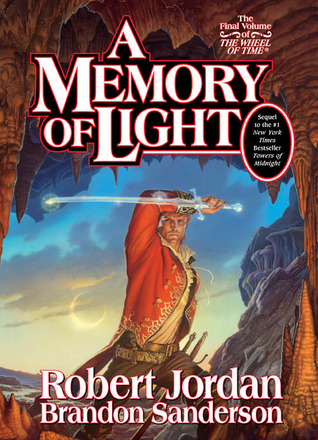
Review: "A Memory of Light" By Robert Jordan & Brandon Sanderson
As I turned the last pages of A Memory of Light so many things were racing through my mind. First, it struck me that this is the end of an era, as I have been religiously reading and rereading this series for over 20 years (23 to be precise!). Second, this is absolutely one of the best fantasy series I have ever read, and I am profoundly and utterly amazed and astonished at the quality of the writing, and complexity of the plotting and characterization from the first volume to this, the fourteenth volume, A Memory of Light. Finally, I don't know that I have ever read one single book that has run me through the emotional 'ringer' the way that A Memory of Light has; and like Life, there are moments of great joy and happiness as well as deep sadness and grief. I cannot begin to tell you how many times while reading this book I simply stopped reading and quietly wept for a few moments. It was, all in all, a simply glorious reading experience!
I am not going to give one word away about how A Memory of Light wraps up this grand journey that all of us have been on for nearly two decades. Suffice it to say that A Memory of Light is nearly 1,000 pages of near perfection, and we should all stand up and bellow at the top of our lungs, Tai'shar Jordan! Tai'shar Sanderson!, as they have given us a grand story and an ending for the ages. Obviously, much of A Memory of Light revolves around 'Tarmon Gai'don' (The Last Battle), and the battle scenes are riveting and make the book incredibly difficult to put down.
As any devoted 'Wheel of Time' fan, I went into A Memory of Light with just a tiny bit of trepidation. After all, this series has finally come to an end, and how it ended was very important to me. Now that I've finished my first reading of A Memory of Light, I have to say that I really don't know what I was worried about. Robert Jordan and Brandon Sanderson have crafted a finale that is emotionally powerful and so intellectually satisfying that it very nearly belies words. Oh, I'm sure that there will be those that will want to change this or that, but not me. I really do think that the series has ended just as it should, and I honestly don't think I'd change a thing. I can't wait to reread A Memory of Light again soon, as I'm sure that upon a more careful second reading it will become an even more meaningful experience for me.
For something over twenty years this series has been a meaningful part of my literary life. At first it was really just great fun--a wonderfully complex and complicated bit of fantasy fiction to enjoy as each installment came out. Now, however, I am beginning to realize that just as Tolkien was inspired through his fiction and poetry to work on developing a mythology for the English peoples, I think Robert Jordan challenged himself to craft a mythology for an American time. Nation-building, economic and environmental pressures, political machinations, faith and belief systems, cultural diversity, it is all there. Mostly the 'Wheel of Time' is the story of men and women and the human condition and the choices we make. Seriously folks, this series is right up there, in my humble opinion, with Steven Erikson's "The Malazan Book of the Fallen", George R.R. Martin's "A Song of Ice and Fire", and J.R.R. Tolkien's "The Lord of the Rings"--it really is that good!
A Memory of Light
By Robert Jordan & Brandon Sanderson
Tor Books, Hardcover, 2013
909 pp.
ISBN 0765325950
***
I am not going to give one word away about how A Memory of Light wraps up this grand journey that all of us have been on for nearly two decades. Suffice it to say that A Memory of Light is nearly 1,000 pages of near perfection, and we should all stand up and bellow at the top of our lungs, Tai'shar Jordan! Tai'shar Sanderson!, as they have given us a grand story and an ending for the ages. Obviously, much of A Memory of Light revolves around 'Tarmon Gai'don' (The Last Battle), and the battle scenes are riveting and make the book incredibly difficult to put down.
As any devoted 'Wheel of Time' fan, I went into A Memory of Light with just a tiny bit of trepidation. After all, this series has finally come to an end, and how it ended was very important to me. Now that I've finished my first reading of A Memory of Light, I have to say that I really don't know what I was worried about. Robert Jordan and Brandon Sanderson have crafted a finale that is emotionally powerful and so intellectually satisfying that it very nearly belies words. Oh, I'm sure that there will be those that will want to change this or that, but not me. I really do think that the series has ended just as it should, and I honestly don't think I'd change a thing. I can't wait to reread A Memory of Light again soon, as I'm sure that upon a more careful second reading it will become an even more meaningful experience for me.
For something over twenty years this series has been a meaningful part of my literary life. At first it was really just great fun--a wonderfully complex and complicated bit of fantasy fiction to enjoy as each installment came out. Now, however, I am beginning to realize that just as Tolkien was inspired through his fiction and poetry to work on developing a mythology for the English peoples, I think Robert Jordan challenged himself to craft a mythology for an American time. Nation-building, economic and environmental pressures, political machinations, faith and belief systems, cultural diversity, it is all there. Mostly the 'Wheel of Time' is the story of men and women and the human condition and the choices we make. Seriously folks, this series is right up there, in my humble opinion, with Steven Erikson's "The Malazan Book of the Fallen", George R.R. Martin's "A Song of Ice and Fire", and J.R.R. Tolkien's "The Lord of the Rings"--it really is that good!
There are no endings, and never will be endings, to the turning of the Wheel of Time.
But it was an ending.
A Memory of Light
By Robert Jordan & Brandon Sanderson
Tor Books, Hardcover, 2013
909 pp.
ISBN 0765325950
***
January 9, 2013
Review: "Great North Road" By Peter F. Hamilton
In reading Peter F. Hamilton's Great North Road I certainly stepped out of my reading 'box', but then I've been doing that a lot over the past few years. This massive tome--nearly 1,000 pages--is a rock-solid and riveting example of the sub-genre of science fiction known as 'space opera', and I have to say that I enjoyed every moment reading this book. I had never read anything by Hamilton before, but I am quite sure that I'll be looking at some of his other fiction in the near future.
Simply put, Great North Road is a tale that takes place approximately 150 years in the future, and is a wonderful combination of a police-procedural murder mystery and the story of a military expedition and exploration on the new and strange world of St. Libra, an Earth-like planet, orbiting the Sirius star system (about 8 light years from our own Solar System). St. Libra is a planet that is mostly covered with water, but with several large land masses that contain a dense and virtually impenetrable jungle. St. Libra also happens to be the location of a large "bioil" facility that manufactures petroleum products created from algae that is 'farmed' in large paddies. This oil is then transported through a "trans-spacial connection", or gateway, back to Earth where it is used by European countries in what is now known as "Grande Europe" (a nod to the current European Union, I'm guessing).
Much of the police procedural elements of the novel are centered on the city of Newcastle in England, where there is a corresponding 'gateway' that allows instantaneous travel and transportation of people and equipment from Earth to St. Libra. Many countries around the world have also established gateways to other worlds and have either created quasi-Utopian settlements, or have engaged in economic- or ethnic-cleansing and have transported their undesirables to these new worlds (i.e., much like the English used to transport criminals, and others, to penal colonies in Australia in the early 19th century). Additionally, there is the added tension throughout much of the novel of the risk of invasion and attack by a truly horrific alien life-form, the "Zanthswarm", which has attacked and destroyed several of the human settlements on other worlds with millions of human casualties. The Human Defense Alliance (HDA) exists to protect all humans (and the gateways) from alien threats, and kind of reminded me of our NATO alliance today, or even the U.S. Homeland Security Department.
Hamilton's world-building and his information-dumps are well handled through the use of a timeline that hops back and forth over a span of a century or more, and seen through multiple points-of-view of the various characters in the novel. There are also some really well thought out notions associated with human cloning, and gene modification (if you have the money) that slows and even reverses the effects of aging, some seriously cool and advanced medical procedures. I also really found fascinating Hamilton's vision of how artificial intelligence (AI) and information technology is used in this novel. People are essentially hard-wired into the 'world-wide-web' and can pull up and utilize their own personal 'net' to communicate and access and process all kinds of information and technology--pretty much all 'virtual reality'. Obviously, this technology allows the police to accomplish some pretty amazing things when it comes to trying to solve crimes, and the soldiers on St. Libra to coordinate and stay linked together as they search for a dangerous alien entity that may, or may not, be involved in the murder that occurred back on Earth.
While some readers may balk a bit at the slightly ponderous pace of the first third of the novel--mostly involving the murder mystery and the Newcastle police--I encourage readers to stay with it as the pace picks up dramatically as characters and plot-lines begin to converge, and then one finds oneself fully engaged as the book roars to its very satisfying conclusion. I have to say that I was mightily impressed at the overall tone and tenor of the novel and its subtle, and sometimes not-so-subtle, moral messages that invite the reader to periodically stop and reflect upon a whole of host of issues, including things like population and emigration/immigration control, medical and bio-ethics, control and use of nuclear and biological weapons, and environmental stewardship and the harvesting and utilization of natural resources. Without being 'preachy' in the novel, I think Hamilton wants his reader to think about these issues and the moral and ethical responsibilities that humans--as an intelligent species--have, and that as we move forward in exploring our Solar System that we do so in a thoughtful, deliberate, and responsible fashion.
The Great North Road is an excellent novel on many levels, and I unhesitatingly recommend reading it. If you like scifi you'll probably love the book; and even if you don't, the plot and science elements in Great North Road are still close enough to our time frame such that it makes sense and isn't too abstract. For me, Great North Road is a solid four out of five stars. A good read indeed!
Great North Road
By Peter F. Hamilton
Del Rey/Ballantine Books, 2012
948 pp.
ISBN 978-0-345-52666-3
***
Simply put, Great North Road is a tale that takes place approximately 150 years in the future, and is a wonderful combination of a police-procedural murder mystery and the story of a military expedition and exploration on the new and strange world of St. Libra, an Earth-like planet, orbiting the Sirius star system (about 8 light years from our own Solar System). St. Libra is a planet that is mostly covered with water, but with several large land masses that contain a dense and virtually impenetrable jungle. St. Libra also happens to be the location of a large "bioil" facility that manufactures petroleum products created from algae that is 'farmed' in large paddies. This oil is then transported through a "trans-spacial connection", or gateway, back to Earth where it is used by European countries in what is now known as "Grande Europe" (a nod to the current European Union, I'm guessing).
Much of the police procedural elements of the novel are centered on the city of Newcastle in England, where there is a corresponding 'gateway' that allows instantaneous travel and transportation of people and equipment from Earth to St. Libra. Many countries around the world have also established gateways to other worlds and have either created quasi-Utopian settlements, or have engaged in economic- or ethnic-cleansing and have transported their undesirables to these new worlds (i.e., much like the English used to transport criminals, and others, to penal colonies in Australia in the early 19th century). Additionally, there is the added tension throughout much of the novel of the risk of invasion and attack by a truly horrific alien life-form, the "Zanthswarm", which has attacked and destroyed several of the human settlements on other worlds with millions of human casualties. The Human Defense Alliance (HDA) exists to protect all humans (and the gateways) from alien threats, and kind of reminded me of our NATO alliance today, or even the U.S. Homeland Security Department.
Hamilton's world-building and his information-dumps are well handled through the use of a timeline that hops back and forth over a span of a century or more, and seen through multiple points-of-view of the various characters in the novel. There are also some really well thought out notions associated with human cloning, and gene modification (if you have the money) that slows and even reverses the effects of aging, some seriously cool and advanced medical procedures. I also really found fascinating Hamilton's vision of how artificial intelligence (AI) and information technology is used in this novel. People are essentially hard-wired into the 'world-wide-web' and can pull up and utilize their own personal 'net' to communicate and access and process all kinds of information and technology--pretty much all 'virtual reality'. Obviously, this technology allows the police to accomplish some pretty amazing things when it comes to trying to solve crimes, and the soldiers on St. Libra to coordinate and stay linked together as they search for a dangerous alien entity that may, or may not, be involved in the murder that occurred back on Earth.
While some readers may balk a bit at the slightly ponderous pace of the first third of the novel--mostly involving the murder mystery and the Newcastle police--I encourage readers to stay with it as the pace picks up dramatically as characters and plot-lines begin to converge, and then one finds oneself fully engaged as the book roars to its very satisfying conclusion. I have to say that I was mightily impressed at the overall tone and tenor of the novel and its subtle, and sometimes not-so-subtle, moral messages that invite the reader to periodically stop and reflect upon a whole of host of issues, including things like population and emigration/immigration control, medical and bio-ethics, control and use of nuclear and biological weapons, and environmental stewardship and the harvesting and utilization of natural resources. Without being 'preachy' in the novel, I think Hamilton wants his reader to think about these issues and the moral and ethical responsibilities that humans--as an intelligent species--have, and that as we move forward in exploring our Solar System that we do so in a thoughtful, deliberate, and responsible fashion.
The Great North Road is an excellent novel on many levels, and I unhesitatingly recommend reading it. If you like scifi you'll probably love the book; and even if you don't, the plot and science elements in Great North Road are still close enough to our time frame such that it makes sense and isn't too abstract. For me, Great North Road is a solid four out of five stars. A good read indeed!
Great North Road
By Peter F. Hamilton
Del Rey/Ballantine Books, 2012
948 pp.
ISBN 978-0-345-52666-3
***
September 6, 2012
Review: "The Grand Design: Strategy and the U.S. Civil War" By Donald Stoker
As you can tell from my recent postings, I have immersed myself in reading and reviewing some really excellent books about the American Civil War. Being a history buff, especially an American history buff, I have always had an abiding passion for the political and military events associated with this momentous period in our republic's history. I often wonder if most people really realize just how close "the great American experiment" came to becoming a complete and abject failure? Reading books about the Civil War continues to remind me just how precious and fragile our great democracy really is, and that it has always taken great sacrifice and dedication to carefully protect and nurture it, and that remains so even today.
I also have a very personal connection to the American Civil War as my great-great grandfather served as a member of the 21st Massachusetts Volunteer infantry regiment. He started as a private and ultimately rose to the rank of 1st Lieutenant before being mustered out near the end of the war in 1865. The regiment was formed in Woburn, Massachusetts, and fought in Burnside's North Carolina coastal campaign (1862) and then many of the campaigns of the Union Army of the Potomac, including the Battle of Second Bull Run, Antietam, Fredericksburg, and Grant's Overland Campaign of 1864. My ancestor was actually badly wounded (shot through both legs) at the Battle of Antietam on September 17, 1862 at the fighting around Burnside's Bridge at the southern end of the battlefield.
With both my personal connection and my historical interest in the Civil War, I very much looked forward to reading Donald Stoker's relatively recent book, The Grand Design: Strategy and the U.S. Civil War in an effort to better understand how the rebellion was actually put down by the Union, and why the South wasn't able to reach its goal of independence. It is worth mentioning that Stoker is well-qualified to write about this subject as he is a Professor of Strategy and Policy for the U.S. Naval War College's program at the Naval Postgraduate School in Monterey, California. This well-written book guides the reader through the prosecution of the Civil War from secession through the surrender of the final Confederate armies in the field in May and June 1865.
I consider myself to be fairly knowledgeable about most of the major political and military battles fought during the war, as well as with all of the various personalities on both the Confederate and Union sides, but I can't say that I was all that familiar with the national and regional realities that shaped the development and implementation of the over-arching strategies used to prosecute the war. This book does a superb job of setting the stage and then walking the reader through the development of the national policies and decisions that led to the fashioning of national and regional operational strategies by the civilian political leaders and military high commands. There was a steep learning curve for leaders--political and military--on both sides during the first year or so of the war. Lincoln was perhaps more adept at drawing the bright line ensuring that military commanders didn't dabble in the political arena, but he was almost as guilty as Jefferson Davis when it came to meddling with day-to-day military matters. Many of the army commanders and their subordinates, on both sides, were graduates of the U.S. Army Military Academy at West Point, and many had years of field experience serving in the U.S. Army, including during the Mexican War (1846-1848). While many of the military commanders had solid resumes when it came to tactically leading troops into battle, most were not able to effectively develop and implement a larger-scale strategic vision. It would take a couple of years of hard fighting to weed out the more incompetent commanders and begin to identify those with strategic vision and that also shared the same strategic goals and objectives as their respective civilian authorities.
I think that there were two critically important themes that ran through this book that made all of the sense in the world to me once I stopped and considered them, including: (1) In order to develop an effective national strategy for winning the war, and then developing effective operational or theater strategies, it first required the identification of specific "centers-of-gravity"; and (2) meaningfully addressing the logistical issues associated with the movement and sustaining of large armies in the field became vitally important. The centers-of-gravity concept was an important one for me--as well as the generals and political leaders--to fully grasp and understand. For example, some of the primary Union centers-of-gravity, in the context of militarily suppressing the rebellion included the following:
Clearly, Federal manufacturing, transportation infrastructure, ability to raise and sustain armies and replace those killed or wounded far out-stripped that of the Confederacy. If the Confederate States were going to achieve victory it really had to have occurred early in the war, and needed to occur decisively. Once the Union implemented the naval blockade, exerted diplomatic pressure on other countries not to interfere, and then brought the full weight of the Federal war-making machine down upon the South it really just became a matter of time. Stoker's book brought home the point that the war may well have gone on even longer had not Lincoln finally found and entrusted prosecution of the war to generals like Ulysses S. Grant, William T. Sherman, George H. Thomas, and Philip Sheridan, and like-minded others. These military commanders understood that victory meant the absolute and utter destruction of not only the enemy's armies, but the will of the citizens to continue the fight. This was the "Total War" developed and so effectively implemented by Grant at Vicksburg, and then greatly expanded upon by Sherman as he marched across Georgia to the coast and then northward through the Carolinas. From mid-1864 to early-1865, Sherman and his armies literally ripped the guts out of the Confederacy whilst Grant pinned and pummeled Lee's Army of Northern Virginia outside of the gates of Richmond and during the siege of Petersburg. Logistics was the determinative factor in bringing to bear and sustaining Union power in its strategic contest with the Confederate armies and civilian populations.
Professor Stoker's book does a great job of describing all of the key decision-making that led to the battlefield victories or defeats, and how the civilian and military leadership, on both sides, was able to adapt, or not, to changing circumstances as they developed national and/or operational strategies. The political and military conduct of the war is largely arranged chronologically in the book, and at the end of each chapter he provides an interesting summation and analysis of what worked, or didn't, and why. Additionally, at the end of the book, the last chapter essentially provides a "report card" and grades the political and military leadership of both the Union and Confederacy, and it makes for great reading and pondering. There are several large-scale maps scattered throughout the book, and I think if I had one reasonable criticism it would be that I would have liked a few more maps at the regional or theater scale that might have helped to better support and understand some of the issues associated with the geographical or logistical issues for both sides.
Finally, I think this is actually an important book that will appeal not only to readers interested in American history and military history, but that it really should be required reading among senior non-commissioned officers and officers in the military, as well as our national civilian political leadership. This would seem to be particularly pertinent as the United States enters its eleventh year of counter-insurgency operations in Afghanistan and other regions around the world. Understanding the concept of centers-of-gravity and the development and design of appropriate strategies would seem to be a pretty important element in successfully prosecuting a war through to its conclusion.
***
The Grand Design: Strategy and the U.S. Civil War
By Donald Stoker
Hardcover, 512 pages
Oxford University Press, USA, 2010
I also have a very personal connection to the American Civil War as my great-great grandfather served as a member of the 21st Massachusetts Volunteer infantry regiment. He started as a private and ultimately rose to the rank of 1st Lieutenant before being mustered out near the end of the war in 1865. The regiment was formed in Woburn, Massachusetts, and fought in Burnside's North Carolina coastal campaign (1862) and then many of the campaigns of the Union Army of the Potomac, including the Battle of Second Bull Run, Antietam, Fredericksburg, and Grant's Overland Campaign of 1864. My ancestor was actually badly wounded (shot through both legs) at the Battle of Antietam on September 17, 1862 at the fighting around Burnside's Bridge at the southern end of the battlefield.
With both my personal connection and my historical interest in the Civil War, I very much looked forward to reading Donald Stoker's relatively recent book, The Grand Design: Strategy and the U.S. Civil War in an effort to better understand how the rebellion was actually put down by the Union, and why the South wasn't able to reach its goal of independence. It is worth mentioning that Stoker is well-qualified to write about this subject as he is a Professor of Strategy and Policy for the U.S. Naval War College's program at the Naval Postgraduate School in Monterey, California. This well-written book guides the reader through the prosecution of the Civil War from secession through the surrender of the final Confederate armies in the field in May and June 1865.
I consider myself to be fairly knowledgeable about most of the major political and military battles fought during the war, as well as with all of the various personalities on both the Confederate and Union sides, but I can't say that I was all that familiar with the national and regional realities that shaped the development and implementation of the over-arching strategies used to prosecute the war. This book does a superb job of setting the stage and then walking the reader through the development of the national policies and decisions that led to the fashioning of national and regional operational strategies by the civilian political leaders and military high commands. There was a steep learning curve for leaders--political and military--on both sides during the first year or so of the war. Lincoln was perhaps more adept at drawing the bright line ensuring that military commanders didn't dabble in the political arena, but he was almost as guilty as Jefferson Davis when it came to meddling with day-to-day military matters. Many of the army commanders and their subordinates, on both sides, were graduates of the U.S. Army Military Academy at West Point, and many had years of field experience serving in the U.S. Army, including during the Mexican War (1846-1848). While many of the military commanders had solid resumes when it came to tactically leading troops into battle, most were not able to effectively develop and implement a larger-scale strategic vision. It would take a couple of years of hard fighting to weed out the more incompetent commanders and begin to identify those with strategic vision and that also shared the same strategic goals and objectives as their respective civilian authorities.
I think that there were two critically important themes that ran through this book that made all of the sense in the world to me once I stopped and considered them, including: (1) In order to develop an effective national strategy for winning the war, and then developing effective operational or theater strategies, it first required the identification of specific "centers-of-gravity"; and (2) meaningfully addressing the logistical issues associated with the movement and sustaining of large armies in the field became vitally important. The centers-of-gravity concept was an important one for me--as well as the generals and political leaders--to fully grasp and understand. For example, some of the primary Union centers-of-gravity, in the context of militarily suppressing the rebellion included the following:
- Implementing and maintaining an effective blockade along the Confederate coast line, which prevented the South from receiving supplies and exporting its cotton and other commodities;
- Controlling and/or destroying the Confederate rail-road infrastructure, which limited the ability of the rebel armies to transport men and material, and allowed the Union to use the rail system for its own military purposes;
- Control of the rivers (especially the Mississippi River) and water-ways in rebel-held territories, which allowed the Union to deny the rebels the use of the rivers while using them as transportation corridors itself;
- Maintaining the focus on the capture and/or destruction of rebel armies (especially the Army of Northern Virginia and the Army of Tennessee); and
- Occupation and restoration of Union control within the State of Tennessee which was the 'heart' of the Confederate west and largely ensured that Kentucky didn't go south too.
Clearly, Federal manufacturing, transportation infrastructure, ability to raise and sustain armies and replace those killed or wounded far out-stripped that of the Confederacy. If the Confederate States were going to achieve victory it really had to have occurred early in the war, and needed to occur decisively. Once the Union implemented the naval blockade, exerted diplomatic pressure on other countries not to interfere, and then brought the full weight of the Federal war-making machine down upon the South it really just became a matter of time. Stoker's book brought home the point that the war may well have gone on even longer had not Lincoln finally found and entrusted prosecution of the war to generals like Ulysses S. Grant, William T. Sherman, George H. Thomas, and Philip Sheridan, and like-minded others. These military commanders understood that victory meant the absolute and utter destruction of not only the enemy's armies, but the will of the citizens to continue the fight. This was the "Total War" developed and so effectively implemented by Grant at Vicksburg, and then greatly expanded upon by Sherman as he marched across Georgia to the coast and then northward through the Carolinas. From mid-1864 to early-1865, Sherman and his armies literally ripped the guts out of the Confederacy whilst Grant pinned and pummeled Lee's Army of Northern Virginia outside of the gates of Richmond and during the siege of Petersburg. Logistics was the determinative factor in bringing to bear and sustaining Union power in its strategic contest with the Confederate armies and civilian populations.
Professor Stoker's book does a great job of describing all of the key decision-making that led to the battlefield victories or defeats, and how the civilian and military leadership, on both sides, was able to adapt, or not, to changing circumstances as they developed national and/or operational strategies. The political and military conduct of the war is largely arranged chronologically in the book, and at the end of each chapter he provides an interesting summation and analysis of what worked, or didn't, and why. Additionally, at the end of the book, the last chapter essentially provides a "report card" and grades the political and military leadership of both the Union and Confederacy, and it makes for great reading and pondering. There are several large-scale maps scattered throughout the book, and I think if I had one reasonable criticism it would be that I would have liked a few more maps at the regional or theater scale that might have helped to better support and understand some of the issues associated with the geographical or logistical issues for both sides.
Finally, I think this is actually an important book that will appeal not only to readers interested in American history and military history, but that it really should be required reading among senior non-commissioned officers and officers in the military, as well as our national civilian political leadership. This would seem to be particularly pertinent as the United States enters its eleventh year of counter-insurgency operations in Afghanistan and other regions around the world. Understanding the concept of centers-of-gravity and the development and design of appropriate strategies would seem to be a pretty important element in successfully prosecuting a war through to its conclusion.
***
The Grand Design: Strategy and the U.S. Civil War
By Donald Stoker
Hardcover, 512 pages
Oxford University Press, USA, 2010
August 31, 2012
Review: "Cold Harbor: Grant and Lee, May 26--June 3, 1864" By Gordon C. Rhea
Cold Harbor: Grant and Lee, May 26-June3, 1864 is the final volume in Gordon Rhea’s brilliant series of four books describing the “Overland Campaign” of U.S. Grant and the Union Army of the Potomac conducted against Robert E. Lee’s Confederate Army of Northern Virginia during the spring and summer of 1864. This book picks up with the two armies maneuvering from their stand at the North Anna River crossings, and Grant’s efforts to continue to sidle south around Lee’s right flank and interpose the Union army between Lee and Richmond. Rhea masterfully describes the movements of the two armies as they come together again at the important road junction of Cold Harbor just nine or ten miles from the Confederate capital of Richmond. Much of the book then focuses on the particularly vicious and bloody fighting that occurred on June 1st and June 3rd during the Battle of Cold Harbor. Unfortunately, for Grant and the Federal army this is the continuing story of missed opportunities during the Overland Campaign, and just like during the Battles of the Wilderness and Spotsylvania Court House, those missed opportunities translate into great loss of life on both sides and the extension of the war by several months, if not longer.
Observations and what I learned reading this book and from Rhea’s series—
The Federal cavalry arm of the Army of the Potomac was now the master of the battlefield in the eastern theater. They had grown up, learned their lessons, and were now ruthlessly efficient and thoroughly professional. The days of pell-mell charges and saber-slinging were over, the Federal cavalry with their repeating carbines and well-fed horses were now being utilized as mobile infantry that, when they met their foes on the field of battle, generally dismounted and fought behind defensive protection or earthworks. While Federal cavalry units were now largely decisively defeating their Confederate counterparts when they met in combat, the primary problem associated with the Federal cavalry during the Overland Campaign revolved around the on-going feud between Army commander George Gordon Meade and the cavalry commander, Major General Philip Sheridan. Consequently, Meade typically wouldn’t ask for assistance from Sheridan (or even the tactically correct assistance), and Sheridan wouldn’t respond even when he did. Inexplicably, Grant could have stepped in and dealt with Sheridan’s insubordination, but never did. Worse yet, in my humble opinion, Grant never did utilize this professional cavalry corps as he should have—i.e., to effectively scout out Lee’s intentions, or use them as a blocking force, or to effectively determine the disposition of Lee’s forces on each of the battlefields, or even to use the cavalry to recon proposed Federal army corps movement routes. Again, in my opinion, this was one of a number of significant short-comings associated with Grant’s overall leadership of the Federal forces during this campaign.
In the context of the Battle of Cold Harbor, had Grant and Meade more efficiently or effectively utilized Sheridan’s troopers, they probably could have ‘sniffed’ out the inherent weaknesses in the southern portion of Lee’s lines near Cold Harbor early on June 1st. Lee’s right flank was more than ripe for turning and Grant could have opened him up like a tin-can and moved the Confederate army (or a portion thereof) out of its impregnable earthworks, and probably easily gotten himself between Lee and Richmond. This very well could have been the proverbial “straw that broke the back” of Lee’s army, but we’ll never know because at the time Grant and Meade hadn’t the foggiest idea of Lee’s positions and strengths along much of his Cold Harbor lines. Additionally, the Federal corps commanders weren’t any better at actively collecting or assessing information and then closely cooperating and coordinating with one another, or even passing that information on to Grant and Meade in a timely fashion. Ultimately, and tragically, the Battle of Cold Harbor really was nothing much more than a bunch of individual set-piece affairs of frontal assaults by brave Federal troops against Lee’s entrenched lines, and the results were all too familiar—bloody repulses and significant casualties.
Some of my observations about Grant vs. Lee that I picked up reading this series—
It probably goes without saying that the two commanders of the Federal and Confederate armies in the Overland Campaign—Ulysses S. Grant and Robert E. Lee—were the very best combat leaders on either side, and were mostly pretty evenly matched in skills. Both had a profoundly accurate sense of the overarching strategies required for prosecuting the war from both the Federal and Confederate perspectives. Maybe the nod goes to Grant in the sense that he and President Lincoln not only had a good working relationship, but he and Lincoln shared a firm grasp on the national strategy that involved ensuring that there was a combined and coordinated push by all Federal forces in all theaters of the war. This is something that Confederate President Jefferson Davis just wasn’t able to grasp; or, if grasped, just wasn’t able to effectively implement it with the resources he had available. Even Lee, to a large degree, was fixated and focused only on the strategic situation and potential tactical opportunities in the immediate theater surrounding Richmond and Washington, D.C. During the course of the Overland Campaign it very well may be that Lee knew that it really was just a matter of time before the Army of Northern Virginia was pinned, by Grant, with its back against Richmond; and that the best that he could do was try and hurt Grant and the Federal army enough to force a political solution that could lead to the independence of the Confederate states (i.e., through the defeat of Lincoln in the 1864 election by an anti-war candidate).
A lot has been made over the past 150 years of the notion that Grant was a “butcher” and needlessly wasted the lives of his men in senseless headlong assaults against Lee’s entrenched army. At first blush, this seems like an accurate assessment as Grant’s Overland Campaign cost something like 55,000 Federals killed, wounded or captured over a 45-day period (or, approximately 45% of the total number of men in his army). The Battle of Cold Harbor is always held up as the prime example of “Grant the butcher”. Frankly, in my opinion, the facts simply don’t warrant this conclusion. For example, at the North Anna River Grant and his corps commanders had tactically won some minor engagements, but he soon realized that the entrenched Confederate position was virtually unassailable and would lead to great bloodshed, and no material gain, if he attacked. Consequently, during the night he deftly withdrew three Federal army corps back across to the north side of the North Anna River and smartly maneuvered the entire army east and south again in an effort to turn Lee’s flank and engage him in open country.
Staying with this theme then, if any one general during the American Civil War is deserving of the moniker of “butcher” it perhaps could be fairly stated that it was Lee himself. For example, Lee, over the three days at Gettysburg, lost more men in battle than any other general, north or south. Another pertinent example is that Lee, during that horrific one day at Antietam in 1862, lost more men than any other general did during a single day. Finally, Lee’s combined losses during the 45-day period of the Overland Campaign were more than 33,000, or greater than 50% of the total strength of his vaunted Army of Northern Virginia. Bluntly put, once Lee’s blood was up he worshiped at the ‘Altar of Carnage’ with the best of them.
It is true that Grant’s army suffered significant losses while assaulting the Bloody Angle in The Muleshoe at Spotsylvania Court House, or during the frontal assaults at Cold Harbor, but these attacks were directly stimulated by the efforts of the Federals to exploit existing or perceived weaknesses in Lee’s lines during the heat of battle. I submit that most battlefield commanders would have made similar assaults given the facts at hand—witness Lee’s assault on the Federal center at Gettysburg on the third day, as he was confident that the center had been significantly weakened based upon the hard fighting that had occurred during the first two days of the battle.
Much has also been made that to Grant, Meade, and even Lincoln to some degree, the Overland Campaign was nothing more than a battle of attrition, and was just a numbers game. While in hindsight this is certainly true, and that at the time the Federal high command probably recognized it too, it certainly didn’t mean that Federal commanders were callous or negligent in their use of the troops at their disposal during the Overland Campaign. At best, the summer of 1864 was dicey period politically within the Union, and if it seemed that the war had simply turned into a blood-fest with no end in sight, it was clear that the President would likely not be reelected, and Grant and Meade, and even the Army itself, understood this probability well. Additionally, the Army of the Potomac could ill afford to ‘throw away’ any troops as it was bleeding strength anyway as a good number of regiments’ three-year enlistments were expiring and the existing conscription efforts simply couldn’t make up for the losses. More importantly, the three years of hard fighting had sapped the Army of the Potomac of many of its combat-hardened veterans. The new troops coming into the Federal army just weren’t of the same caliber as those who had fought their way through The Seven Days, Antietam, Fredericksburg, Chancellorsville, Second Bull Run, and Gettysburg. Having said all of this though, it was clear to both Grant and Lee that it was certainly easier for the Federals to replace their losses than it was for the Confederates. After four hard years of a war that had evolved into—as Sherman put it—a “Total War”, the Confederate ability to come up with additional troops, replace material, and even provide for the civilian population was becoming more and more limited with each passing day. It really was just a matter of time now.
Finally, I think Rhea’s books highlight the other significant element of Grant’s strategic vision that was critical to the long-term success of the Federal forces against Lee and the Confederacy and that was his management of the logistical issues for the Army of the Potomac once it moved south of the Rapidan River and began its relentless struggle with Lee’s Army of Northern Virginia. Up to this point in time, all other Federal commanders had swooped south and fought Lee, and then shifted back (normally in defeat) across the river to rest and refit. Grant was determined to latch on to Lee and his army and not let go. Therefore, he needed to utilize the existing road and rail network in this part of Virginia to ensure that he could efficiently receive supplies, transmit and receive communications, and transport reinforcements and wounded to and fro. His ability to work with the U.S. Army Quartermaster Corps and the U.S. Navy ensured that he could cut himself off completely and just focus on the task at hand—running Lee and the Army of Northern Virginia to ground. Grant kept his eyes on the prize, and he ultimately won the game because of this single-minded focus.
In writing these four volumes about the Overland Campaign of 1864, Gordon Rhea has performed an extremely valuable service for all who are interested in American history and especially those interested in the military history of the American Civil War. While each of the books are important in the detailed description of the tactical movements and outcomes on each of the battlefields, perhaps the real strength of the series is Rhea’s ability to continually review and update the strategic issues and realities from both the Union and Confederate perspectives. These four well-written volumes document and support Rhea’s assertion that it was not just the story of a series of independent battles—the Battle of the Wilderness, the Battle of Spotsylvania Court House, the North Anna River, or the Battle of Cold Harbor—it was the assertion that Grant set out and entered upon a coordinated campaign with the overarching goal being the absolute and utter destruction of Lee’s army. The movements of the troops led to the battles, and the battles led to next series of movements and the next battle, and so on. The point being that these battles and movements were clearly inter-related and inter-dependent from start to finish, and I think that when you have completed reading all four books you’ll agree that by the time the two armies settled into the siege at Petersburg, Lee’s Army of Northern Virginia was largely finished as an effective combat force of any significant power.
In conclusion, I highly recommend the entire series that Gordon Rhea has written about Grant's Overland Campaign of 1864. I guarantee that you won't be disappointed, as these four books are a superbly well-written "you are right there" military history of a campaign and set of battles that hasn't really received all that much attention by scholars in the past. These books would be a valuable addition to the library of any Civil War history aficionado.
***
Cold Harbor: Grant and Lee, May 26--June 3, 1864
By Gordon C. Rhea
Hardcover, 552 pages
Louisiana State University Press, 2002
Observations and what I learned reading this book and from Rhea’s series—
The Federal cavalry arm of the Army of the Potomac was now the master of the battlefield in the eastern theater. They had grown up, learned their lessons, and were now ruthlessly efficient and thoroughly professional. The days of pell-mell charges and saber-slinging were over, the Federal cavalry with their repeating carbines and well-fed horses were now being utilized as mobile infantry that, when they met their foes on the field of battle, generally dismounted and fought behind defensive protection or earthworks. While Federal cavalry units were now largely decisively defeating their Confederate counterparts when they met in combat, the primary problem associated with the Federal cavalry during the Overland Campaign revolved around the on-going feud between Army commander George Gordon Meade and the cavalry commander, Major General Philip Sheridan. Consequently, Meade typically wouldn’t ask for assistance from Sheridan (or even the tactically correct assistance), and Sheridan wouldn’t respond even when he did. Inexplicably, Grant could have stepped in and dealt with Sheridan’s insubordination, but never did. Worse yet, in my humble opinion, Grant never did utilize this professional cavalry corps as he should have—i.e., to effectively scout out Lee’s intentions, or use them as a blocking force, or to effectively determine the disposition of Lee’s forces on each of the battlefields, or even to use the cavalry to recon proposed Federal army corps movement routes. Again, in my opinion, this was one of a number of significant short-comings associated with Grant’s overall leadership of the Federal forces during this campaign.
In the context of the Battle of Cold Harbor, had Grant and Meade more efficiently or effectively utilized Sheridan’s troopers, they probably could have ‘sniffed’ out the inherent weaknesses in the southern portion of Lee’s lines near Cold Harbor early on June 1st. Lee’s right flank was more than ripe for turning and Grant could have opened him up like a tin-can and moved the Confederate army (or a portion thereof) out of its impregnable earthworks, and probably easily gotten himself between Lee and Richmond. This very well could have been the proverbial “straw that broke the back” of Lee’s army, but we’ll never know because at the time Grant and Meade hadn’t the foggiest idea of Lee’s positions and strengths along much of his Cold Harbor lines. Additionally, the Federal corps commanders weren’t any better at actively collecting or assessing information and then closely cooperating and coordinating with one another, or even passing that information on to Grant and Meade in a timely fashion. Ultimately, and tragically, the Battle of Cold Harbor really was nothing much more than a bunch of individual set-piece affairs of frontal assaults by brave Federal troops against Lee’s entrenched lines, and the results were all too familiar—bloody repulses and significant casualties.
Some of my observations about Grant vs. Lee that I picked up reading this series—
It probably goes without saying that the two commanders of the Federal and Confederate armies in the Overland Campaign—Ulysses S. Grant and Robert E. Lee—were the very best combat leaders on either side, and were mostly pretty evenly matched in skills. Both had a profoundly accurate sense of the overarching strategies required for prosecuting the war from both the Federal and Confederate perspectives. Maybe the nod goes to Grant in the sense that he and President Lincoln not only had a good working relationship, but he and Lincoln shared a firm grasp on the national strategy that involved ensuring that there was a combined and coordinated push by all Federal forces in all theaters of the war. This is something that Confederate President Jefferson Davis just wasn’t able to grasp; or, if grasped, just wasn’t able to effectively implement it with the resources he had available. Even Lee, to a large degree, was fixated and focused only on the strategic situation and potential tactical opportunities in the immediate theater surrounding Richmond and Washington, D.C. During the course of the Overland Campaign it very well may be that Lee knew that it really was just a matter of time before the Army of Northern Virginia was pinned, by Grant, with its back against Richmond; and that the best that he could do was try and hurt Grant and the Federal army enough to force a political solution that could lead to the independence of the Confederate states (i.e., through the defeat of Lincoln in the 1864 election by an anti-war candidate).
A lot has been made over the past 150 years of the notion that Grant was a “butcher” and needlessly wasted the lives of his men in senseless headlong assaults against Lee’s entrenched army. At first blush, this seems like an accurate assessment as Grant’s Overland Campaign cost something like 55,000 Federals killed, wounded or captured over a 45-day period (or, approximately 45% of the total number of men in his army). The Battle of Cold Harbor is always held up as the prime example of “Grant the butcher”. Frankly, in my opinion, the facts simply don’t warrant this conclusion. For example, at the North Anna River Grant and his corps commanders had tactically won some minor engagements, but he soon realized that the entrenched Confederate position was virtually unassailable and would lead to great bloodshed, and no material gain, if he attacked. Consequently, during the night he deftly withdrew three Federal army corps back across to the north side of the North Anna River and smartly maneuvered the entire army east and south again in an effort to turn Lee’s flank and engage him in open country.
Staying with this theme then, if any one general during the American Civil War is deserving of the moniker of “butcher” it perhaps could be fairly stated that it was Lee himself. For example, Lee, over the three days at Gettysburg, lost more men in battle than any other general, north or south. Another pertinent example is that Lee, during that horrific one day at Antietam in 1862, lost more men than any other general did during a single day. Finally, Lee’s combined losses during the 45-day period of the Overland Campaign were more than 33,000, or greater than 50% of the total strength of his vaunted Army of Northern Virginia. Bluntly put, once Lee’s blood was up he worshiped at the ‘Altar of Carnage’ with the best of them.
It is true that Grant’s army suffered significant losses while assaulting the Bloody Angle in The Muleshoe at Spotsylvania Court House, or during the frontal assaults at Cold Harbor, but these attacks were directly stimulated by the efforts of the Federals to exploit existing or perceived weaknesses in Lee’s lines during the heat of battle. I submit that most battlefield commanders would have made similar assaults given the facts at hand—witness Lee’s assault on the Federal center at Gettysburg on the third day, as he was confident that the center had been significantly weakened based upon the hard fighting that had occurred during the first two days of the battle.
Much has also been made that to Grant, Meade, and even Lincoln to some degree, the Overland Campaign was nothing more than a battle of attrition, and was just a numbers game. While in hindsight this is certainly true, and that at the time the Federal high command probably recognized it too, it certainly didn’t mean that Federal commanders were callous or negligent in their use of the troops at their disposal during the Overland Campaign. At best, the summer of 1864 was dicey period politically within the Union, and if it seemed that the war had simply turned into a blood-fest with no end in sight, it was clear that the President would likely not be reelected, and Grant and Meade, and even the Army itself, understood this probability well. Additionally, the Army of the Potomac could ill afford to ‘throw away’ any troops as it was bleeding strength anyway as a good number of regiments’ three-year enlistments were expiring and the existing conscription efforts simply couldn’t make up for the losses. More importantly, the three years of hard fighting had sapped the Army of the Potomac of many of its combat-hardened veterans. The new troops coming into the Federal army just weren’t of the same caliber as those who had fought their way through The Seven Days, Antietam, Fredericksburg, Chancellorsville, Second Bull Run, and Gettysburg. Having said all of this though, it was clear to both Grant and Lee that it was certainly easier for the Federals to replace their losses than it was for the Confederates. After four hard years of a war that had evolved into—as Sherman put it—a “Total War”, the Confederate ability to come up with additional troops, replace material, and even provide for the civilian population was becoming more and more limited with each passing day. It really was just a matter of time now.
Finally, I think Rhea’s books highlight the other significant element of Grant’s strategic vision that was critical to the long-term success of the Federal forces against Lee and the Confederacy and that was his management of the logistical issues for the Army of the Potomac once it moved south of the Rapidan River and began its relentless struggle with Lee’s Army of Northern Virginia. Up to this point in time, all other Federal commanders had swooped south and fought Lee, and then shifted back (normally in defeat) across the river to rest and refit. Grant was determined to latch on to Lee and his army and not let go. Therefore, he needed to utilize the existing road and rail network in this part of Virginia to ensure that he could efficiently receive supplies, transmit and receive communications, and transport reinforcements and wounded to and fro. His ability to work with the U.S. Army Quartermaster Corps and the U.S. Navy ensured that he could cut himself off completely and just focus on the task at hand—running Lee and the Army of Northern Virginia to ground. Grant kept his eyes on the prize, and he ultimately won the game because of this single-minded focus.
In writing these four volumes about the Overland Campaign of 1864, Gordon Rhea has performed an extremely valuable service for all who are interested in American history and especially those interested in the military history of the American Civil War. While each of the books are important in the detailed description of the tactical movements and outcomes on each of the battlefields, perhaps the real strength of the series is Rhea’s ability to continually review and update the strategic issues and realities from both the Union and Confederate perspectives. These four well-written volumes document and support Rhea’s assertion that it was not just the story of a series of independent battles—the Battle of the Wilderness, the Battle of Spotsylvania Court House, the North Anna River, or the Battle of Cold Harbor—it was the assertion that Grant set out and entered upon a coordinated campaign with the overarching goal being the absolute and utter destruction of Lee’s army. The movements of the troops led to the battles, and the battles led to next series of movements and the next battle, and so on. The point being that these battles and movements were clearly inter-related and inter-dependent from start to finish, and I think that when you have completed reading all four books you’ll agree that by the time the two armies settled into the siege at Petersburg, Lee’s Army of Northern Virginia was largely finished as an effective combat force of any significant power.
In conclusion, I highly recommend the entire series that Gordon Rhea has written about Grant's Overland Campaign of 1864. I guarantee that you won't be disappointed, as these four books are a superbly well-written "you are right there" military history of a campaign and set of battles that hasn't really received all that much attention by scholars in the past. These books would be a valuable addition to the library of any Civil War history aficionado.
***
Cold Harbor: Grant and Lee, May 26--June 3, 1864
By Gordon C. Rhea
Hardcover, 552 pages
Louisiana State University Press, 2002
Review: "To the North Anna River: Grant and Lee, May 13-25, 1864" By Gordon C. Rhea
Like two dueling grandmasters, Lee and Grant sat down over the 'chess-board' of the northern Virginia landscape that separated Washington, D.C. from Richmond, Virginia. For the first two weeks of May 1864, the two generals have been adroitly maneuvering their armies across the terrain and engaging in some of the most sustained, ferocious and horrific combat seen in the Civil War. It is spring 1864, and the Northern population is wearying of the war, and Lincoln and his administration are up for reelection in November. While the South may not be able to prevail any longer militarily on the battlefield, it is hoped that Lee can buy time for a political solution by conducting a careful and defensive campaign against Grant's much larger Army of the Potomac.
Rhea's third volume in his "Overland Campaign" series, To the North Anna River: Grant and Lee, May 13-25, 1864 is an incredibly fascinating story about the little-known period of time between the dreadfully bloody Battle of Spotsylvania Courthouse (see my review of Rhea's The Battles for Spotsylvania Court House and the Road to Yellow Tavern, May 7-12, 1864 below) and the impending slaughter at the Battle of Cold Harbor. Following the bloodbath at Spotsylvania Court House, Grant gingerly disengages his army from his lines fronting Lee and deftly begins to sidle south and east around Lee's right flank.
Grant's short-term strategic goal is to turn Lee out of his earthworks at Spotsylvania Court House and hopefully engage him in battle on more open ground. In fact, Grant even sends Hancock's Second Corps trundling off southward as 'bait' in an effort to draw Lee out. Lee doesn't fall for Grant's trick though, and rapidly shunts his army 25 miles due south to the banks of the North Anna River and devises an ingenious system of defensive earthworks, and awaits the approaching federals with a trap of his own.
Close on the heels of Lee's army, Grant and the Army of the Potomac move up to the North Anna River, and thinking that the Confederates have continued to retreat toward Richmond, move across the North Anna at two separate crossings that are a couple of miles apart. This has the effect of splitting the large Union army into two pieces separated by Lee's entrenched rebel army. In essence, with his interior lines, Lee can now attack each wing of the federal army and defeat them in detail.
Fate and Chance always seem to have a way of intervening on the battlefield, and it is no different here. Lee becomes very ill with dysentery and as he is bedridden he is really quite unable to aggressively lead the rebel army in these complicated maneuvers, and his subordinate command structure is unable to fill the void. Simultaneously, Grant does come to realize the predicament he is in and immediately has his army entrench and protect itself. With the opportunity to 'check-mate' one another now passed by, Grant is realistically left with just two options: (1) attack Lee's virtually impregnable position on the North Anna; or (2) disengage and sidle east or west of Lee's position and try and maneuver Lee out of his works toward Richmond. He chooses the latter option and determines to sidle easterly, and the two grandmasters continue their game of maneuver and probing for defensive weaknesses. In just a few days the two commanders and their armies will meet again on the field of battle near the tiny hamlet and road junction of Cold Harbor just nine miles from Richmond.
I really can't say enough about the quality of Rhea's writing and his ability to bring history alive. Somehow his story-telling manages to impart a real feeling of 'you are there as an eyewitness' so very effectively. While the decisions of the command structures of the two armies are certainly important to Rhea's narrative in the book, I think it is Rhea's attention to the stories of the common foot-soldiers, artillerymen, and cavalrymen that makes this book--and the entire series--so darned poignant and engaging. These books illustrate and describe accounts of patriotism, courage and extraordinary feats of heroism--on both sides of this bloody conflict--that are such an important part of the overall saga of the history of our American republic.
***
To the North Anna River: Grant and Lee, May 13-25, 1864
By Gordon C. Rhea
Hardcover, 472 pages
Louisiana State University Press, 2000
Rhea's third volume in his "Overland Campaign" series, To the North Anna River: Grant and Lee, May 13-25, 1864 is an incredibly fascinating story about the little-known period of time between the dreadfully bloody Battle of Spotsylvania Courthouse (see my review of Rhea's The Battles for Spotsylvania Court House and the Road to Yellow Tavern, May 7-12, 1864 below) and the impending slaughter at the Battle of Cold Harbor. Following the bloodbath at Spotsylvania Court House, Grant gingerly disengages his army from his lines fronting Lee and deftly begins to sidle south and east around Lee's right flank.
Grant's short-term strategic goal is to turn Lee out of his earthworks at Spotsylvania Court House and hopefully engage him in battle on more open ground. In fact, Grant even sends Hancock's Second Corps trundling off southward as 'bait' in an effort to draw Lee out. Lee doesn't fall for Grant's trick though, and rapidly shunts his army 25 miles due south to the banks of the North Anna River and devises an ingenious system of defensive earthworks, and awaits the approaching federals with a trap of his own.
Close on the heels of Lee's army, Grant and the Army of the Potomac move up to the North Anna River, and thinking that the Confederates have continued to retreat toward Richmond, move across the North Anna at two separate crossings that are a couple of miles apart. This has the effect of splitting the large Union army into two pieces separated by Lee's entrenched rebel army. In essence, with his interior lines, Lee can now attack each wing of the federal army and defeat them in detail.
Fate and Chance always seem to have a way of intervening on the battlefield, and it is no different here. Lee becomes very ill with dysentery and as he is bedridden he is really quite unable to aggressively lead the rebel army in these complicated maneuvers, and his subordinate command structure is unable to fill the void. Simultaneously, Grant does come to realize the predicament he is in and immediately has his army entrench and protect itself. With the opportunity to 'check-mate' one another now passed by, Grant is realistically left with just two options: (1) attack Lee's virtually impregnable position on the North Anna; or (2) disengage and sidle east or west of Lee's position and try and maneuver Lee out of his works toward Richmond. He chooses the latter option and determines to sidle easterly, and the two grandmasters continue their game of maneuver and probing for defensive weaknesses. In just a few days the two commanders and their armies will meet again on the field of battle near the tiny hamlet and road junction of Cold Harbor just nine miles from Richmond.
I really can't say enough about the quality of Rhea's writing and his ability to bring history alive. Somehow his story-telling manages to impart a real feeling of 'you are there as an eyewitness' so very effectively. While the decisions of the command structures of the two armies are certainly important to Rhea's narrative in the book, I think it is Rhea's attention to the stories of the common foot-soldiers, artillerymen, and cavalrymen that makes this book--and the entire series--so darned poignant and engaging. These books illustrate and describe accounts of patriotism, courage and extraordinary feats of heroism--on both sides of this bloody conflict--that are such an important part of the overall saga of the history of our American republic.
***
To the North Anna River: Grant and Lee, May 13-25, 1864
By Gordon C. Rhea
Hardcover, 472 pages
Louisiana State University Press, 2000
Review: "The Battles for Spotsylvania Court House and the Road to Yellow Tavern" By Gordon C. Rhea
"Out of the frying pan, and into the fire"--Out of the butchery of The Wilderness, and into the horrific carnage of The Muleshoe and Bloody Angle of Spotsylvania--this is the second entry in Gordon Rhea's masterful series describing the Overland Campaign of Ulysses S. Grant and the Union Army of the Potomac against Robert E. Lee's Army of Northern Virgina in the spring and summer of 1864. Following the inconclusive horror of two days of bloody fighting in the tangled forests of The Wilderness, Grant has sidled the Union Army to the southeast, hoping to turn Lee's right flank and put his army between the Confederates and their capital in Richmond, Virginia. Unfortunately, for the federals and Grant, Lee's army beats him by a step to the tiny hamlet of Spotsylvania Court House, and there behind superbly constructed defensive works repels numerous assaults made by the larger Union Army of the Potomac over the next week.
It was with riveting horror that I read of each of the attacks made against the rebel fortifications in what became known as "The Muleshoe"--a large salient that jutted out from the center of Lee's lines. The Muleshoe was nearly a half-mile in length and nearly as wide and was ably defended by Lee's Second Army Corps, commanded by Lt. General Dick Ewell. By the end of May 12th, at the conclusion of major fighting on this section of the battlefield, nearly 18,000 men had been killed, wounded, or captured (8,000 rebel, and almost 10,000 federal). It was carnage on a scale not seen before in the Civil War, and that the bulk of the fighting took place in the defensive earthworks ringing and within The Muleshoe, it portended the gruesome butchery that was to come in the trenches of the First World War just fifty years later.
Rhea is an excellent story-teller, and tells of these horrifying days and events through the use of the personal accounts (e.g., letters and diaries) of the officers and men that participated in the fighting. It is my understanding that perhaps William D. Matter's If It Takes All Summer: The Battle of Spotsylvania is an even better account of the Spotsylvania Campaign--that may be so, as I've yet to read it--but Rhea's is a gripping "you are there" account that is a page-turner from the very first to the last. The thirty maps that are included within the text are incredibly detailed, from both a strategic and tactical perspective, and perfectly complement Rhea's masterful prose and battle descriptions.
By the time one has finished this excellent book, one cannot help but completely agree with the conclusion reached in Rhea's epilogue--
***
The Battles for Spotsylvania Court House and the Road to Yellow Tavern
By Gordon C. Rhea
Hardcover, 512 pages
Louisiana State University Press, 1997
It was with riveting horror that I read of each of the attacks made against the rebel fortifications in what became known as "The Muleshoe"--a large salient that jutted out from the center of Lee's lines. The Muleshoe was nearly a half-mile in length and nearly as wide and was ably defended by Lee's Second Army Corps, commanded by Lt. General Dick Ewell. By the end of May 12th, at the conclusion of major fighting on this section of the battlefield, nearly 18,000 men had been killed, wounded, or captured (8,000 rebel, and almost 10,000 federal). It was carnage on a scale not seen before in the Civil War, and that the bulk of the fighting took place in the defensive earthworks ringing and within The Muleshoe, it portended the gruesome butchery that was to come in the trenches of the First World War just fifty years later.
Rhea is an excellent story-teller, and tells of these horrifying days and events through the use of the personal accounts (e.g., letters and diaries) of the officers and men that participated in the fighting. It is my understanding that perhaps William D. Matter's If It Takes All Summer: The Battle of Spotsylvania is an even better account of the Spotsylvania Campaign--that may be so, as I've yet to read it--but Rhea's is a gripping "you are there" account that is a page-turner from the very first to the last. The thirty maps that are included within the text are incredibly detailed, from both a strategic and tactical perspective, and perfectly complement Rhea's masterful prose and battle descriptions.
By the time one has finished this excellent book, one cannot help but completely agree with the conclusion reached in Rhea's epilogue--
"The Confederates were technically correct in considering May 10 and 12 as victories. After all, they had foiled Grant's assaults on each occasion. But a few more such victories would leave Lee's army in shambles. Eight days of fighting Grant had gutted the Army of Northern Virginia's capacity to go on the offensive. For the future, Lee had little choice but to continue his defensive tactics, hoping to thwart Grant's thrusts and to buy time for a political solution to the war."If anything, I enjoyed this second volume in Rhea's four-volume series about the Overland Campaign of 1864 even more than the first, and now it is on to the third book, To the North Anna River: Grant and Lee, May 13-25, 1864.
***
The Battles for Spotsylvania Court House and the Road to Yellow Tavern
By Gordon C. Rhea
Hardcover, 512 pages
Louisiana State University Press, 1997
Review: "The Battle of the Wilderness, May 5-6, 1864" By Gordon C. Rhea
Like two titans, Ulysses S. Grant and Robert E. Lee locked armies and ferociously grappled with each other over two days in early-May 1864 in a dense forbidding patch of terrain and landscape in northern Virginia known as "The Wilderness". At the conclusion of these two days of some of the most severest fighting of the entire Civil War, the two armies had lost a combined total of nearly 29,000 men killed, wounded, or captured.
Gordon Rhea's account of Grant's first battle as the Union Army Commander-in-Chief, is a well-written and very thorough description of The Battle of the Wilderness. Grant was determined to maneuver the Union Army of the Potomac between Robert E. Lee's Army of Northern Virginia and the Confederate capitol in Richmond, and in The Wilderness he very nearly succeeded. He started three extremely powerful Union Army Corps eastward down the Orange Plank Road and the Orange Turnpike and ran headlong into two Confederate Corps commanded by A.P. Hill and Dick Ewell. Unfortunately for the Federals, as the fighting started the corps and brigade commanders just couldn't maintain effective coordination and communication as the assaults progressed, and the out-numbered Confederate corps were able to beat back most of the Federal attacks at great cost to both attacker and defender.
The woods were so dense and disorienting that the attacking troops couldn't see but just a few yards in any directions, and unit movements became fragmented and went off-track almost immediately. The firing of muskets and artillery actually started numerous forest fires, which flared up among the troops as they moved through the woods, or lay wounded on the forest floor. The fighting was pretty much a unconstrained brawl between the two armies and just raged back and forth and up and down the turnpike and plank roads. Finally, after two days, the major fighting slowly sputtered out and the two armies were largely back in their original starting positions and just scowling at each other.
Rhea assesses the result of two days of battle in The Wilderness as, at best, a tactical victory for Lee and the Confederates, but a strategic victory for Grant and the Federal army. The bottom-line was that Grant was not going to leave--not even after nearly 18,000 Federal casualties--but was going to latch onto Lee's army like a pitbull, and not let up up until the war was over. This attitude for prosecution of the war was a sea-change compared to all of the previous commanders of the Union Army of the Potomac. Grant, in The Wilderness, tried to exercise the use of power in attacking Lee's army, as he did so successfully in his campaigns in the western theater. The problem was that his subordinate commanders (i.e., Meade, Hancock, Sedgewick, Burnside, et al.) and the Army of the Potomac just weren't up to the challenge yet. Both Grant and the Army of the Potomac needed to learn how to fight differently and fight 'together', and this first step in The Wilderness was clearly part of that learning process.
I can't begin to relate how much I learned about Grant's leadership qualities and The Battle of the Wilderness in this excellent book by Gordon Rhea, and how much I am looking forward to reading the next three books in his series about the Overland Campaign. The maps included in the book are truly quite superb and make much of the complicated maneuvering of the units during the battle much easier to follow and comprehend. As usual, I wish there were even more maps, but that's a common litany of mine. Every serious Civil War buff ought to have this book on their shelf.
***
The Battle of the Wilderness, May 5-6, 1864
By Gordon C. Rhea
Hardcover, 512 pages
Louisiana State University Press, 1994
Gordon Rhea's account of Grant's first battle as the Union Army Commander-in-Chief, is a well-written and very thorough description of The Battle of the Wilderness. Grant was determined to maneuver the Union Army of the Potomac between Robert E. Lee's Army of Northern Virginia and the Confederate capitol in Richmond, and in The Wilderness he very nearly succeeded. He started three extremely powerful Union Army Corps eastward down the Orange Plank Road and the Orange Turnpike and ran headlong into two Confederate Corps commanded by A.P. Hill and Dick Ewell. Unfortunately for the Federals, as the fighting started the corps and brigade commanders just couldn't maintain effective coordination and communication as the assaults progressed, and the out-numbered Confederate corps were able to beat back most of the Federal attacks at great cost to both attacker and defender.
The woods were so dense and disorienting that the attacking troops couldn't see but just a few yards in any directions, and unit movements became fragmented and went off-track almost immediately. The firing of muskets and artillery actually started numerous forest fires, which flared up among the troops as they moved through the woods, or lay wounded on the forest floor. The fighting was pretty much a unconstrained brawl between the two armies and just raged back and forth and up and down the turnpike and plank roads. Finally, after two days, the major fighting slowly sputtered out and the two armies were largely back in their original starting positions and just scowling at each other.
Rhea assesses the result of two days of battle in The Wilderness as, at best, a tactical victory for Lee and the Confederates, but a strategic victory for Grant and the Federal army. The bottom-line was that Grant was not going to leave--not even after nearly 18,000 Federal casualties--but was going to latch onto Lee's army like a pitbull, and not let up up until the war was over. This attitude for prosecution of the war was a sea-change compared to all of the previous commanders of the Union Army of the Potomac. Grant, in The Wilderness, tried to exercise the use of power in attacking Lee's army, as he did so successfully in his campaigns in the western theater. The problem was that his subordinate commanders (i.e., Meade, Hancock, Sedgewick, Burnside, et al.) and the Army of the Potomac just weren't up to the challenge yet. Both Grant and the Army of the Potomac needed to learn how to fight differently and fight 'together', and this first step in The Wilderness was clearly part of that learning process.
I can't begin to relate how much I learned about Grant's leadership qualities and The Battle of the Wilderness in this excellent book by Gordon Rhea, and how much I am looking forward to reading the next three books in his series about the Overland Campaign. The maps included in the book are truly quite superb and make much of the complicated maneuvering of the units during the battle much easier to follow and comprehend. As usual, I wish there were even more maps, but that's a common litany of mine. Every serious Civil War buff ought to have this book on their shelf.
***
The Battle of the Wilderness, May 5-6, 1864
By Gordon C. Rhea
Hardcover, 512 pages
Louisiana State University Press, 1994
Review: "The Maps of Chickamauga: An Atlas of the Chickamauga Campaign, Including the Tullahoma Operations, June 22-September 23, 1863" By David Powell & David Friedrichs
This beautiful atlas starts the story of this fascinating, but not all that well known, campaign in June 1863 with Union Major General William S. Rosecrans and his Army of the Cumberland in Murfreesboro, Tennessee. Just south of him is Confederate General Braxton Bragg and the Army of Tennessee in Tullahoma, Tennessee. Rosecrans moves south and over the course of the next couple of months maneuvers Bragg's army southeasterly all the way to Chattanooga, Tennessee. Finally, Bragg and the Army of Tennessee had enough and counter-punched, and counter-punched hard against Rosecrans in the long narrow valley through which Chickamauga Creek flowed. With the text and 126 full-color incredibly detailed maps, Powell tells the complete story of this frenzied and chaotic bloody battle. The maps and the text describe the movements of the units on the battlefield at the brigade and/or regimental level in increments of 15-30 minutes. With this book in hand it would easily be possible to absolutely walk the battlefield in step--minute-by-minute--with those combatants in butternut and blue from nearly 150 years ago.
Finally, I highly recommend a combined reading of this book with Peter Cozzens' This Terrible Sound: The Battle of Chickamauga (reviewed below) to get the full flavor of the vicious intensity of the combat at the Battle of Chickamauga on September 19-20, 1863, in that densely wooded valley in northwestern Georgia. Trust me, armchair Civil War historians, wargamers, and military history buffs are just gonna eat this book up! Once you pick this atlas up you'll find that a couple of hours has just flown by as you slowly page through the book. Big 'kudos' to Savas Beatie for the overall superb quality of the binding and printing of this book too, it'll last for years and years!
***
The Maps of Chickamauga: An Atlas of the Chickamauga Campaign
By David Powell & David Friedrichs
Hardcover, 319 pages
Savas Beatie, 2009
August 7, 2012
Review: "Cain at Gettysburg" By Ralph Peters
Cain at Gettysburg, by Ralph Peters, is a new historical novel describing the bloody three-day battle at Gettysburg, Pennsylvania, on July1-3, 1863. Gettysburg is still the largest land battle ever fought on the North American continent, and was the bloodiest of the American Civil War.
While superficially similar in scope to Michael Shaara's epic novel The Killer Angels, Peters' book also focuses on the battle leaders on both sides, as well as several of the enlisted men from a Confederate regiment (the 26th North Carolina) and some of the Union's German-Americans (of the 26th Wisconsin) and Irish-Americans (of the 69th Pennsylvania). Shaara spent much of his novel telling of the brilliant and dogged defense of the extreme left of the Union line at Little Round Top by the 20th Maine, commanded by Colonel Joshua Chamberlain; and Peters, in Cain at Gettysburg, tells the story of the fierce combat associated with the first day of fighting near Seminary Ridge and the area just north of the town of Gettysburg. This part of the battlefield was ably contested by elements of the First and Eleventh Corps of the Union Army. The time bought by the courageous actions of these two army corps allowed the Union Army to slowly fall back and dig in on some very good ground (i.e., up on Cemetery Ridge) that ultimately led to the defeat of the Confederate forces after three days of ferocious combat.
Peters' military background, and that he has been a serious student of the Civil War for 50+ years, has resulted in a historical novel that pays close attention to detail and the facts, and focuses on accurately describing the tactics and consequences of the bloody business that was combat between the regiments and brigades during the Civil War. Peters is a very good writer and in telling this very compelling tale about one of the seminal moments in American history he really gives it his all. This is grim, gritty stuff and it is not for the faint of heart, but then war never is, is it?
P.S. If you like historical detective fiction set during the American Civil War, I understand that Ralph Peters, under the pen-name of Owen Parry, has written a series of five or six historical novels featuring his character, Union Major Abel Jones. I've not yet read any of these, but based upon my enjoyment of Cain at Gettysburg I expect I will try one or two of them.
***
Cain at Gettysburg
By Ralph Peters
Forge Books, 2012
Hardcover, 432 pages
While superficially similar in scope to Michael Shaara's epic novel The Killer Angels, Peters' book also focuses on the battle leaders on both sides, as well as several of the enlisted men from a Confederate regiment (the 26th North Carolina) and some of the Union's German-Americans (of the 26th Wisconsin) and Irish-Americans (of the 69th Pennsylvania). Shaara spent much of his novel telling of the brilliant and dogged defense of the extreme left of the Union line at Little Round Top by the 20th Maine, commanded by Colonel Joshua Chamberlain; and Peters, in Cain at Gettysburg, tells the story of the fierce combat associated with the first day of fighting near Seminary Ridge and the area just north of the town of Gettysburg. This part of the battlefield was ably contested by elements of the First and Eleventh Corps of the Union Army. The time bought by the courageous actions of these two army corps allowed the Union Army to slowly fall back and dig in on some very good ground (i.e., up on Cemetery Ridge) that ultimately led to the defeat of the Confederate forces after three days of ferocious combat.
Peters' military background, and that he has been a serious student of the Civil War for 50+ years, has resulted in a historical novel that pays close attention to detail and the facts, and focuses on accurately describing the tactics and consequences of the bloody business that was combat between the regiments and brigades during the Civil War. Peters is a very good writer and in telling this very compelling tale about one of the seminal moments in American history he really gives it his all. This is grim, gritty stuff and it is not for the faint of heart, but then war never is, is it?
P.S. If you like historical detective fiction set during the American Civil War, I understand that Ralph Peters, under the pen-name of Owen Parry, has written a series of five or six historical novels featuring his character, Union Major Abel Jones. I've not yet read any of these, but based upon my enjoyment of Cain at Gettysburg I expect I will try one or two of them.
***
Cain at Gettysburg
By Ralph Peters
Forge Books, 2012
Hardcover, 432 pages
Review: "Gettysburg: A Testing of Courage" By Noah Andre Trudeau
This was an amazing book, and ever-so-well written! I have been to Gettysburg National Military Park several times over the course of my adult life, and I never fail but to be astounded at the overall importance of this battle and that the Union Army was able to ultimately prevail over the Confederate Army during this battle on July 1-3, 1863. The other important element of this battle that Americans need to understand is the sheer ferocity with which this battle was fought between the two sides. It really was blood-letting on an almost unimaginable scale with about 45,000 men--blue and grey--killed, wounded, or missing over the three days of battle in this quiet little Pennsylvanian town.
In 2002, former National Public Radio producer Noah Andre Trudeau published his own detailed account of this significant episode in American history, and it really is a solid winner. With 65 superb maps in the book, this is virtually an hour-by-hour, or blow-by-blow account of the battle, and for much of the book leaves the reader almost breathless with anticipation as one turns the pages, as this battle really was a very near-run thing and could just as easily have turned to the favor of Lee's Army of Northern Virginia.
A lot of books (a bazillion, maybe?) have been written about this seminal battle of the American Civil War, and it is easy to see why. The Battle of Gettysburg is generally considered to be the "High Tide of the Confederacy", and with Lee's loss at Gettysburg on July 1-3, and the Confederate surrender of Vicksburg to Grant's Army on July 4th, it really did become just a matter of time before the war would end in victory for Lincoln and the Union. I remember reading Edwin B. Coddington's The Gettysburg Campaign: A Study in Command many, many years ago, and while Coddington's analysis is truly superb, I think that most readers are likely to enjoy Trudeau's even more. I've also yet to read Stephen Sears' one-volume account, Gettysburg, but have it on my 'Mount To-Be-Read' shelf waiting for me (I'm actually halfway through it now). Finally, if you're interested in fictional accounts of the Battle of Gettysburg, I urge you to read Michael Shaara's The Killer Angels and the very recent novel, Cain at Gettysburg, by Ralph Peters (review posted, above).
If you're at all interested in the American Civil War, American history, or military strategy and tactics, I highly recommend Noah Andre Trudeau's book, Gettysburg: A Testing of Courage. Finally, it is worth pointing out that the 150th anniversary of the Battle of Gettysburg is coming up next year--July 1-3, 2013. This book would be worth reading between now and then and ponder the consequences; and if you've the time, take your family and go visit this hallowed ground.
***
Gettysburg: A Testing of Courage
By Noah Andre Trudeau
Harper, 2002
Hardcover, 720 pages
In 2002, former National Public Radio producer Noah Andre Trudeau published his own detailed account of this significant episode in American history, and it really is a solid winner. With 65 superb maps in the book, this is virtually an hour-by-hour, or blow-by-blow account of the battle, and for much of the book leaves the reader almost breathless with anticipation as one turns the pages, as this battle really was a very near-run thing and could just as easily have turned to the favor of Lee's Army of Northern Virginia.
A lot of books (a bazillion, maybe?) have been written about this seminal battle of the American Civil War, and it is easy to see why. The Battle of Gettysburg is generally considered to be the "High Tide of the Confederacy", and with Lee's loss at Gettysburg on July 1-3, and the Confederate surrender of Vicksburg to Grant's Army on July 4th, it really did become just a matter of time before the war would end in victory for Lincoln and the Union. I remember reading Edwin B. Coddington's The Gettysburg Campaign: A Study in Command many, many years ago, and while Coddington's analysis is truly superb, I think that most readers are likely to enjoy Trudeau's even more. I've also yet to read Stephen Sears' one-volume account, Gettysburg, but have it on my 'Mount To-Be-Read' shelf waiting for me (I'm actually halfway through it now). Finally, if you're interested in fictional accounts of the Battle of Gettysburg, I urge you to read Michael Shaara's The Killer Angels and the very recent novel, Cain at Gettysburg, by Ralph Peters (review posted, above).
If you're at all interested in the American Civil War, American history, or military strategy and tactics, I highly recommend Noah Andre Trudeau's book, Gettysburg: A Testing of Courage. Finally, it is worth pointing out that the 150th anniversary of the Battle of Gettysburg is coming up next year--July 1-3, 2013. This book would be worth reading between now and then and ponder the consequences; and if you've the time, take your family and go visit this hallowed ground.
***
Gettysburg: A Testing of Courage
By Noah Andre Trudeau
Harper, 2002
Hardcover, 720 pages
Review: "11/22/63" By Stephen King
Whee-Doggy! This was a great novel from start-to-finish! A real barn-burner of a book! Over the years I have come to conclusion that Stephen King may very well be the modern American equivalent of Charles Dickens, and 11/22/63 has only reinforced that notion. The man sure knows how to write about the human character--both good and bad. 11/22/63 is not a mystery, it is not a tale of horror, nor is it fantasy. In my humble opinion, this is simply one helluva good story about a whole bunch of interesting characters inside one humdinger of a plot. I started this early one morning and in about 48 hours I'd plowed through all 850 pages. You just can't put this damn thing down once started!
In a nutshell, here's the premise of the novel--
If you could go back in time are there things that you'd try and change? In 11/22/63, the protagonist, Jake Epping, has just this opportunity, and he goes back in time in an effort to prevent the assassination of President John F. Kennedy. The only catch is that he has to go back in the Fall of 1958--so, he needs to integrate himself into the America of the late-50s for nearly five years before that fateful day in Dallas in 1963. What one learns during the course of reading this incredible novel is that the past is obdurate to change, and that there are always unintended consequences to all of the actions, be they in the past or present. I am not going to say any more about the plot of the novel, other than it is one of the more thought-provoking plots I've encountered in a while. There were a lot of 'Whoa!' moments as I read this book.
After reading a lot of Stephen King's fiction in the 70s and 80s, and especially after reading his magnum opus "The Stand", I kind of stopped reading his work. I think it was because I just felt that The Stand really couldn't be topped, and that I wanted that novel to be my standard of excellence associated with his body of work. Well, I gotta say that 11/22/63 is right up there, and I think is destined to ultimately be considered a true classic of 'time-travel' fiction. I highly recommend this book, you won't be sorry. Finally, I have to say that I think that this book would make one terrific movie!
***
11/22/63
By Stephen King
Scribner, 2011
Hardcover, 849 pages
November 6, 2011
Review: "The Songs of the Kings" by Barry Unsworth
I have just finished reading The Songs of the Kings by Booker Prize winner, Barry Unsworth. This is an eloquent and powerfully written novel that is quite thought-provoking on several levels. The novel was published in 2003, and I have to wonder if there was an external motivation behind Unsworth's writing of the novel than simply writing a good story? More on that in a moment though. First, I think it will be useful to provide a brief bit of background on a few important aspects of Greek mythology that bear on the plot of the novel.
Okay, so I need all of you to dredge up and recall some of the bits and pieces of Greek mythology that you've run across in the course of your life. First, the "Judgment of Paris", where Paris (son of Trojan king and queen, Priam and Hecuba) selects Aphrodite as "the most beautiful" among the three goddesses, Hera, Athena, and Aphrodite. In return, Aphrodite rewards Paris (the sycophant that he is) with the ability to 'seduce' and carry off Helen of Sparta, the wife of Menelaus, king of Sparta, and the brother of Agamemnon, the king of Mycenae. Second, as part of the agreement behind Helen choosing which suitor to marry, her father Tyndareus evoked a pledge from all of her suitors that they would rally and stand behind whoever her eventual husband was if there was ever any "future threat to the marriage". The suitors--pretty much all of the Greek chieftains--so pledged, and Helen then selected Menelaus to be her husband. Now, fast forward about ten-years, and along comes 'pretty-boy' Paris, and Helen elopes with him and off to Troy they go. It is safe to say that this action probably qualified as a "threat to the marriage" of Helen and Menelaus. Consequently, the Greeks rally their forces, under the command of Agamemnon, and set off to destroy Troy and 'rescue' Helen from the 'lecherous' clutches of Paris. The Greek fleet sails to its initial rendezvous point on the east coast of Greece, to a little fishing village known as Aulis. This is where Unsworth picks up the tale in The Songs of the Kings.
Unsworth's book is a story in five acts, and must be a nod to the structure typically utilized by the ancient Greek dramatists. The Greek fleet is trapped at Aulis by contrary winds and weather conditions, and the army, and its chieftains, are getting restless and losing their will to carry the fight to Troy. In Unsworth's novel, we read of a cabal of the senior Greek leaders, instigated and led by Odysseus (he brings new meaning to the term "Machiavellian"), that begins to develop a conspiracy that will compel Agamemnon and Menelaus to irrevocably commit to the War with Troy. Using intrigue, deception, selective interpretation and misinformation, the conspirators convince Agamemnon that Zeus requires the sacrifice of his eldest daughter, Iphigeneia; and that with her sacrifice, the weather conditions will change and the Greek fleet can set sail. At first, as one can well imagine, Agamemnon is horrified at the thought of having to offer up his child as a sacrifice to the gods. Odysseus and the other conspirators determinedly continue to brow-beat and cajole Agamemnon into doing the right thing for Greece and restoring its national honor.
The Greek leaders, in the novel, are really more like a gang of Wall Street CEOs, all trying to exert their own influence and power and looking to acquire more treasure, honor and glory. Morality and principles mean little to nothing to most of them. Unsworth's portrayal of Agamemnon, Menelaus, Odysseus, and Achilles is unflattering at best. These are vain-glorious men who care little for anything or anybody if it doesn't benefit them in the long-run. Unsworth satirically plays off of many of the personality traits that can be gleaned from Homer's portrayal in The Iliad and The Odyssey, or of the later Greek playwrights like Aeschylus, Sophocles, and Euripides. For example, there is Agamemnon, the thuggish control-freak; Menelaus, the weak-willed cuckold; or Odysseus, the clever and manipulative talker; or Achilles, the sulking glory-hound dilettante; or the two Ajaxes, Big and Little, both just brutish homicidal maniacs. The one character that sees through the conspiracy is Calchas, the foreign-born priest of Apollo. He knows that this is all a terrible fabric of lies, but feels powerless to stand up to the conspirators.
In the 'second act' of the book, the conspirators have finally succeeded in convincing Agamemnon that he is really left with no choice, and that he must sacrifice his daughter for the national good. He is told that in the long-run the poets will sing his praises for the courage he showed in reaching this difficult decision. Unsworth even creates the character of a blind bard, or "singer", who the conspirators use to disseminate their lies and misinformation in his songs and poems that recites at the soldiers fires at night. If a story is told a certain way long enough, it becomes true. The conspirators understand the use of the media and religion in getting 'the facts' out there for the masses. Now, the entire army knows that Agamemnon must sacrifice his daughter to propitiate the gods and create the favorable conditions necessary to prosecute the war.
Unsworth also takes the reader back to Mycenae in the novel's 'third act' and spends several chapters introducing and developing the characters of Iphigeneia and her maid-servant, Sisipyla. After getting to know Iphigeneia, the reader can't help but become more and more horrified at the impending doom that seems to face this likeable young woman. I need to mention too that Iphigeneia is also a priestess for the goddess Artemis (the twin sister of Apollo, and goddess of the hunt, wild animals, goddess of childbirth, and the protector of all young living things, animal and human). Iphigeneia has been trained in this role by her mother, Clytemnestra, Agamemnon's wife and the Mycenaean queen. The horror just continues to mount when a delegation from Agamemnon shows up in Mycenae with the news that Iphigeneia must travel to Aulis in order to be married to Achilles. Of course, Clytemnestra and Iphigeneia think this is wonderful news, as Achilles, the son of a goddess (Thetis) is also the champion of the entire Greek army. The reader knows though that this is all just a ruse to get Iphigeneia to Aulis. I felt utterly helpless as I read about this lovely young woman happily packing her wedding trousseau and preparing for the trip to see her father and to meet her betrothed.
You'll have to read the 'last act' of the novel to find out how it ends. There's an intriguing twist that had me holding my breath as I read the last 50 pages of the book. Iphigeneia and her maid, Sisipyla, have arrived in Aulis, and the tension among all of the characters was palpable and thick enough to cut with a bronze sacrificial knife (pun thoroughly intended). At this point in the book, that old adage "the train has left the station" really applies, as things said, and things done are virtually irrevocable at this stage in the plot. This knowledge, on the part of the reader just adds to the theater and drama of Unsworth's tale.
As I read this brilliant little novel there were a couple of observations that jumped out at me. First, this book could have been an almost line-by-line script for the Bush Administration's run up to the war with Iraq. The twisting and manipulation of facts by Odysseus and the other Greek chieftains in the novel eerily reminded me of the "weapons of mass destruction" issue and all of the speeches given by the President and members of his administration as the case for war with Iraq was constructed. Secondly, I think Unsworth is also telling the story of the dangers of religious and gender persecution here. Remember that Iphigeneia is a priestess for the goddess Artemis--an archetypal 'Mother Goddess'. The Greek army's chief priests all serve Zeus, the Father of the gods, and are vocal proponents of the patriarchal system that was becoming widespread across the Bronze Age Mediterranean region. These priests needed to eradicate the last vestiges of the worship of the Mother Goddess and the female deities. By labeling Iphigeneia as a "witch" and then publicly killing her as a priestess of Artemis powerfully symbolized asserting their strength and control.
After making these observations while reading Unsworth's novel, I wondered if I was simply over-reaching and reading more into this than Unsworth intended. I immediately read Euripides' last known play, Iphigeneia at Aulis (probably written about 404-402 B.C.E.). Upon finishing it, I have to say that it is my opinion that Unsworth has done a terrific job in his novel at portraying the pathos, drama, intrigue, and humanity depicted in Euripides' powerful play. Unsworth's novel makes us a party to the conspiracy, makes us feel the overwhelming guilt of a father who knows he is doing wrong, and makes us, in a somewhat voyeuristic fashion, a witness to a victim unwittingly proceeding down the path to her Fate and Destiny. This is a story about decision-making that spirals out of control and the far-reaching consequences that affected not only the primary protagonists, but the Mycenaean empire, Troy and the Trojans, and even reaches out and touches all of us in our own time--i.e., the Iraq War. Like Sophocles' great play, Antigone, Euripides' play and Unsworth's novel are hard-hitting examples of people placed in extraordinary and desperate circumstances requiring moral courage and the adoption and adherence to principled positions. The failure to find that courage or the failure to stand up in the face of tyranny or persecution can have devastating consequences. This, ultimately, is the message of Euripides in his play, Iphigeneia at Aulis, and in Barry Unsworth's beautiful novel, The Songs of Kings.
The Songs of the Kings
By Barry Unsworth
Hardcover
Nan A. Talese/Doubleday, 2003, 341 pages.
From my personal collection.
***
Recommended Additional Reading:
Iphigeneia at Aulis, by Euripides
The Greek Myths, by Robert Graves
The Oresteia, by Aeschylus
A Dream of Fair Women, Alfred Lord Tennyson (the 1842 version of the poem).
***
Okay, so I need all of you to dredge up and recall some of the bits and pieces of Greek mythology that you've run across in the course of your life. First, the "Judgment of Paris", where Paris (son of Trojan king and queen, Priam and Hecuba) selects Aphrodite as "the most beautiful" among the three goddesses, Hera, Athena, and Aphrodite. In return, Aphrodite rewards Paris (the sycophant that he is) with the ability to 'seduce' and carry off Helen of Sparta, the wife of Menelaus, king of Sparta, and the brother of Agamemnon, the king of Mycenae. Second, as part of the agreement behind Helen choosing which suitor to marry, her father Tyndareus evoked a pledge from all of her suitors that they would rally and stand behind whoever her eventual husband was if there was ever any "future threat to the marriage". The suitors--pretty much all of the Greek chieftains--so pledged, and Helen then selected Menelaus to be her husband. Now, fast forward about ten-years, and along comes 'pretty-boy' Paris, and Helen elopes with him and off to Troy they go. It is safe to say that this action probably qualified as a "threat to the marriage" of Helen and Menelaus. Consequently, the Greeks rally their forces, under the command of Agamemnon, and set off to destroy Troy and 'rescue' Helen from the 'lecherous' clutches of Paris. The Greek fleet sails to its initial rendezvous point on the east coast of Greece, to a little fishing village known as Aulis. This is where Unsworth picks up the tale in The Songs of the Kings.
Unsworth's book is a story in five acts, and must be a nod to the structure typically utilized by the ancient Greek dramatists. The Greek fleet is trapped at Aulis by contrary winds and weather conditions, and the army, and its chieftains, are getting restless and losing their will to carry the fight to Troy. In Unsworth's novel, we read of a cabal of the senior Greek leaders, instigated and led by Odysseus (he brings new meaning to the term "Machiavellian"), that begins to develop a conspiracy that will compel Agamemnon and Menelaus to irrevocably commit to the War with Troy. Using intrigue, deception, selective interpretation and misinformation, the conspirators convince Agamemnon that Zeus requires the sacrifice of his eldest daughter, Iphigeneia; and that with her sacrifice, the weather conditions will change and the Greek fleet can set sail. At first, as one can well imagine, Agamemnon is horrified at the thought of having to offer up his child as a sacrifice to the gods. Odysseus and the other conspirators determinedly continue to brow-beat and cajole Agamemnon into doing the right thing for Greece and restoring its national honor.
The Greek leaders, in the novel, are really more like a gang of Wall Street CEOs, all trying to exert their own influence and power and looking to acquire more treasure, honor and glory. Morality and principles mean little to nothing to most of them. Unsworth's portrayal of Agamemnon, Menelaus, Odysseus, and Achilles is unflattering at best. These are vain-glorious men who care little for anything or anybody if it doesn't benefit them in the long-run. Unsworth satirically plays off of many of the personality traits that can be gleaned from Homer's portrayal in The Iliad and The Odyssey, or of the later Greek playwrights like Aeschylus, Sophocles, and Euripides. For example, there is Agamemnon, the thuggish control-freak; Menelaus, the weak-willed cuckold; or Odysseus, the clever and manipulative talker; or Achilles, the sulking glory-hound dilettante; or the two Ajaxes, Big and Little, both just brutish homicidal maniacs. The one character that sees through the conspiracy is Calchas, the foreign-born priest of Apollo. He knows that this is all a terrible fabric of lies, but feels powerless to stand up to the conspirators.
In the 'second act' of the book, the conspirators have finally succeeded in convincing Agamemnon that he is really left with no choice, and that he must sacrifice his daughter for the national good. He is told that in the long-run the poets will sing his praises for the courage he showed in reaching this difficult decision. Unsworth even creates the character of a blind bard, or "singer", who the conspirators use to disseminate their lies and misinformation in his songs and poems that recites at the soldiers fires at night. If a story is told a certain way long enough, it becomes true. The conspirators understand the use of the media and religion in getting 'the facts' out there for the masses. Now, the entire army knows that Agamemnon must sacrifice his daughter to propitiate the gods and create the favorable conditions necessary to prosecute the war.
Unsworth also takes the reader back to Mycenae in the novel's 'third act' and spends several chapters introducing and developing the characters of Iphigeneia and her maid-servant, Sisipyla. After getting to know Iphigeneia, the reader can't help but become more and more horrified at the impending doom that seems to face this likeable young woman. I need to mention too that Iphigeneia is also a priestess for the goddess Artemis (the twin sister of Apollo, and goddess of the hunt, wild animals, goddess of childbirth, and the protector of all young living things, animal and human). Iphigeneia has been trained in this role by her mother, Clytemnestra, Agamemnon's wife and the Mycenaean queen. The horror just continues to mount when a delegation from Agamemnon shows up in Mycenae with the news that Iphigeneia must travel to Aulis in order to be married to Achilles. Of course, Clytemnestra and Iphigeneia think this is wonderful news, as Achilles, the son of a goddess (Thetis) is also the champion of the entire Greek army. The reader knows though that this is all just a ruse to get Iphigeneia to Aulis. I felt utterly helpless as I read about this lovely young woman happily packing her wedding trousseau and preparing for the trip to see her father and to meet her betrothed.
You'll have to read the 'last act' of the novel to find out how it ends. There's an intriguing twist that had me holding my breath as I read the last 50 pages of the book. Iphigeneia and her maid, Sisipyla, have arrived in Aulis, and the tension among all of the characters was palpable and thick enough to cut with a bronze sacrificial knife (pun thoroughly intended). At this point in the book, that old adage "the train has left the station" really applies, as things said, and things done are virtually irrevocable at this stage in the plot. This knowledge, on the part of the reader just adds to the theater and drama of Unsworth's tale.
As I read this brilliant little novel there were a couple of observations that jumped out at me. First, this book could have been an almost line-by-line script for the Bush Administration's run up to the war with Iraq. The twisting and manipulation of facts by Odysseus and the other Greek chieftains in the novel eerily reminded me of the "weapons of mass destruction" issue and all of the speeches given by the President and members of his administration as the case for war with Iraq was constructed. Secondly, I think Unsworth is also telling the story of the dangers of religious and gender persecution here. Remember that Iphigeneia is a priestess for the goddess Artemis--an archetypal 'Mother Goddess'. The Greek army's chief priests all serve Zeus, the Father of the gods, and are vocal proponents of the patriarchal system that was becoming widespread across the Bronze Age Mediterranean region. These priests needed to eradicate the last vestiges of the worship of the Mother Goddess and the female deities. By labeling Iphigeneia as a "witch" and then publicly killing her as a priestess of Artemis powerfully symbolized asserting their strength and control.
After making these observations while reading Unsworth's novel, I wondered if I was simply over-reaching and reading more into this than Unsworth intended. I immediately read Euripides' last known play, Iphigeneia at Aulis (probably written about 404-402 B.C.E.). Upon finishing it, I have to say that it is my opinion that Unsworth has done a terrific job in his novel at portraying the pathos, drama, intrigue, and humanity depicted in Euripides' powerful play. Unsworth's novel makes us a party to the conspiracy, makes us feel the overwhelming guilt of a father who knows he is doing wrong, and makes us, in a somewhat voyeuristic fashion, a witness to a victim unwittingly proceeding down the path to her Fate and Destiny. This is a story about decision-making that spirals out of control and the far-reaching consequences that affected not only the primary protagonists, but the Mycenaean empire, Troy and the Trojans, and even reaches out and touches all of us in our own time--i.e., the Iraq War. Like Sophocles' great play, Antigone, Euripides' play and Unsworth's novel are hard-hitting examples of people placed in extraordinary and desperate circumstances requiring moral courage and the adoption and adherence to principled positions. The failure to find that courage or the failure to stand up in the face of tyranny or persecution can have devastating consequences. This, ultimately, is the message of Euripides in his play, Iphigeneia at Aulis, and in Barry Unsworth's beautiful novel, The Songs of Kings.
The Songs of the Kings
By Barry Unsworth
Hardcover
Nan A. Talese/Doubleday, 2003, 341 pages.
From my personal collection.
***
Recommended Additional Reading:
Iphigeneia at Aulis, by Euripides
The Greek Myths, by Robert Graves
The Oresteia, by Aeschylus
A Dream of Fair Women, Alfred Lord Tennyson (the 1842 version of the poem).
***
Subscribe to:
Posts (Atom)