Showing posts with label five stars. Show all posts

July 15, 2013

Review: "The Portrait of a Lady" By Henry James

One of the most enthralling and enchanting novels that I've read in a long, long time.  The Portrait of a Lady is early Henry James (written in 1881), and as cliche as it may sound, it is a veritable masterpiece.  There is simply so much going on within the covers of this elegantly crafted and sophisticated novel that it will take me a while to sort out my swirling thoughts and emotions upon finishing it.  Simply put though, this is the story of the young American woman, Isabel Archer, and her voyage of self-discovery among the staid and traditional landscape of British and European society.  Isabel's ability to 'choose', and the 'choices' she makes are the thread that is carefully woven throughout the novel, and it raises her stature as a fictional heroine, in my opinion, to the level of that of an Anna Karenina or Dorothea Brooke.  The novel's Chapter Forty-Two--with Isabel, by herself, sitting in the darkened room thinking for most of the night--is perhaps the greatest psychological tour-de-force I've encountered in fiction.  I reread that chapter probably four times in a row, and simply marveled at the creative genius that is Henry James in writing this novel and creating the character of Isabel Archer.  Stunning stuff!

This is an immensely powerful and profound novel that I am going to reread again very soon.  I want to reread it in conjunction with a reading of Michael Gorra's recent book, Portrait of a Novel: Henry James and the Making of an American Masterpiece, a runner-up for the 2013 Pulitzer Prize for biography and autobiography.  Give me a couple of weeks to reread The Portrait of a Lady and Gorra's book, and I'll be back in an effort to provide a more comprehensive review that will do justice to what just may be, in my very humble opinion, the 'Great American Novel'.  There really is ever so much to say about this most amazing novel.  There is no doubt in my mind that this is one of the best novels I've read in a couple of years--a genuine classic!  Five of five stars!

***

The Portrait of a Lady
By Henry James, 1881
Everyman's Library Edition
Hardcover, 672 pp.

March 22, 2013

Review: "The Old Way: A Story of the First People" By Elizabeth Marshall Thomas

The Old Way: A Story of the First People is an absolutely fascinating account of the !Kung, or Ju/wasi ("The People"), people of the Kalahari Desert region of southwestern Africa.  Elizabeth Marshall Thomas wrote this book in 2006, based upon the many years that she and her family spent with these amazing people starting in the early 1950s.  In fact, Thomas's mother ended up publishing several anthropological monographs through Harvard University describing the !Kung hunter-gatherer lifestyle in this desolate and unforgiving landscape.  Thomas herself, as a young woman, spent several years living with and getting to know the !Kung, and recorded her observations in her personal journals.  Her older brother, John, spent most of his life with these people, working tirelessly on their behalf, and even married a Ju/wasi woman.

Like most people, I'd heard about the "Bushmen of the Kalahari" as a boy, but really had no idea what that meant, or really who these people were.  In a nutshell, the !Kung are an ancient people that have essentially lived a nomadic Paleolithic lifestyle in the Kalahari Desert for more than 20,000 years.  Interestingly too, with the recent completion of the Human Genome Project, we now know that these people are some of the most ancient and genetically diverse anatomically modern humans (i.e., Homo sapiens) on the planet.  If you will, the !Kung peoples are the 'rootstock' of most of us.  And as such, I think a book like that which Ms. Thomas has written is incredibly important for all of us to read and think about.  In other words, this book has the capability of putting us firmly in touch with who we were, and who we are. 

The !Kung also speak an incredibly ancient language--one of the African 'click' languages--a mix of phonemes and click sounds made with the palate, lips, tongue, or cheeks.  Linguists believe that the click language that the !Kung speak is at least 60,000 years old, and may rank as one of humanity's oldest existing languages.  In reading this book I discovered that utilizing a click language actually makes great sense when living and hunting in a dangerously hostile environment like the Kalahari, as the click sounds tend to blend in and sound more 'natural' and don't alarm prey or alert potential predators like spoken words can.

Ms. Thomas starts off talking about the relationship of these people to the 1,500 centuries, or more, of modern human existence; and up until the mid-1960s, not much had changed from the way our Paleolithic ancestors lived some 60,000-70,000 years ago.  She then described the complex relationship that the !Kung had with their environment and the animals that occupied the Kalahari and that the people depended upon for meat.  The heart of the book is that these were peoples that were completely connected to the habitat and ecology around them.  They intimately understood the habits of all of the animals and and habitat preferences and uses for the plant species of the savannah and desert. Ms. Thomas describes in fascinating detail how plants are gathered and used among the people, marriage and the importance of lineage, how children were raised, how animals were hunted, religious and mythological beliefs, the interactions and social fabric of the family dynamic and small collections of families that lived and migrated together.  There is even a whole chapter on the relationship of the !Kung with the top predators of the Kalahari, African lions, leopards, and spotted hyenas.

Inevitably though time and the new way of human life caught up to this remote corner of the world, and Thomas reports that by the 1990s most of the Bushmen, including the !Kung, had been forced off of their natural ranges and now live in government-sponsored shanty towns and have largely given up their hunter-gatherer subsistence lifestyle.  And similar to what has happened to many Native American peoples in the United States, it has been a very difficult transition for many of them in trying to adapt to the new ways of 'modern' living.  It made me sad to think that these people, so lovingly described and respected by Ms. Thomas in this book, really no longer exist.  Sure, there are still Bushmen living in southwestern Africa near their old homelands in the Kalahari Desert, but they're not living "The Old Way" as the "First People" any longer, and that, I think, is a loss for all of humanity.

In conclusion, I highly recommend this book, and count it as a non-fiction favorite read for 2013, and is certainly a book that I will undoubtedly revisit sometime in the future.

The Old Way--A Story of the First People
By Elizabeth Marshall Thomas
Hardcover, 344 pp.
Farrar Strauss Giroux, 2006
ISBN 0374225524

***

March 10, 2013

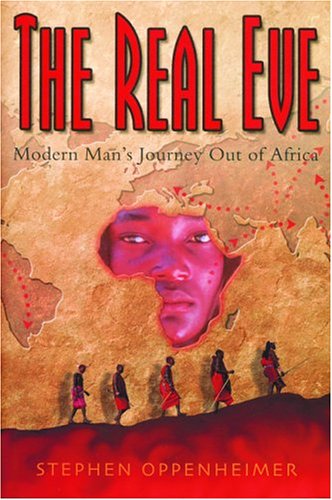
Review: "The Real Eve: Modern Man's Journey Out of Africa" By Stephen Oppenheimer

Dr. Stephen Oppenheimer's The Real Eve: Modern Man's Journey Out of Africa (2003) is absolutely one of the very best non-fiction books I've read in a few years!  And I say this on several levels too.  First, if you are at all interested in your own human origins, and what makes us human, you'll love this book.  Second, if you're interested in paleoanthropology, and are interested in what happened after anatomically modern humans (i.e., Homo sapiens) appeared in Africa somewhere around 200,000 years ago and when did we actually become 'behaviorally modern' too, you'll love this book.  Finally, if you're at all interested in how anatomically and behaviorally modern humans then spread out in the great diaspora about 80,000 years ago known as the "Out-of-Africa" dispersal, you'll love this book.

Much of this book is an incredibly compelling melding of the existing paleoanthropological, archaeological, and genetic evidence that, when combined with known ecological and climatological data, tells the story of these robust early modern humans that undertook this grand journey that completely changed the world we live in.  Oppenheimer carefully presents and considers all of the available archaeological evidence and the conclusions drawn from it, and then compares it with the results of the now extensive amount of genetic research associated with maternal mitochondrial-DNA and male Y-chromosome analyses.  Oppenheimer believes that we now have answers or, at a minimum, some pretty compelling hypotheses that go far in addressing questions about who these peoples were that trekked along the coasts colonizing the Near East, eastern and western Europe, India, southeast Asia and eventually even New Guinea, and Australia; while others continued 'coasting' up along the Asian-Pacific coast before turning inland and settling the hinterlands of the ice-age steppe tundra of Siberia and Mongolia.  Finally, Oppenheimer addresses one of the most contentious issues in modern archaeology--that of the settling of the Americas.  When did modern humans reach the Americas?  Who were these early colonizers? Where did they come from?  Did they come in a single wave following the end of the last ice-age, or were there multiple entries?  And were the Clovis peoples really the first to arrive about 12,000 years ago?

The organization of this book in its seven chapters is simply superb too, in my opinion.  Dr. Oppenheimer starts off with the fascinating discussion of our early modern human ancestors in Africa, and what it was that might have compelled them to leave Africa between 80,000 and 90,000 years ago.  He then spends time describing the archaeological evidence associated with the potential routes of initial dispersal from Africa (i.e., a northern route through the Levant, or the southern route--the preferred alternative--via the Bab al Mandab at the bottom of the Red Sea and the Horn of Africa).

The second chapter is equally fascinating, and addresses the all-important question of when did anatomically modern humans become 'behaviorally modern'.  This has been a vexing question to paleoanthropologists and archaeologists for some time now, and there is a considerable body of evidence out there that can be interpreted quite differently.  Frankly though, I'm leaning toward agreement with Dr. Oppenheimer that the appearance of anatomically modern humans between 200,000 years and 170,000 years ago was largely concurrent with the appearance of our behavioral modernity as well.  In contrast, there are many well-respected anthropologists, e.g., Richard G. Klein of Stanford University, who believe that Homo sapiens became behaviorally modern sometime around 50,000 years ago, the result of additional adaptations within the human brain.  Oppenheimer and other geneticists have not yet ferreted out what this change might have been, nor does he believe that the archaeological evidence supports this theory.  All in all, I found this a very thought-provoking chapter.

The remainder of the book's chapters (i.e., 3-7) focus on detailed archaeological and genetic discussions of the timing of the entries into the various regions of the world colonized by the mitochondrial 'Out-of-Africa Eve' and Y-chromosomal 'Out-of-Africa Adam' and their genetic descendants.  Chapter Three describes the types of people and timing of the colonizing of eastern and western Europe.  Chapter Four focuses on the colonization of India, southeast Asia and leading to humans reaching New Guinea and Australia by about 60,000 years ago (implication being you'd certainly have to have been 'behaviorally modern' to fabricate a craft that was capable of 'island-hopping' and crossing many tens of kilometers of open ocean to reach Australia!).  Chapter Five looks at the types of peoples and the timing of the settling of the great interior regions of ice-age Asia and eastern Russia.  Chapter Six tells the story of the impact of the last ice-age in the late-Pleistocene (i.e., the Last Glacial Maximum), that wreaked havoc on the small populations of humans scattered throughout Europe and Asia.  The last chapter of the book is Oppenheimer's take on the peopling of the Americas.  He's of the opinion--based upon archaeology and genetics--that the first 'Americans' arrived between 25,000 years and 22,000 years ago, and that this was followed by a re-expansion of peoples that had occupied Beringia (the huge continent that existed between 25,000-11,000 years ago and linked Asian Siberia with North American Alaska during the run up and through the Last Glacial Maximum).

'So,' you ask, 'having read this fascinating book, what's the upshot?'  Well, first, I can categorically answer that we are all African!  Second, I think the genetic evidence and its most parsimonious interpretations tend to validate and enhance the current "Out-of-Africa" hypothesis for the dispersal of Homo sapiens from eastern Africa around 80,000 years ago.  Third, after reading this book you'll never look at another human being quite the same.  You'll always be thinking about our remarkable kinship, yet more fully understanding the meaning of the differences that exist among the peoples of our world today.  I think it is also important to point out that Dr. Oppenheimer has also very carefully sourced and documented the material he presents in the book with over 50 pages of end-notes.  I strongly recommend reading each of the end-notes too, it made for an even more complete reading experience for me.

Dr. Oppenheimer's The Real Eve: Modern Man's Journey Out of Africa is a grand synthesis of a grand story--our own human origins and subsequent dispersal around the globe.  This book is really the incredible story of how a very small group (1,000-2,000 individuals) from a total population of the approximately 20,000 Homo sapiens that occupied Africa about 80,000 years ago actually got up the gumption to strike out and explore and colonize the rest of the world over the next 40,000 years or so.  Finally, don't be intimidated by the subject matter,  Dr. Oppenheimer is an engaging writer and spends the time and effort to present the material in such a fashion as to be understandable by any reader.  It includes loads of terrific maps and detailed charts illustrating and supporting the genetic evidence and conclusions presented in the book.

In closing, I do want to say that I consider myself more than just a casual student of topics in paleoanthropology and human origins and evolution.  Over my entire adult life I have made a point of staying current with the latest information, via books and technical journal articles, on this intellectually challenging subject, and I can unhesitatingly say that I believe that this is one of the most important books that I've read associated with modern human origins.  This was such a good book that I've gone ahead and found a hardcover edition for my paleoanthropology book collection, as I know that I will be diving into this book time and again in the future.  I highly recommend this book, and feel entirely justified in giving this 'five stars'.

The Real Eve: Modern Man's Journey Out of Africa
By Stephen Oppenheimer
Softcover, 440 pp.
Carroll & Graf Publishing, 2004
ISBN 0-7867-1334-8

***

February 4, 2013

Review: "Deadhouse Gates" By Steven Erikson

Deadhouse Gates is the second book in Steven Erikson’s brilliant and uber-epic ten-volume fantasy series, "The Malazan Book of the Fallen" (MBotF).  I think this is now the third time I’ve read this book and it still remains one of my favorites.  Deadhouse Gates is nothing short of a ‘nail-biter’ from the get-go and the pacing is utterly relentless.  I have to say that Deadhouse Gates is an easier read than Erikson’s first book in the MBotF series, Gardens of the Moon, and much of that is because the reader is slowly, but surely, becoming more familiar with Erikson’s writing style and more comfortable with the unique qualities of the Malazan world that he has crafted.

In my opinion, Deadhouse Gates is a fine example of what I truly love the most about the MBotF series, and that is Erikson’s ability to make his readers empathize with the characters in his books.  One thing that really impresses me about Erikson’s characters is that they are all typically people that the reader can relate to, and there are really very few, if any, characters that aren’t flawed in one fashion or another.  Also, Erikson’s MBotF characters exhibit a strong dose of egalitarianism, as men and women in the books commonly occupy positions of authority and responsibility across all walks of life in the Malazan world.

Much of Deadhouse Gates occurs on the continent of “Seven Cities” and introduces a whole new cast of characters from those presented in Gardens of the Moon.  Never fear though, of the multiple story arcs in Deadhouse Gates, one arc does involve a small group of characters that the reader met in Gardens of the Moon and who become quite important to the storyline in this episode.  As is typical of Erikson novels in the MBotF series, there are plots and sub-plots galore swirling around throughout this 600+ page book (trade-paperback edition), and each of them is an attention-grabber, and at times contain a powerful ‘punch to the gut’.

Without giving away anything of significance away, Deadhouse Gates revolves around the rebellion of many of the subjugated peoples of the Seven Cities continent.  This rebellion is known as “The Whirlwind” and is intended to rid the continent of all of the Malazan occupiers, both administrative and military.  The main plot of the novel is one that just takes your breath away—that of the tactical retreat of the Malazan Seventh Army over several hundred leagues from one city to another.  The Malazan Seventh is commanded by Coltaine, a Wickan Crow Clan warchief, and now a Fist (General) in the Malazan Army.  Fist Coltaine and many of the other Wickan characters are some of my favorites in the entire MBotF series, and the Wickan Clans themselves—with names like “Foolish Dog Clan”, “Weasel Clan, and “Crow Clan”—reminded me of some of the Native American tribes that so effectively battled the U.S. Army in the latter half of the 19th century.

Honestly, the story of the Seventh Army’s retreat across the landscape of Seven Cities is truly nothing short of epic, as Coltaine must try and not only preserve the fighting capacity of the Seventh Army, but protect more than 50,000 refugees that his forces are endeavoring to shepherd to safety.  This plot thread that weaves through much of the novel becomes known as “Coltaine’s Chain of Dogs”, a moniker of significant distinction and pride to the members of the Seventh Army, as well as the rest of the Malazan Empire. As a veteran of the military myself, there was something in this story of the “Chain of Dogs” that truly tugged at the heartstrings of my very soul, and I cannot begin to tell you how many times while reading about the desperate attempts of the Seventh Army to survive its horrifying trek across Seven Cities that I had to set the book aside for a few moments and simply let the tears roll down my cheeks.  While at times a terribly tragic story, the tale of Coltaine’s “Chain of Dogs” is also one that exhibits the finest qualities of humanity—courage, compassion, comradeship, and Love. 

Erikson's description of this epic journey, and the battles fought along the way, rivals any that have been written about in numerous superb non-fiction military histories.  Examples that immediately come to mind include the U.S. Continental Army’s retreat from New York to Valley Forge, or Napoleon’s Grande Armee’s retreat from Russia, or Field Marshal von Manstein's strategic retreat of several German armies across the frozen steppes of southern Russia in early 1942 (after the fall of Stalingrad).  Erikson’s tale of the “Chain of Dogs” in Deadhouse Gates is some of the best military fiction I’ve ever read, and should appeal to readers with even a passing interest in military or historical fiction or non-fiction.

But wait, there’s even more—So much more!  Deadhouse Gates is also chock full of important plot and story lines that really help to begin to open up the full breadth and scope of the Malazan world to the reader.  There are significant tie-backs to important events and happenings in Gardens of the Moon, as well as explanations of the fascinating and complex system of magic and sorcery, and loads of new information about the mythology and significance of the pantheon of gods and goddesses who occupy the Malazan world.  Deadhouse Gates can perhaps be best characterized as the ‘tale of multiple journeys’, with Coltaine’s “Chain of the Dogs” being the centerpiece, but there are also the journeys of several other groups of characters that are just as meaningful to the overall plot and are very, very important to future episodes in the MBotF series.

I continue to be completely blown away with the sheer quality of the writing, the plotting, the character development, the pacing, the pathos and drama, and the sheer inventiveness and originality of the world that Erikson has created. Mr. Erikson doesn't pull his punches, this is truly some hard, bleak, and dark fiction; and it is at times viscerally tragic and profoundly sad.  At the same time though, Erikson soars to heights almost unknown in fantasy fiction with his moments of triumph, success, and the joy of experiencing those fleeting instants of pure and unbridled goodness and humanity.

In closing, I highly and unhesitatingly recommend this series; and, in my opinion, Deadhouse Gates is much more than a quantum step forward from the first novel in the series, Gardens of the Moon.  Deadhouse Gates was the book in the MBotF series that cemented my love affair with all things Malazan.  Read Deadhouse Gates--you’ll become a believer too!

Deadhouse Gates
By Steven Erikson
Tor Books, 2005
Trade Paperback Edition, 608 pp
ISBN-0765314290

***

January 25, 2013

Review Redux: "Gardens of the Moon" By Steven Erikson (Malazan Book of the Fallen #1)

For those of you that follow ProSe bear with me, as I will be reviewing a book in this posting that I reviewed two years ago here.  Gardens of the Moon by Steven Erikson is an amazing novel on so many levels, and I guess part of my rationale in providing another look at it is to encourage more readers to discover the incredible world and story that Erikson has created in his ten-volume series known as "The Malazan Book of the Fallen".

Gardens of the Moon, and the entire "Malazan Book of the Fallen" series is generally classified as fantasy fiction, and while that is an appropriate designation, it is also so much more than that.  I'd like to use this posting to briefly describe why I think it is actually kind of hard to simply pigeon-hole this series safely in the fantasy genre.

First of all, let's talk about what this series is not.  The "Malazan Book of the Fallen" (or, MBotF) is not a recounting of an epic struggle between Good and Evil.  Nor is the MBotF a bildungsroman of some young poor farmer boy or girl who sets out upon a grand and desperate quest to save the world from an evil sorcerer or ruler.  Finally, the MBotF series is not the story of one, or even a few, main characters, but contains a cast of hundreds.  Frankly, very few of the typical fantasy tropes are in play in this series, the MBotF is some seriously new and cutting-edge stuff, and it probably is not going to appeal to all who pick it up.  I'm also convinced that the MBotF is destined to ultimately be viewed as 'classic' and will be read for many, many years to come.  It really is that original.

Up front you need to realize that Steven Erikson does not 'hold your hand' while reading this series.  By that I mean there are no big 'information dumps' that explain the Malazan world, or detailed character backgrounds, or in-depth descriptions of how the magic systems works, or even what's going on at any precise moment in time.  You really gotta work for it in reading this series, and sometimes its bloody hard work and can be quite frustrating.  In some respects, reading the MBotF is kinda like assembling a giant 10,000-piece jigsaw puzzle of a Jackson Pollack painting--it takes time, and it can be confusing as hell; but when it 'clicks' it becomes an immensely satisfying reading experience, and one that you'll want to revisit and delve into for the rest of your life.

To me, the MBotF is like reading the history of a whole planet, as you will be learning about new cultures and events that have occurred over the span of several hundred millenia.  This characteristic is actually very reflective of Erikson's educational background and years of work experience.  'Steven Erikson' is the pen-name for Steve Rune Lundin, a Canadian anthropologist and author.  Apparently, a lot of the original concepts associated with elements of the MBotF were 'ginned up' by Erikson and his friend, Ian C. Esslemont (more on Esslemont later) during anthropological/archaeological field trips and sitting around the campfire at night.  As you read these books you do recognize similarities between some of the characters and cultures in Erikson's Malazan world and historic and prehistoric human cultures.  For example, there are human-like peoples that very much reminded me of early hominid species like Neanderthals and the even earlier hominid, Homo erectus, and there are races of peoples that certainly remind me of various Native American cultures.  The Malazans themselves bear some similarity to the peoples and cultures of the ancient Greek or Roman empires.

The mythopoeic quality of the MBotF series is astounding and maybe one of the more important elements that sets this series apart from all other modern fantasy fiction.  The only other book, in my humble opinion, that creates such a fantastical and intellectually creative fictional mythology is The Silmarillion by J.R.R. Tolkien.  Erikson's mythology, like Tolkien's, is an elegant amalgam of creation and origin myths, religious elements, and cultural and social geography all of which seems to be strongly connected to the environment and geology of the Malazan world.  The MBotF contains an enormous and complex pantheon of goddesses and gods that rivals the Greeks, Romans, Norse, Celts and other human cultures.  Much of this mythology is presented in the MBotF as epigraphical poetry or fictional bits of history leading off chapters in each of the books, that when initially read can seem quite enigmatic but ultimately help illuminate plot points and/or foreshadow events to come.  Interestingly, the Malazan world goddesses and gods, like the Greek gods of Homer's The Iliad and The Odyssey delight in meddling in the affairs of the mortals, and are perhaps even somewhat envious of the Human condition, i.e., the capacity to love, to experience pain, sadness, joy, and even to die.

The MBotF, while a series of ten interconnected books, is not an entirely linear plot structure.  Each book in the series could, I suppose, be read on its own with varying degrees of success.  The point is that each book is largely a self-contained 'chapter' in this magnificent saga, this 'history', of the Malazan world.  Each novel also tends to introduce a whole host of new characters, cultures, a new geographic locale and environmental conditions, and sometimes even new gods and goddesses, but--and its an important "but"--each book and its individual story arc is hugely significant in successfully making the intellectual journey from the first book in the series, Gardens of the Moon, to the tenth and final book, The Crippled God.  And you just gotta make this journey, as it is some of the most mind-bogglingly awesome fiction you'll likely ever encounter.  There is a storyline and cast of characters that you genuinely care about, and enough pathos and drama to carry the reader through the full gamut of emotions--from the heights of great joy and laughter to the depths of profound grief.

Gardens of the Moon is arguably the toughest book to read in the entire series, and much of that is simply related to the reader having to become accustomed to Erikson's writing and story-telling style.  As I said earlier, he makes you work for it.  It took me two attempts before I successfully read and completed Gardens of the Moon, and from what I understand I'm not particularly unique in that experience.  I think if you can just 'hang tough' and get through the first four chapters, you'll start being able to put some pieces of the puzzle together and I'm betting that your interest will be piqued enough to see you through the end of the novel.  This novel, like all in the series, is full of a gritty, but heart-felt realism that I think we can all relate to, i.e., it just feels right some how.  And once you've finished Gardens of the Moon and start Deadhouse Gates (one of my personal favorites in the series), I predict that you'll be hooked and then you're in for the long-haul.

Gardens of the Moon opens with a great battle involving a Malazan army and its mages attacking the city of Pale and a bizarre gigantic chuck of basalt that is suspended in the sky over Pale that is known as "Moon's Spawn".  While you will likely leave the first couple of chapters somewhat 'dazed-and-confused', you should probably take the time to go back and reread sections of this opening section again and again, and the 'muddy waters' will slowly begin to clear for you.  I recommend that new readers get used to the notion that being 'dazed-and-confused' initially is really okay, and that eventually you will come across information later that helps explain things and start answering your questions.  Erikson rewards you as you figure things out, as you get these significant 'aha', or 'lightbulb', moments.  For example, the 'Siege of Pale' (Chapter Two) is an important event, and will be referred to time and time again throughout all ten books in the series, but you'll not quite have it all figured out until you're well into the series.  Anyway, following the events at Pale, the scene shifts south to the large city of Darujhistan and the Malazan Empire's efforts to covertly infiltrate the city and bring it to heel.  To the best of your ability, pay attention to everything, for just about everything that Erikson gives you is important, including events as well as things said.  Utilize the "Dramatis Personae" and maps (at the front of the book) and the "Glossary" (at the end of the book) liberally.  Slowly, but surely, you'll begin to get your 'sea-legs' in the Malazan world and you'll soon find yourself swept up in the tale.

Finally, I want to come back to Erikson's friend, Ian C. Esslemont, or as we Malazan fans refer to him, ICE.  Esslemont is also an archaeologist and author, and is the co-creator of the Malazan world with Steven Erikson.  In fact, ICE has now authored five novels in his "Malazan Empire" series, and the plots of his books are inter-woven and connected with the ten books in Erikson's MBotF.  It is my understanding that ICE has a couple more Malazan Empire novels in him and then we'll have "the rest of the story".  The cool thing is that ICE uses his novels to tell the stories about events and happenings or topics about which Erikson has been specifically vague or even silent on.  So, by reading the books of both authors a reader really can start figuring it all out.

In conclusion, I highly recommend both the MBotF series by Steven Erikson, and the Malazan Empire books by Ian Esslemont.  I have read the entire "Wheel of Time" series by Robert Jordan (and capably finished by Brandon Sanderson), and the "A Song of Ice and Fire" series by George R.R. Martin, and while they are both very, very good, the Malazan world created by Messrs. Erikson and Esslemont kicks their collective asses!  Don't take my word for it though, give Gardens of the Moon a try, and see what you think.  Try your best not to give up, and just persevere through the first one-hundred pages or so; and if you do give up, just set it up on the shelf and come back a few weeks later.  It'll 'click' at some point, and you be so glad that it did.  It is one of my favorite series of books, and I know that the Malazan world is going to be a part of my literary life as long as I live.

If you're interested, here's a listing of Erikson's books in the "Malazan Book of the Fallen" series--

Gardens of the Moon
Deadhouse Gates
Memories of Ice
House of Chains
Midnight Tides
The Bonehunters
Reaper's Gale
Toll the Hounds
Dust of Dreams
The Crippled God

And here's a listing of Esslemont's books in his "Malazan Empire" series (so far)--

Night of Knives
Return of the Crimson Guard
Stonewielder
Orb Sceptre Throne
Blood and Bone
***


January 22, 2013

Review: "Blood and Bone By Ian C. Esslemont (Malazan Empire #5)

Blood and Bone is far and away the best episode in Ian C. Esslemont's on-going series of "Malazan Empire" novels.  For those who don't know, Esslemont and his "Malazan World" co-creater, Steven Erikson, have authored two series of books that are all interconnected and interwoven together to create, in my humble opinion, the finest fantasy series ever written.  Erikson's series is ten books and is entitled "The Malazan Book of the Fallen, and with Blood and Bone, Esslemont has now completed five novels in his "Malazan Empire" series.

Blood and Bone is a tour de force on so many levels--the quality of writing, the plotting and complexity, characterization, and then the sheer significance to the entire Malazan canon.  This novel grabbed me from the first page and didn't let up until the very last page--it really is that good!  Both Erikson and Esslemont are known for Malazan novels that build with tension and a whole host of seemingly incongruous plot-threads, but generally about two-thirds of the way through the book a series of convergences begin to occur.  This typically culminates in the 'mother of all convergences' near the end of the book, with everything coming flying together, usually in spectacular--and sometimes bloody--fashion.

Blood and Bone begins its mega-convergence pretty much from the first page and just builds like a series of monstrous waves crashing on a rocky shoreline.  As I read Blood and Bone I kept thinking about Joseph Conrad's brilliant little novel Heart of Darkness, and I just have to believe that Esslemont must have also been influenced by it as he wrote this book (as well as his anthropological work in Southeast Asia).  Additionally, there is a real cinematic quality to Esslemont's writing in this book that very much reminded me of Francis Ford Coppola's film Apocalypse Now (his take on Conrad's Heart of Darkness).

Blood and Bone is set on the island continent of 'Jacaruku' which is bisected by a great range of mountains that run from the northern end to the southern.  The western half of the island is home to a group of warring desert tribes people and a brutal society of practitioners of dark and evil magic.  The eastern half of Jacaruku is a dense and incredibly dangerous jungle realm known as 'Himatan' that will likely make most readers think of the great jungles in the heart of Africa or the Amazon in South America.  And like Conrad's Heart of Darkness, Blood and Bone recounts the stories of the trials and tribulations of several disparate groups of peoples that are all struggling to travel into the interior of this jungle to a fabled lost city--including one group's truly epic journey up a river through the jungle of 'Himatan'.  I'm not going to tell you why, except to say that it is all about power--gaining it, or denying it of somebody else.

I think that Blood and Bone is vitally important in helping to answer some questions, or shed significant light on events touched upon in the other novels in Erikson's and Esslemont's Malazan world.  If you've been a close reader, you will very much enjoy much of what you discover in this action-packed novel.  You're also going to be delighted to encounter some 'old friends' from previous novels, and you're going to love the 'new friends' you're meeting for the first time.  While complexly plotted, this is a rollicking good read with loads of action, tension, and a goodly number of moments of mind-numbing terror.  As I said at the outset, I think this is Esslemont's best novel yet, and I can't wait to see where he takes us in his next installment.  While I have a pretty good guess, I'll let you read Blood and Bone and work that out for yourself.  I have no qualms awarding this book five of five stars, it is a truly great story!

Blood and Bone
By Ian C. Esslemont
Bantam Press, UK, Hardcover
586 pp.
ISBN 0593064467

***

January 14, 2013

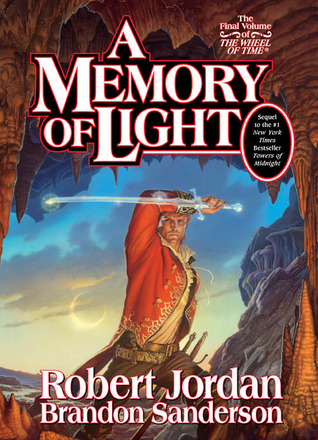
Review: "A Memory of Light" By Robert Jordan & Brandon Sanderson

As I turned the last pages of A Memory of Light so many things were racing through my mind.  First, it struck me that this is the end of an era, as I have been religiously reading and rereading this series for over 20 years (23 to be precise!).  Second, this is absolutely one of the best fantasy series I have ever read, and I am profoundly and utterly amazed and astonished at the quality of the writing, and complexity of the plotting and characterization from the first volume to this, the fourteenth volume, A Memory of Light.  Finally, I don't know that I have ever read one single book that has run me through the emotional 'ringer' the way that A Memory of Light has; and like Life, there are moments of great joy and happiness as well as deep sadness and grief.  I cannot begin to tell you how many times while reading this book I simply stopped reading and quietly wept for a few moments.  It was, all in all, a simply glorious reading experience! 

I am not going to give one word away about how A Memory of Light wraps up this grand journey that all of us have been on for nearly two decades.  Suffice it to say that A Memory of Light is nearly 1,000 pages of near perfection, and we should all stand up and bellow at the top of our lungs, Tai'shar Jordan! Tai'shar Sanderson!, as they have given us a grand story and an ending for the ages.  Obviously, much of A Memory of Light revolves around 'Tarmon Gai'don' (The Last Battle), and the battle scenes are riveting and make the book incredibly difficult to put down.

As any devoted 'Wheel of Time' fan, I went into A Memory of Light with just a tiny bit of trepidation.  After all, this series has finally come to an end, and how it ended was very important to me.  Now that I've finished my first reading of A Memory of Light, I have to say that I really don't know what I was worried about.  Robert Jordan and Brandon Sanderson have crafted a finale that is emotionally powerful and so intellectually satisfying that it very nearly belies words.  Oh, I'm sure that there will be those that will want to change this or that, but not me.  I really do think that the series has ended just as it should, and I honestly don't think I'd change a thing.  I can't wait to reread A Memory of Light again soon, as I'm sure that upon a more careful second reading it will become an even more meaningful experience for me.

For something over twenty years this series has been a meaningful part of my literary life.  At first it was really just great fun--a wonderfully complex and complicated bit of fantasy fiction to enjoy as each installment came out.  Now, however, I am beginning to realize that just as Tolkien was inspired through his fiction and poetry to work on developing a mythology for the English peoples, I think Robert Jordan challenged himself to craft a mythology for an American time.  Nation-building, economic and environmental pressures, political machinations, faith and belief systems, cultural diversity, it is all there.  Mostly the 'Wheel of Time' is the story of men and women and the human condition and the choices we make.  Seriously folks, this series is right up there, in my humble opinion, with Steven Erikson's "The Malazan Book of the Fallen", George R.R. Martin's "A Song of Ice and Fire", and J.R.R. Tolkien's "The Lord of the Rings"--it really is that good!
There are no endings, and never will be endings, to the turning of the Wheel of Time.

But it was an ending.
 
A Memory of Light
By Robert Jordan & Brandon Sanderson
Tor Books, Hardcover, 2013
909 pp.
ISBN 0765325950

***

Review: "The Child Thief" By Brom

I am now an unabashed fan of the artwork and writing of Brom.  I recently finished reading Brom's The Child Thief, a dark--and very much adult--retelling of J.M. Barrie's Peter Pan.  Frankly, based upon this novel, I'm willing to suggest that Brom is America's answer to British author Neil Gaiman, with the ability to take the folklore and fairy tales of the ages and give them a thoroughly modern spin.  Even setting aside Brom's gorgeous art that graces this novel, the tale itself is a sophisticated amalgam of elements from Celtic mythology, Arthurian legend, and American history, and it really, really works well.  Having said this, this is not the 'Peter Pan' of your youth, and most certainly is not the 'Peter Pan' and 'Tinkerbelle' of the Disney cartoon.  Nope, this is some seriously dark stuff that continually tugs at the heart-strings, horrifies, and even amuses as it deals with things like friendship, loyalty, belief and faith, and love.  Something tells me that J.M. Barrie would very much approve of Brom's interpretation and retelling of 'Peter Pan' in this book.  I really need to see if I can find a hardcover edition of The Child Thief, as this is a book to cherish and reread, and add to my growing collection of the tales of mythology and faerie.  This gets a solid five out of five stars from me, a genuine favorite.

The Child Thief
By Brom
Harper Voyager, Trade Paperback, 2009
476 pp.
ISBN 0061671339

***

January 5, 2013

Review: "Red Country" By Joe Abercrombie

Wow!  Joe Abercrombie's Red Country is one of the first books that I've read in 2013, and I'll wager that it ends up being one of the best I've read this year.  I found the dark gritty fiction of Abercrombie a few years ago when I read his First Law trilogy (2006-2008), and then followed it up with his brilliant, and my favorite, novel, The Heroes (2011).  Red Country is right up there with The Heroes and is somehow an incredibly clever blend of cinematic gorefest ala Sam Peckinpah and the unrelenting violence and pathos of the writing of Cormac McCarthy; and while Red Country is a fantasy novel of the first order, it reads and feels like a western.

The plot is really quite simple.  Farms in the hinterlands have been burned, people brutally killed, and a lot of children have been captured and kidnapped by a gang of desperadoes.  The novel's primary protagonists are all a group of misfits and deeply flawed characters that have come together to trek across a brutal landscape, some in search of the missing children, others in pursuit of gold, and others just trying to find themselves and start new lives.  'Shy South' and 'Lamb', a father-figure to Shy and her younger siblings, are in pursuit of the kidnapped children.  And if you've read any of Abercrombie's earlier novels you'll be delighted as you encounter a goodly number of rogues who reappear in Red Country.  Additionally, there is a whole group of fascinating new characters that range from utterly monstrous and despicable to some that are honorable and good-hearted.  Having said that though, it is amazing to me that at times it is still hard to sort out who is really good and who is really bad, and that is solely a function of the quality of Abercrombie's plotting and writing.

Abercrombie has a way with words and can truly turn a phrase.  One thing I've come to expect when reading his fiction is the earthy and pithy philosophical one- or two-liners from his characters.  They're really quite priceless, and I've taken to marking them as I encounter them whilst reading.  Here's a sampler of Abercrombie witticisms--
My old commander Sazine once told me you should laugh every moment you live, for you'll find it decidedly difficult afterward.
'Severed heads,'Cosca was explaining, 'never go out of fashion.  Used sparingly and with artistic sensibility, they can make a point a great deal more eloquently than those still attached.'
There is no bad living, and no good death.
The bottle's a shifty banker--it might lend you courage but it's apt to call the debt in sudden.
'Death loves me.' Lamb smiled, black-eyed, wet-eyed, and the smile was worse even than the snarl had been. 'All the work I done for him? The crowds I've sent his way? He knows he ain't got no better friends.'
'Why does everyone pout so over children?' Cosca called after him. 'They'll turn out just as old and disappointing as the rest of us.'
'Men are animals.  Conscience is a burden we choose to bear.  Morality is the lie we tell ourselves to make its bearing easier.'
Well, you get the picture.  Abercrombie sure can write, and Red Country is a relentless torrent of words and writing that simply compels you to keep reading and turning pages, one after the other until you reach the immensely satisfying conclusion.  This is a great book with awesome characters that is sure to please any reader encountering Abercrombie for the first time.  If you've had the pleasure of reading any of Abercrombie's other books, oh are you in for a hell of a delightful surprise.  Finally, even if you're the type of reader who swears they don't like fantasy fiction, give Red Country a try, I'm gonna bet that you're gonna find Abercrombie's fiction is well worth it and in the 'wheel-house' of many, many readers.  Red Country gets a solid five out of five stars from me.

Red Country
By Joe Abercrombie
Orbit Books, 2012
453 pp.
ISBN 9780316187213

***

Review: "Something Red" By Douglas Nicholas

Every once in a great while you just happen upon a book and author that you absolutely know nothing about, but you take a chance and take it home with you and you are simply blown away at what you've discovered.  Something Red, by Douglas Nicholas, is just such a book and is really a stunning little novel.  This dark and grim story revolves around a small troupe of travelers on a journey through a rugged wild portion of northern England during a bleak and cold winter in the 13th Century.  During the course of their trip the horror and terror mounts until the explosive climax near the end of the book.

The author of Something Red, Douglas Nicholas, in my opinion, is a writer of great promise.  Not only can he spin a great yarn, but his prose is gorgeous and verges on the poetic at times; which actually makes sense as Nicholas is apparently a well known published poet from the Hudson Valley of New York state.  The characters in Something Red are interesting and well wrought, and his use of magic and mythology is deft and sure-footed and works well in the plot.  I have to say that more times than not this dark tale reminded me of the early Anglo-Saxon alliterative epic poem, Beowulf (especially Seamus Heaney's brilliant translation). Also, it is actually quite hard to pigeon-hole this book as horror, fantasy, mystery, or medieval historical fiction--as it really is all of the above.  Mostly though, this is just one damn good book that I had a hard time putting down until I'd read the last page.  I ain't gonna say anymore, other than to urge you to read this superb and riveting debut novel from Douglas Nicholas.  This received five out of five stars from me, as it really was a most excellent novel, and one that I will surely read again sometime soon.

Something Red
By Douglas Nicholas
Emily Bestler Books/ATRIA Books, 2012 
315 pp.
ISBN 978-1-4516-6007-4

***