Showing posts with label book review. Show all posts

March 22, 2013

Review: "The Old Way: A Story of the First People" By Elizabeth Marshall Thomas

The Old Way: A Story of the First People is an absolutely fascinating account of the !Kung, or Ju/wasi ("The People"), people of the Kalahari Desert region of southwestern Africa.  Elizabeth Marshall Thomas wrote this book in 2006, based upon the many years that she and her family spent with these amazing people starting in the early 1950s.  In fact, Thomas's mother ended up publishing several anthropological monographs through Harvard University describing the !Kung hunter-gatherer lifestyle in this desolate and unforgiving landscape.  Thomas herself, as a young woman, spent several years living with and getting to know the !Kung, and recorded her observations in her personal journals.  Her older brother, John, spent most of his life with these people, working tirelessly on their behalf, and even married a Ju/wasi woman.

Like most people, I'd heard about the "Bushmen of the Kalahari" as a boy, but really had no idea what that meant, or really who these people were.  In a nutshell, the !Kung are an ancient people that have essentially lived a nomadic Paleolithic lifestyle in the Kalahari Desert for more than 20,000 years.  Interestingly too, with the recent completion of the Human Genome Project, we now know that these people are some of the most ancient and genetically diverse anatomically modern humans (i.e., Homo sapiens) on the planet.  If you will, the !Kung peoples are the 'rootstock' of most of us.  And as such, I think a book like that which Ms. Thomas has written is incredibly important for all of us to read and think about.  In other words, this book has the capability of putting us firmly in touch with who we were, and who we are. 

The !Kung also speak an incredibly ancient language--one of the African 'click' languages--a mix of phonemes and click sounds made with the palate, lips, tongue, or cheeks.  Linguists believe that the click language that the !Kung speak is at least 60,000 years old, and may rank as one of humanity's oldest existing languages.  In reading this book I discovered that utilizing a click language actually makes great sense when living and hunting in a dangerously hostile environment like the Kalahari, as the click sounds tend to blend in and sound more 'natural' and don't alarm prey or alert potential predators like spoken words can.

Ms. Thomas starts off talking about the relationship of these people to the 1,500 centuries, or more, of modern human existence; and up until the mid-1960s, not much had changed from the way our Paleolithic ancestors lived some 60,000-70,000 years ago.  She then described the complex relationship that the !Kung had with their environment and the animals that occupied the Kalahari and that the people depended upon for meat.  The heart of the book is that these were peoples that were completely connected to the habitat and ecology around them.  They intimately understood the habits of all of the animals and and habitat preferences and uses for the plant species of the savannah and desert. Ms. Thomas describes in fascinating detail how plants are gathered and used among the people, marriage and the importance of lineage, how children were raised, how animals were hunted, religious and mythological beliefs, the interactions and social fabric of the family dynamic and small collections of families that lived and migrated together.  There is even a whole chapter on the relationship of the !Kung with the top predators of the Kalahari, African lions, leopards, and spotted hyenas.

Inevitably though time and the new way of human life caught up to this remote corner of the world, and Thomas reports that by the 1990s most of the Bushmen, including the !Kung, had been forced off of their natural ranges and now live in government-sponsored shanty towns and have largely given up their hunter-gatherer subsistence lifestyle.  And similar to what has happened to many Native American peoples in the United States, it has been a very difficult transition for many of them in trying to adapt to the new ways of 'modern' living.  It made me sad to think that these people, so lovingly described and respected by Ms. Thomas in this book, really no longer exist.  Sure, there are still Bushmen living in southwestern Africa near their old homelands in the Kalahari Desert, but they're not living "The Old Way" as the "First People" any longer, and that, I think, is a loss for all of humanity.

In conclusion, I highly recommend this book, and count it as a non-fiction favorite read for 2013, and is certainly a book that I will undoubtedly revisit sometime in the future.

The Old Way--A Story of the First People
By Elizabeth Marshall Thomas
Hardcover, 344 pp.
Farrar Strauss Giroux, 2006
ISBN 0374225524

***

March 4, 2013

Review: "Missing Links: In Search of Human Origins" By John Reader

This book is largely a complete rewrite of a similarly titled book that Reader first published in 1981.  This lavishly illustrated book is an excellent and comprehensive survey of the history behind the search for our human origins.  Mr. Reader guides the reader through the first early discoveries and interpretations of the fossils and artifacts that led the great thinkers of the 18th and 19th centuries to begin pondering our origins.  From the mid-19th century on, as many of you are aware, things really take off, and significant fossil hominin discoveries are made in Europe, Asia, and then in Africa.  And as we know now, it is in Africa where the cradle of humanity and all of its closest relatives are to be found. 

What Mr. Reader has created in Missing Links: In Search of Human Origins (2011) is a profoundly interesting story.  First, for its detailed description of the expeditions and the 'thrill of the hunt' associated with all of the fascinating fossil discoveries and interpretations of the biological evidence.  Second, Reader uses the book to tell the story of the fascinating personalities (and, in some cases, huge egos) of all of the men and women involved in these searches for hominin fossils and their role in better understanding our own biological history.  This is as much a story of Charles Darwin, Arthur Keith, Eugene Dubois, Raymond Dart, Robert Bloom, the Leakey family, Phillip Tobias, Don Johanson, Tim White, and Michel Brunet, and a host of others, as it is about the fossils themselves.  Another important element that Reader brings to the story is the importance of the integration of many different scientific disciplines when investigating and endeavoring to piece together and tell the complicated story and timeline of our human existence over the past six to seven million years.

In some respects, this book reminded me of the second edition of Ian Tattersall's brilliant book, The Fossil Trail: How We Know What We Think We Know about Human Evolution (2008).  While Tattersall's book is perhaps more technically oriented to the actual fossil evidence and biological data, Mr. Reader's is more focused on the historical elements associated with the finds and the anthropologists and anatomists doing the work.  All in all, they are actually quite complementary works, and well worth having in your collection.  So, whether you're a professional anthropologist or you are simply interested in better understanding your own biological and evolutionary history and origins, I highly recommend John Reader's Missing Links: In Search of Human Origins.

Missing Links: In Search of Human Origins
By John Reader
Hardcover, 538 pp.
Oxford University Press, 2011
ISBN 0199276854


Review: "The Neanderthal's Necklace: In Search of the First Thinkers" By Juan Luis Arsuaga (translated by Andy Katt)

Juan Luis Arsuaga's The Neanderthal's Necklace: In Search of the First Thinkers (2002) is an excellent and compelling addition to my collection of paleoanthropological books.  Dr. Arsuaga is a Spanish anthropologist and has spent much of his career at the famous archaeological sites at the Sierra de Atapuerca.  He and his team are known for discovering the largest collection of pre-Neandertal hominins--some 2,000 human fossils, comprising maybe as many as thirty-two individuals.  According to Professor Arsuaga, all of these fossils are likely an ancestral species to both the Neandertals (Homo neanderthalensis) and anatomically modern humans (Homo sapiens), and are classified as either Homo heidelbergensis or Homo antecessor.  This human species occupied the Iberian peninsula and other portions of western Europe for a very long period of time, from approximately 780,000 years before present to perhaps 130,000 years before present.

What Professor Arsuaga accomplishes in this book is to eloquently tell the history of the early human species that occupied western Europe, especially the Iberian peninsula from the Middle Paleolithic through the early Upper Paleolithic and the extinction of the Neandertals.  What I particularly appreciated was Dr. Arsuaga's melding of the data associated with regional climatic and ecological conditions in telling the story of these early hominin species who occupied these habitats so many millenia in our past in Spain during those fluctuating periods of extreme world-wide glaciation and interglacials.  Over the years that I have been reading books and technical papers about human origins, I have come to better understand and appreciate that data and information associated with the effects of global and regional climate change and regional ecological conditions are every bit as important as the fossil and genetic evidence.

Personally, I think Professor Arsuaga's book, The Neanderthal's Necklace: In Search of the First Thinkers, is an important book and goes far in helping fill in the details about our human origins between what we currently know about the dispersal of Homo erectus from Africa between approximately 1.5-1.2 million years ago, and the arrival of fully-functioning anatomically modern humans (Homo sapiens) in western Europe about 45,000 years ago.  I also strongly suggest that Professor Arsuaga's book makes an excellent companion to Clive Finlayson's relatively recent (2010) book entitled, The Humans Who Went Extinct: Why Neanderthals Died Out and We Survived.  In reading both of these books, the reader will come away with a clear understanding of the role of the early hominin species in western Europe and the role that climate change and ecological conditions played in ultimately reaching the point that only one human species--Homo sapiens--remained on the planet.

The Neanderthal's Necklace: In Search of the First Thinkers
By Juan Luis Arsuaga, translated by Andy Katt
Hardcover, 320 pp.
Basic Books, 2002
ISBN 1568581874

***

February 4, 2013

Review: "Deadhouse Gates" By Steven Erikson

Deadhouse Gates is the second book in Steven Erikson’s brilliant and uber-epic ten-volume fantasy series, "The Malazan Book of the Fallen" (MBotF).  I think this is now the third time I’ve read this book and it still remains one of my favorites.  Deadhouse Gates is nothing short of a ‘nail-biter’ from the get-go and the pacing is utterly relentless.  I have to say that Deadhouse Gates is an easier read than Erikson’s first book in the MBotF series, Gardens of the Moon, and much of that is because the reader is slowly, but surely, becoming more familiar with Erikson’s writing style and more comfortable with the unique qualities of the Malazan world that he has crafted.

In my opinion, Deadhouse Gates is a fine example of what I truly love the most about the MBotF series, and that is Erikson’s ability to make his readers empathize with the characters in his books.  One thing that really impresses me about Erikson’s characters is that they are all typically people that the reader can relate to, and there are really very few, if any, characters that aren’t flawed in one fashion or another.  Also, Erikson’s MBotF characters exhibit a strong dose of egalitarianism, as men and women in the books commonly occupy positions of authority and responsibility across all walks of life in the Malazan world.

Much of Deadhouse Gates occurs on the continent of “Seven Cities” and introduces a whole new cast of characters from those presented in Gardens of the Moon.  Never fear though, of the multiple story arcs in Deadhouse Gates, one arc does involve a small group of characters that the reader met in Gardens of the Moon and who become quite important to the storyline in this episode.  As is typical of Erikson novels in the MBotF series, there are plots and sub-plots galore swirling around throughout this 600+ page book (trade-paperback edition), and each of them is an attention-grabber, and at times contain a powerful ‘punch to the gut’.

Without giving away anything of significance away, Deadhouse Gates revolves around the rebellion of many of the subjugated peoples of the Seven Cities continent.  This rebellion is known as “The Whirlwind” and is intended to rid the continent of all of the Malazan occupiers, both administrative and military.  The main plot of the novel is one that just takes your breath away—that of the tactical retreat of the Malazan Seventh Army over several hundred leagues from one city to another.  The Malazan Seventh is commanded by Coltaine, a Wickan Crow Clan warchief, and now a Fist (General) in the Malazan Army.  Fist Coltaine and many of the other Wickan characters are some of my favorites in the entire MBotF series, and the Wickan Clans themselves—with names like “Foolish Dog Clan”, “Weasel Clan, and “Crow Clan”—reminded me of some of the Native American tribes that so effectively battled the U.S. Army in the latter half of the 19th century.

Honestly, the story of the Seventh Army’s retreat across the landscape of Seven Cities is truly nothing short of epic, as Coltaine must try and not only preserve the fighting capacity of the Seventh Army, but protect more than 50,000 refugees that his forces are endeavoring to shepherd to safety.  This plot thread that weaves through much of the novel becomes known as “Coltaine’s Chain of Dogs”, a moniker of significant distinction and pride to the members of the Seventh Army, as well as the rest of the Malazan Empire. As a veteran of the military myself, there was something in this story of the “Chain of Dogs” that truly tugged at the heartstrings of my very soul, and I cannot begin to tell you how many times while reading about the desperate attempts of the Seventh Army to survive its horrifying trek across Seven Cities that I had to set the book aside for a few moments and simply let the tears roll down my cheeks.  While at times a terribly tragic story, the tale of Coltaine’s “Chain of Dogs” is also one that exhibits the finest qualities of humanity—courage, compassion, comradeship, and Love. 

Erikson's description of this epic journey, and the battles fought along the way, rivals any that have been written about in numerous superb non-fiction military histories.  Examples that immediately come to mind include the U.S. Continental Army’s retreat from New York to Valley Forge, or Napoleon’s Grande Armee’s retreat from Russia, or Field Marshal von Manstein's strategic retreat of several German armies across the frozen steppes of southern Russia in early 1942 (after the fall of Stalingrad).  Erikson’s tale of the “Chain of Dogs” in Deadhouse Gates is some of the best military fiction I’ve ever read, and should appeal to readers with even a passing interest in military or historical fiction or non-fiction.

But wait, there’s even more—So much more!  Deadhouse Gates is also chock full of important plot and story lines that really help to begin to open up the full breadth and scope of the Malazan world to the reader.  There are significant tie-backs to important events and happenings in Gardens of the Moon, as well as explanations of the fascinating and complex system of magic and sorcery, and loads of new information about the mythology and significance of the pantheon of gods and goddesses who occupy the Malazan world.  Deadhouse Gates can perhaps be best characterized as the ‘tale of multiple journeys’, with Coltaine’s “Chain of the Dogs” being the centerpiece, but there are also the journeys of several other groups of characters that are just as meaningful to the overall plot and are very, very important to future episodes in the MBotF series.

I continue to be completely blown away with the sheer quality of the writing, the plotting, the character development, the pacing, the pathos and drama, and the sheer inventiveness and originality of the world that Erikson has created. Mr. Erikson doesn't pull his punches, this is truly some hard, bleak, and dark fiction; and it is at times viscerally tragic and profoundly sad.  At the same time though, Erikson soars to heights almost unknown in fantasy fiction with his moments of triumph, success, and the joy of experiencing those fleeting instants of pure and unbridled goodness and humanity.

In closing, I highly and unhesitatingly recommend this series; and, in my opinion, Deadhouse Gates is much more than a quantum step forward from the first novel in the series, Gardens of the Moon.  Deadhouse Gates was the book in the MBotF series that cemented my love affair with all things Malazan.  Read Deadhouse Gates--you’ll become a believer too!

Deadhouse Gates
By Steven Erikson
Tor Books, 2005
Trade Paperback Edition, 608 pp
ISBN-0765314290

***

January 22, 2013

Review: "Blood and Bone By Ian C. Esslemont (Malazan Empire #5)

Blood and Bone is far and away the best episode in Ian C. Esslemont's on-going series of "Malazan Empire" novels.  For those who don't know, Esslemont and his "Malazan World" co-creater, Steven Erikson, have authored two series of books that are all interconnected and interwoven together to create, in my humble opinion, the finest fantasy series ever written.  Erikson's series is ten books and is entitled "The Malazan Book of the Fallen, and with Blood and Bone, Esslemont has now completed five novels in his "Malazan Empire" series.

Blood and Bone is a tour de force on so many levels--the quality of writing, the plotting and complexity, characterization, and then the sheer significance to the entire Malazan canon.  This novel grabbed me from the first page and didn't let up until the very last page--it really is that good!  Both Erikson and Esslemont are known for Malazan novels that build with tension and a whole host of seemingly incongruous plot-threads, but generally about two-thirds of the way through the book a series of convergences begin to occur.  This typically culminates in the 'mother of all convergences' near the end of the book, with everything coming flying together, usually in spectacular--and sometimes bloody--fashion.

Blood and Bone begins its mega-convergence pretty much from the first page and just builds like a series of monstrous waves crashing on a rocky shoreline.  As I read Blood and Bone I kept thinking about Joseph Conrad's brilliant little novel Heart of Darkness, and I just have to believe that Esslemont must have also been influenced by it as he wrote this book (as well as his anthropological work in Southeast Asia).  Additionally, there is a real cinematic quality to Esslemont's writing in this book that very much reminded me of Francis Ford Coppola's film Apocalypse Now (his take on Conrad's Heart of Darkness).

Blood and Bone is set on the island continent of 'Jacaruku' which is bisected by a great range of mountains that run from the northern end to the southern.  The western half of the island is home to a group of warring desert tribes people and a brutal society of practitioners of dark and evil magic.  The eastern half of Jacaruku is a dense and incredibly dangerous jungle realm known as 'Himatan' that will likely make most readers think of the great jungles in the heart of Africa or the Amazon in South America.  And like Conrad's Heart of Darkness, Blood and Bone recounts the stories of the trials and tribulations of several disparate groups of peoples that are all struggling to travel into the interior of this jungle to a fabled lost city--including one group's truly epic journey up a river through the jungle of 'Himatan'.  I'm not going to tell you why, except to say that it is all about power--gaining it, or denying it of somebody else.

I think that Blood and Bone is vitally important in helping to answer some questions, or shed significant light on events touched upon in the other novels in Erikson's and Esslemont's Malazan world.  If you've been a close reader, you will very much enjoy much of what you discover in this action-packed novel.  You're also going to be delighted to encounter some 'old friends' from previous novels, and you're going to love the 'new friends' you're meeting for the first time.  While complexly plotted, this is a rollicking good read with loads of action, tension, and a goodly number of moments of mind-numbing terror.  As I said at the outset, I think this is Esslemont's best novel yet, and I can't wait to see where he takes us in his next installment.  While I have a pretty good guess, I'll let you read Blood and Bone and work that out for yourself.  I have no qualms awarding this book five of five stars, it is a truly great story!

Blood and Bone
By Ian C. Esslemont
Bantam Press, UK, Hardcover
586 pp.
ISBN 0593064467

***

January 14, 2013

Review: "The Graveyard Book" By Neil Gaiman

I loved this little book!  What a wonderful reimagination of Rudyard Kipling's The Jungle Book.  Neil Gaiman is just a born story-teller, and The Graveyard Book is such a terrific example of his talents.  While there is a touch of horror and macabre in the book, it is very much a book that should appeal to young readers as well as adults.  It is also lavishly illustrated by the author-artist Audrey Niffenegger which adds ever so much to the tale.

The premise of The Graveyard Book is of a mysterious man who slays three members of a family, but the fourth member--an 18-month old little baby boy--toddles off in the night and ends up in an old graveyard.  He is adopted by the 'residents'--all dead themselves--who range in age from Roman times up to the present.  He is taken in and 'raised' by a couple, Mr. and Mrs. Owens, who've been dead for something like 300 years, and is named "Nobody Owens" (nick-named "Bod").  Bod also has a living caretaker, 'Silas', that provides for his material needs whilst keeping him safe as he lives and grows up on the grounds of the cemetery.  Bod is in the unique position of being able to essentially cross-walk, if you will, between the land of the living and that of those dead and residing in the cemetery.  Bod is given a basic education from former teachers who are now permanent residents in the cemetery.  His teachers send him out to practice his reading of English and Latin by studying the plethora of headstones in the cemetery.  Bod also learns some nifty little survival tactics, like how to haunt and fade, from all of his dead 'family' and 'friends', and this serves him very well as the mysterious man is still earnestly looking for Bod in order to finish the job.  Bod also begins to learn more about his protectors Silas and Miss Lupescu.

Like much of Gaiman's fiction this is a quick read, but the plot and the writing are immensely satisfying.  There are all sorts of allusions and references to fairy tales and bits of folklore scattered throughout the book that, taken together, truly cements Gaiman's reputation as a master story-teller in our modern age.  The Graveyard Book is a story that I'd love to see somebody (i.e., like Tim Burton, maybe?) endeavor to bring to the 'big screen', as it such a wonderful, wonderful story from start-to-finish.

The Graveyard Book
By Neil Gaiman
Harper Collins, Hardcover, 2008
312 pp.
ISBN 0060530928

***

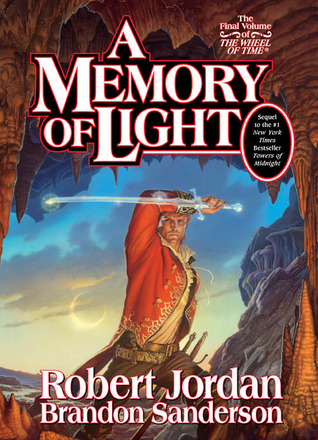
Review: "A Memory of Light" By Robert Jordan & Brandon Sanderson

As I turned the last pages of A Memory of Light so many things were racing through my mind.  First, it struck me that this is the end of an era, as I have been religiously reading and rereading this series for over 20 years (23 to be precise!).  Second, this is absolutely one of the best fantasy series I have ever read, and I am profoundly and utterly amazed and astonished at the quality of the writing, and complexity of the plotting and characterization from the first volume to this, the fourteenth volume, A Memory of Light.  Finally, I don't know that I have ever read one single book that has run me through the emotional 'ringer' the way that A Memory of Light has; and like Life, there are moments of great joy and happiness as well as deep sadness and grief.  I cannot begin to tell you how many times while reading this book I simply stopped reading and quietly wept for a few moments.  It was, all in all, a simply glorious reading experience! 

I am not going to give one word away about how A Memory of Light wraps up this grand journey that all of us have been on for nearly two decades.  Suffice it to say that A Memory of Light is nearly 1,000 pages of near perfection, and we should all stand up and bellow at the top of our lungs, Tai'shar Jordan! Tai'shar Sanderson!, as they have given us a grand story and an ending for the ages.  Obviously, much of A Memory of Light revolves around 'Tarmon Gai'don' (The Last Battle), and the battle scenes are riveting and make the book incredibly difficult to put down.

As any devoted 'Wheel of Time' fan, I went into A Memory of Light with just a tiny bit of trepidation.  After all, this series has finally come to an end, and how it ended was very important to me.  Now that I've finished my first reading of A Memory of Light, I have to say that I really don't know what I was worried about.  Robert Jordan and Brandon Sanderson have crafted a finale that is emotionally powerful and so intellectually satisfying that it very nearly belies words.  Oh, I'm sure that there will be those that will want to change this or that, but not me.  I really do think that the series has ended just as it should, and I honestly don't think I'd change a thing.  I can't wait to reread A Memory of Light again soon, as I'm sure that upon a more careful second reading it will become an even more meaningful experience for me.

For something over twenty years this series has been a meaningful part of my literary life.  At first it was really just great fun--a wonderfully complex and complicated bit of fantasy fiction to enjoy as each installment came out.  Now, however, I am beginning to realize that just as Tolkien was inspired through his fiction and poetry to work on developing a mythology for the English peoples, I think Robert Jordan challenged himself to craft a mythology for an American time.  Nation-building, economic and environmental pressures, political machinations, faith and belief systems, cultural diversity, it is all there.  Mostly the 'Wheel of Time' is the story of men and women and the human condition and the choices we make.  Seriously folks, this series is right up there, in my humble opinion, with Steven Erikson's "The Malazan Book of the Fallen", George R.R. Martin's "A Song of Ice and Fire", and J.R.R. Tolkien's "The Lord of the Rings"--it really is that good!
There are no endings, and never will be endings, to the turning of the Wheel of Time.

But it was an ending.
 
A Memory of Light
By Robert Jordan & Brandon Sanderson
Tor Books, Hardcover, 2013
909 pp.
ISBN 0765325950

***

Review: "The Child Thief" By Brom

I am now an unabashed fan of the artwork and writing of Brom.  I recently finished reading Brom's The Child Thief, a dark--and very much adult--retelling of J.M. Barrie's Peter Pan.  Frankly, based upon this novel, I'm willing to suggest that Brom is America's answer to British author Neil Gaiman, with the ability to take the folklore and fairy tales of the ages and give them a thoroughly modern spin.  Even setting aside Brom's gorgeous art that graces this novel, the tale itself is a sophisticated amalgam of elements from Celtic mythology, Arthurian legend, and American history, and it really, really works well.  Having said this, this is not the 'Peter Pan' of your youth, and most certainly is not the 'Peter Pan' and 'Tinkerbelle' of the Disney cartoon.  Nope, this is some seriously dark stuff that continually tugs at the heart-strings, horrifies, and even amuses as it deals with things like friendship, loyalty, belief and faith, and love.  Something tells me that J.M. Barrie would very much approve of Brom's interpretation and retelling of 'Peter Pan' in this book.  I really need to see if I can find a hardcover edition of The Child Thief, as this is a book to cherish and reread, and add to my growing collection of the tales of mythology and faerie.  This gets a solid five out of five stars from me, a genuine favorite.

The Child Thief
By Brom
Harper Voyager, Trade Paperback, 2009
476 pp.
ISBN 0061671339

***

January 9, 2013

Review: "Great North Road" By Peter F. Hamilton

In reading Peter F. Hamilton's Great North Road I certainly stepped out of my reading 'box', but then I've been doing that a lot over the past few years.  This massive tome--nearly 1,000 pages--is a rock-solid and riveting example of the sub-genre of science fiction known as 'space opera', and I have to say that I enjoyed every moment reading this book.  I had never read anything by Hamilton before, but I am quite sure that I'll be looking at some of his other fiction in the near future.

Simply put, Great North Road is a tale that takes place approximately 150 years in the future, and is a wonderful combination of a police-procedural murder mystery and the story of a military expedition and exploration on the new and strange world of St. Libra, an Earth-like planet, orbiting the Sirius star system (about 8 light years from our own Solar System).  St. Libra is a planet that is mostly covered with water, but with several large land masses that contain a dense and virtually impenetrable jungle.  St. Libra also happens to be the location of a large "bioil" facility that manufactures petroleum products created from algae that is 'farmed' in large paddies.  This oil is then transported through a "trans-spacial connection", or gateway, back to Earth where it is used by European countries in what is now known as "Grande Europe" (a nod to the current European Union, I'm guessing).

Much of the police procedural elements of the novel are centered on the city of Newcastle in England, where there is a corresponding 'gateway' that allows instantaneous travel and transportation of people and equipment from Earth to St. Libra.  Many countries around the world have also established gateways to other worlds and have either created quasi-Utopian settlements, or have engaged in economic- or ethnic-cleansing and have transported their undesirables to these new worlds (i.e., much like the English used to transport criminals, and others, to penal colonies in Australia in the early 19th century).  Additionally, there is the added tension throughout much of the novel of the risk of invasion and attack by a truly horrific alien life-form, the "Zanthswarm", which has attacked and destroyed several of the human settlements on other worlds with millions of human casualties.  The Human Defense Alliance (HDA) exists to protect all humans (and the gateways) from alien threats, and kind of reminded me of our NATO alliance today, or even the U.S. Homeland Security Department.

Hamilton's world-building and his information-dumps are well handled through the use of a timeline that hops back and forth over a span of a century or more, and seen through multiple points-of-view of the various characters in the novel.  There are also some really well thought out notions associated with human cloning, and gene modification (if you have the money) that slows and even reverses the effects of aging, some seriously cool and advanced medical procedures.  I also really found fascinating Hamilton's vision of how artificial intelligence (AI) and information technology is used in this novel.  People are essentially hard-wired into the 'world-wide-web' and can pull up and utilize their own personal 'net' to communicate and access and process all kinds of information and technology--pretty much all 'virtual reality'.  Obviously, this technology allows the police to accomplish some pretty amazing things when it comes to trying to solve crimes, and the soldiers on St. Libra to coordinate and stay linked together as they search for a dangerous alien entity that may, or may not, be involved in the murder that occurred back on Earth.

While some readers may balk a bit at the slightly ponderous pace of the first third of the novel--mostly involving the murder mystery and the Newcastle police--I encourage readers to stay with it as the pace picks up dramatically as characters and plot-lines begin to converge, and then one finds oneself fully engaged as the book roars to its very satisfying conclusion.  I have to say that I was mightily impressed at the overall tone and tenor of the novel and its subtle, and sometimes not-so-subtle, moral messages that invite the reader to periodically stop and reflect upon a whole of host of issues, including things like population and emigration/immigration control, medical and bio-ethics, control and use of nuclear and biological weapons, and environmental stewardship and the harvesting and utilization of natural resources.  Without being 'preachy' in the novel, I think Hamilton wants his reader to think about these issues and the moral and ethical responsibilities that humans--as an intelligent species--have, and that as we move forward in exploring our Solar System that we do so in a thoughtful, deliberate, and responsible fashion.

The Great North Road is an excellent novel on many levels, and I unhesitatingly recommend reading it.  If you like scifi you'll probably love the book; and even if you don't, the plot and science elements in Great North Road are still close enough to our time frame such that it makes sense and isn't too abstract.  For me, Great North Road is a solid four out of five stars.  A good read indeed!

Great North Road
By Peter F. Hamilton
Del Rey/Ballantine Books, 2012
948 pp.
ISBN 978-0-345-52666-3 

***


January 5, 2013

Review: "Red Country" By Joe Abercrombie

Wow!  Joe Abercrombie's Red Country is one of the first books that I've read in 2013, and I'll wager that it ends up being one of the best I've read this year.  I found the dark gritty fiction of Abercrombie a few years ago when I read his First Law trilogy (2006-2008), and then followed it up with his brilliant, and my favorite, novel, The Heroes (2011).  Red Country is right up there with The Heroes and is somehow an incredibly clever blend of cinematic gorefest ala Sam Peckinpah and the unrelenting violence and pathos of the writing of Cormac McCarthy; and while Red Country is a fantasy novel of the first order, it reads and feels like a western.

The plot is really quite simple.  Farms in the hinterlands have been burned, people brutally killed, and a lot of children have been captured and kidnapped by a gang of desperadoes.  The novel's primary protagonists are all a group of misfits and deeply flawed characters that have come together to trek across a brutal landscape, some in search of the missing children, others in pursuit of gold, and others just trying to find themselves and start new lives.  'Shy South' and 'Lamb', a father-figure to Shy and her younger siblings, are in pursuit of the kidnapped children.  And if you've read any of Abercrombie's earlier novels you'll be delighted as you encounter a goodly number of rogues who reappear in Red Country.  Additionally, there is a whole group of fascinating new characters that range from utterly monstrous and despicable to some that are honorable and good-hearted.  Having said that though, it is amazing to me that at times it is still hard to sort out who is really good and who is really bad, and that is solely a function of the quality of Abercrombie's plotting and writing.

Abercrombie has a way with words and can truly turn a phrase.  One thing I've come to expect when reading his fiction is the earthy and pithy philosophical one- or two-liners from his characters.  They're really quite priceless, and I've taken to marking them as I encounter them whilst reading.  Here's a sampler of Abercrombie witticisms--
My old commander Sazine once told me you should laugh every moment you live, for you'll find it decidedly difficult afterward.
'Severed heads,'Cosca was explaining, 'never go out of fashion.  Used sparingly and with artistic sensibility, they can make a point a great deal more eloquently than those still attached.'
There is no bad living, and no good death.
The bottle's a shifty banker--it might lend you courage but it's apt to call the debt in sudden.
'Death loves me.' Lamb smiled, black-eyed, wet-eyed, and the smile was worse even than the snarl had been. 'All the work I done for him? The crowds I've sent his way? He knows he ain't got no better friends.'
'Why does everyone pout so over children?' Cosca called after him. 'They'll turn out just as old and disappointing as the rest of us.'
'Men are animals.  Conscience is a burden we choose to bear.  Morality is the lie we tell ourselves to make its bearing easier.'
Well, you get the picture.  Abercrombie sure can write, and Red Country is a relentless torrent of words and writing that simply compels you to keep reading and turning pages, one after the other until you reach the immensely satisfying conclusion.  This is a great book with awesome characters that is sure to please any reader encountering Abercrombie for the first time.  If you've had the pleasure of reading any of Abercrombie's other books, oh are you in for a hell of a delightful surprise.  Finally, even if you're the type of reader who swears they don't like fantasy fiction, give Red Country a try, I'm gonna bet that you're gonna find Abercrombie's fiction is well worth it and in the 'wheel-house' of many, many readers.  Red Country gets a solid five out of five stars from me.

Red Country
By Joe Abercrombie
Orbit Books, 2012
453 pp.
ISBN 9780316187213

***

Review: "Something Red" By Douglas Nicholas

Every once in a great while you just happen upon a book and author that you absolutely know nothing about, but you take a chance and take it home with you and you are simply blown away at what you've discovered.  Something Red, by Douglas Nicholas, is just such a book and is really a stunning little novel.  This dark and grim story revolves around a small troupe of travelers on a journey through a rugged wild portion of northern England during a bleak and cold winter in the 13th Century.  During the course of their trip the horror and terror mounts until the explosive climax near the end of the book.

The author of Something Red, Douglas Nicholas, in my opinion, is a writer of great promise.  Not only can he spin a great yarn, but his prose is gorgeous and verges on the poetic at times; which actually makes sense as Nicholas is apparently a well known published poet from the Hudson Valley of New York state.  The characters in Something Red are interesting and well wrought, and his use of magic and mythology is deft and sure-footed and works well in the plot.  I have to say that more times than not this dark tale reminded me of the early Anglo-Saxon alliterative epic poem, Beowulf (especially Seamus Heaney's brilliant translation). Also, it is actually quite hard to pigeon-hole this book as horror, fantasy, mystery, or medieval historical fiction--as it really is all of the above.  Mostly though, this is just one damn good book that I had a hard time putting down until I'd read the last page.  I ain't gonna say anymore, other than to urge you to read this superb and riveting debut novel from Douglas Nicholas.  This received five out of five stars from me, as it really was a most excellent novel, and one that I will surely read again sometime soon.

Something Red
By Douglas Nicholas
Emily Bestler Books/ATRIA Books, 2012 
315 pp.
ISBN 978-1-4516-6007-4

***

January 1, 2013

Review: "The Road" By Cormac McCarthy

I just finished rereading this spare, but intensely powerful, little book.  There's an almost intoxicating quality to the writing of Cormac McCarthy, and The Road is an excellent example of his mastery of the craft.  I swear that there is simply not one extraneous word, and that his brief--almost painfully brief--prose somehow majestically morphs into an elegy that becomes a song of sorrow about the last vestiges of human existence on a shattered Earth. 

The Road is both relentlessly sad and horrifying as the reader follows the struggles of the 'man' and the 'boy' as they slowly journey on the road across the ash-covered and tortured landscape.  But as painful as this book is to read, it is also at the same time the story of a beautiful love between a father and his son.

The Road is, at some level I think, a retelling of the Myth of Prometheus.  Prometheus, as you may recall, was the Titan that created humankind from clay and then gifted them with fire.  For defying Zeus and providing humans with fire, he was chained to a mountain-top where each day an eagle swooped down and devoured his liver.  In The Road, the man and boy travel down the road trying to be the "good guys" and "carrying the fire" in a world that has obviously been, and continues to be, brutally ravaged by fire (whether it was by nuclear holocaust, an asteroid strike, or environmental catastrophe is not made clear, nor is it particularly relevant).

In my opinion, McCarthy's prose in The Road rises to the level of the apocalyptic poetic visions of William Blake, William Wordsworth, or even T.S. Eliot, and is richly loaded with allegory, metaphor, and symbology.  And while The Road is grim, dark, and utterly bleak, it is entirely consistent with much of the rest of McCarthy's oeuvre.  Like many of McCarthy's earlier works, The Road is the story of an epic journey and the relationship between a father and son (or older man and younger man).  Think about, for example, Blood Meridian ("The Judge" and "The Kid"); No Country for Old Men (the Sheriff and his Uncle); and then each of the books in The Border Trilogy, and some of his earlier "Appalachian" works like The Orchard Keeper, Suttree, and Outer Dark.

Some how, some way, McCarthy, while exploring the dark side of humanity in his fiction also always manages to find the spark of goodness in some of his characters--and yet Hope always remains an elusive and sketchy notion.  For me, what makes McCarthy's vision of Hell so goddamned terrifying is that there is a palpable sense of doubt in the validity of Hope and Grace in his fiction.  In The Road it is the 'glimmer' of Hope that carries the scent of salvation and keeps the reader going page after page, paragraph after paragraph, and spare sentence after spare sentence. 

When you read Cormac McCarthy you quickly come to realize that really bad things can happen to decent people and that walking 'the road' of life is a difficult proposition at best. Tough stuff to read, but oh so worth it.

***

December 31, 2012

Review: "World War Z" By Max Brooks

I didn't include this book in my list of favorite reads in my "2012--My Year In Review" list that I posted, but I probably should have.  It must be something about the time and age that we live in that the zombie apocalypse has become something of a cult phenomenon--witness all of the zombie books being published and read, and AMC's remarkably popular TV series "The Walking Dead"--and I must confess that I am a 'card-carrying' member of the zombie cult too (which, on its face, is perhaps the most ridiculous thing I've said in months ;-).  Anyway, World War Z was a morbidly fascinating and well-written fictional account that purports to provide an 'oral history' of the efforts of the world's living to contain and eradicate the world's undead.  Max Brooks (Mel Brooks' son) wrote this book as a collection of interviews among the survivors of the horrific war against the zombies, and certainly pays an extraordinary amount of homage to the late Studs Terkel. 

As crazy as it sounds, this was an easy and entertaining book to read, largely because of Brooks' organization of the novel.  It starts with a chapter describing the initial outbreak and spread of the virus that leads to the 'zombification' of billions of humans across the entire globe.  The remaining chapters include the personal accounts of the survivors as they try and combat the horror of the mounting threat of the zombie hordes, and then the formulation and implementation of a global strategy to reclaim the planet from the undead hoards. 

Personally, I liked the use of the personal interview and vignettes of story-telling rather than focusing on a first- or second-person accounting of this horrific tale.  And while the notion of zombies taking over the world may seem a bit far-fetched (I hope?), there was plenty of 'food-for-thought' about the way governments and individuals might react if there were global threats associated with nuclear or biological terrorism, or even the short- and long-term effects associated with global climate change.  The human propensity for inhumanity to other humans is well known, and is maybe even more terrifying than that of the zombies described in Brooks' World War Z.  I'll be interested to see how the upcoming blockbuster movie starring Brad Pitt handles the material in the book when it is released during summer 2013.  World War Z, the book, gets four out of a possible five stars from me.

***

August 31, 2012

Review: "Cold Harbor: Grant and Lee, May 26--June 3, 1864" By Gordon C. Rhea

Cold Harbor: Grant and Lee, May 26-June3, 1864 is the final volume in Gordon Rhea’s brilliant series of four books describing the “Overland Campaign” of U.S. Grant and the Union Army of the Potomac conducted against Robert E. Lee’s Confederate Army of Northern Virginia during the spring and summer of 1864.  This book picks up with the two armies maneuvering from their stand at the North Anna River crossings, and Grant’s efforts to continue to sidle south around Lee’s right flank and interpose the Union army between Lee and Richmond.  Rhea masterfully describes the movements of the two armies as they come together again at the important road junction of Cold Harbor just nine or ten miles from the Confederate capital of Richmond.  Much of the book then focuses on the particularly vicious and bloody fighting that occurred on June 1st and June 3rd during the Battle of Cold Harbor.  Unfortunately, for Grant and the Federal army this is the continuing story of missed opportunities during the Overland Campaign, and just like during the Battles of the Wilderness and Spotsylvania Court House, those missed opportunities translate into great loss of life on both sides and the extension of the war by several months, if not longer.

Observations and what I learned reading this book and from Rhea’s series—

The Federal cavalry arm of the Army of the Potomac was now the master of the battlefield in the eastern theater.  They had grown up, learned their lessons, and were now ruthlessly efficient and thoroughly professional.  The days of pell-mell charges and saber-slinging were over, the Federal cavalry with their repeating carbines and well-fed horses were now being utilized as mobile infantry that, when they met their foes on the field of battle, generally dismounted and fought behind defensive protection or earthworks.  While Federal cavalry units were now largely decisively defeating their Confederate counterparts when they met in combat, the primary problem associated with the Federal cavalry during the Overland Campaign revolved around the on-going feud between Army commander George Gordon Meade and the cavalry commander, Major General Philip Sheridan.  Consequently, Meade typically wouldn’t ask for assistance from Sheridan (or even the tactically correct assistance), and Sheridan wouldn’t respond even when he did.  Inexplicably, Grant could have stepped in and dealt with Sheridan’s insubordination, but never did.  Worse yet, in my humble opinion, Grant never did utilize this professional cavalry corps as he should have—i.e., to effectively scout out Lee’s intentions, or use them as a blocking force, or to effectively determine the disposition of Lee’s forces on each of the battlefields, or even to use the cavalry to recon proposed Federal army corps movement routes.  Again, in my opinion, this was one of a number of significant short-comings associated with Grant’s overall leadership of the Federal forces during this campaign.

In the context of the Battle of Cold Harbor, had Grant and Meade more efficiently or effectively utilized Sheridan’s troopers, they probably could have ‘sniffed’ out the inherent weaknesses in the southern portion of Lee’s lines near Cold Harbor early on June 1st.  Lee’s right flank was more than ripe for turning and Grant could have opened him up like a tin-can and moved the Confederate army (or a portion thereof) out of its impregnable earthworks, and probably easily gotten himself between Lee and Richmond.  This very well could have been the proverbial “straw that broke the back” of Lee’s army, but we’ll never know because at the time Grant and Meade hadn’t the foggiest idea of Lee’s positions and strengths along much of his Cold Harbor lines.  Additionally, the Federal corps commanders weren’t any better at actively collecting or assessing information and then closely cooperating and coordinating with one another, or even passing that information on to Grant and Meade in a timely fashion.  Ultimately, and tragically, the Battle of Cold Harbor really was nothing much more than a bunch of individual set-piece affairs of frontal assaults by brave Federal troops against Lee’s entrenched lines, and the results were all too familiar—bloody repulses and significant casualties.

Some of my observations about Grant vs. Lee that I picked up reading this series—

It probably goes without saying that the two commanders of the Federal and Confederate armies in the Overland Campaign—Ulysses S. Grant and Robert E. Lee—were the very best combat leaders on either side, and were mostly pretty evenly matched in skills.  Both had a profoundly accurate sense of the overarching strategies required for prosecuting the war from both the Federal and Confederate perspectives.  Maybe the nod goes to Grant in the sense that he and President Lincoln not only had a good working relationship, but he and Lincoln shared a firm grasp on the national strategy that involved ensuring that there was a combined and coordinated push by all Federal forces in all theaters of the war.  This is something that Confederate President Jefferson Davis just wasn’t able to grasp; or, if grasped, just wasn’t able to effectively implement it with the resources he had available.  Even Lee, to a large degree, was fixated and focused only on the strategic situation and potential tactical opportunities in the immediate theater surrounding Richmond and Washington, D.C.  During the course of the Overland Campaign it very well may be that Lee knew that it really was just a matter of time before the Army of Northern Virginia was pinned, by Grant, with its back against Richmond; and that the best that he could do was try and hurt Grant and the Federal army enough to force a political solution that could lead to the independence of the Confederate states (i.e., through the defeat of Lincoln in the 1864 election by an anti-war candidate).

A lot has been made over the past 150 years of the notion that Grant was a “butcher” and needlessly wasted the lives of his men in senseless headlong assaults against Lee’s entrenched army.  At first blush, this seems like an accurate assessment as Grant’s Overland Campaign cost something like 55,000 Federals killed, wounded or captured over a 45-day period (or, approximately 45% of the total number of men in his army).  The Battle of Cold Harbor is always held up as the prime example of “Grant the butcher”.  Frankly, in my opinion, the facts simply don’t warrant this conclusion.  For example, at the North Anna River Grant and his corps commanders had tactically won some minor engagements, but he soon realized that the entrenched Confederate position was virtually unassailable and would lead to great bloodshed, and no material gain, if he attacked.  Consequently, during the night he deftly withdrew three Federal army corps back across to the north side of the North Anna River and smartly maneuvered the entire army east and south again in an effort to turn Lee’s flank and engage him in open country.

Staying with this theme then, if any one general during the American Civil War is deserving of the moniker of “butcher” it perhaps could be fairly stated that it was Lee himself.  For example, Lee, over the three days at Gettysburg, lost more men in battle than any other general, north or south.  Another pertinent example is that Lee, during that horrific one day at Antietam in 1862, lost more men than any other general did during a single day.  Finally, Lee’s combined losses during the 45-day period of the Overland Campaign were more than 33,000, or greater than 50% of the total strength of his vaunted Army of Northern Virginia.  Bluntly put, once Lee’s blood was up he worshiped at the ‘Altar of Carnage’ with the best of them.

It is true that Grant’s army suffered significant losses while assaulting the Bloody Angle in The Muleshoe at Spotsylvania Court House, or during the frontal assaults at Cold Harbor, but these attacks were directly stimulated by the efforts of the Federals to exploit existing or perceived weaknesses in Lee’s lines during the heat of battle.  I submit that most battlefield commanders would have made similar assaults given the facts at hand—witness Lee’s assault on the Federal center at Gettysburg on the third day, as he was confident that the center had been significantly weakened based upon the hard fighting that had occurred during the first two days of the battle.

Much has also been made that to Grant, Meade, and even Lincoln to some degree, the Overland Campaign was nothing more than a battle of attrition, and was just a numbers game.  While in hindsight this is certainly true, and that at the time the Federal high command probably recognized it too, it certainly didn’t mean that Federal commanders were callous or negligent in their use of the troops at their disposal during the Overland Campaign.  At best, the summer of 1864 was dicey period politically within the Union, and if it seemed that the war had simply turned into a blood-fest with no end in sight, it was clear that the President would likely not be reelected, and Grant and Meade, and even the Army itself, understood this probability well.  Additionally, the Army of the Potomac could ill afford to ‘throw away’ any troops as it was bleeding strength anyway as a good number of regiments’ three-year enlistments were expiring and the existing conscription efforts simply couldn’t make up for the losses.  More importantly, the three years of hard fighting had sapped the Army of the Potomac of many of its combat-hardened veterans.  The new troops coming into the Federal army just weren’t of the same caliber as those who had fought their way through The Seven Days, Antietam, Fredericksburg, Chancellorsville, Second Bull Run, and Gettysburg.  Having said all of this though, it was clear to both Grant and Lee that it was certainly easier for the Federals to replace their losses than it was for the Confederates.  After four hard years of a war that had evolved into—as Sherman put it—a “Total War”, the Confederate ability to come up with additional troops, replace material, and even provide for the civilian population was becoming more and more limited with each passing day.  It really was just a matter of time now.

Finally, I think Rhea’s books highlight the other significant element of Grant’s strategic vision that was critical to the long-term success of the Federal forces against Lee and the Confederacy and that was his management of the logistical issues for the Army of the Potomac once it moved south of the Rapidan River and began its relentless struggle with Lee’s Army of Northern Virginia.  Up to this point in time, all other Federal commanders had swooped south and fought Lee, and then shifted back (normally in defeat) across the river to rest and refit.  Grant was determined to latch on to Lee and his army and not let go.  Therefore, he needed to utilize the existing road and rail network in this part of Virginia to ensure that he could efficiently receive supplies, transmit and receive communications, and transport reinforcements and wounded to and fro.  His ability to work with the U.S. Army Quartermaster Corps and the U.S. Navy ensured that he could cut himself off completely and just focus on the task at hand—running Lee and the Army of Northern Virginia to ground.  Grant kept his eyes on the prize, and he ultimately won the game because of this single-minded focus.

In writing these four volumes about the Overland Campaign of 1864, Gordon Rhea has performed an extremely valuable service for all who are interested in American history and especially those interested in the military history of the American Civil War.  While each of the books are important in the detailed description of the tactical movements and outcomes on each of the battlefields, perhaps the real strength of the series is Rhea’s ability to continually review and update the strategic issues and realities from both the Union and Confederate perspectives.  These four well-written volumes document and support Rhea’s assertion that it was not just the story of a series of independent battles—the Battle of the Wilderness, the Battle of Spotsylvania Court House, the North Anna River, or the Battle of Cold Harbor—it was the assertion that Grant set out and entered upon a coordinated campaign with the overarching goal being the absolute and utter destruction of Lee’s army.  The movements of the troops led to the battles, and the battles led to next series of movements and the next battle, and so on.  The point being that these battles and movements were clearly inter-related and inter-dependent from start to finish, and I think that when you have completed reading all four books you’ll agree that by the time the two armies settled into the siege at Petersburg, Lee’s Army of Northern Virginia was largely finished as an effective combat force of any significant power.

In conclusion, I highly recommend the entire series that Gordon Rhea has written about Grant's Overland Campaign of 1864.  I guarantee that you won't be disappointed, as these four books are a superbly well-written "you are right there" military history of a campaign and set of battles that hasn't really received all that much attention by scholars in the past.  These books would be a valuable addition to the library of any Civil War history aficionado.


***

Cold Harbor: Grant and Lee, May 26--June 3, 1864
By Gordon C. Rhea
Hardcover, 552 pages
Louisiana State University Press, 2002

Review: "To the North Anna River: Grant and Lee, May 13-25, 1864" By Gordon C. Rhea

Like two dueling grandmasters, Lee and Grant sat down over the 'chess-board' of the northern Virginia landscape that separated Washington, D.C. from Richmond, Virginia.  For the first two weeks of May 1864, the two generals have been adroitly maneuvering their armies across the terrain and engaging in some of the most sustained, ferocious and horrific combat seen in the Civil War.  It is spring 1864, and the Northern population is wearying of the war, and Lincoln and his administration are up for reelection in November.  While the South may not be able to prevail any longer militarily on the battlefield, it is hoped that Lee can buy time for a political solution by conducting a careful and defensive campaign against Grant's much larger Army of the Potomac.

Rhea's third volume in his "Overland Campaign" series, To the North Anna River: Grant and Lee, May 13-25, 1864 is an incredibly fascinating story about the little-known period of time between the dreadfully bloody Battle of Spotsylvania Courthouse (see my review of Rhea's The Battles for Spotsylvania Court House and the Road to Yellow Tavern, May 7-12, 1864 below) and the impending slaughter at the Battle of Cold Harbor.  Following the bloodbath at Spotsylvania Court House, Grant gingerly disengages his army from his lines fronting Lee and deftly begins to sidle south and east around Lee's right flank.

Grant's short-term strategic goal is to turn Lee out of his earthworks at Spotsylvania Court House and hopefully engage him in battle on more open ground.  In fact, Grant even sends Hancock's Second Corps trundling off southward as 'bait' in an effort to draw Lee out.  Lee doesn't fall for Grant's trick though, and rapidly shunts his army 25 miles due south to the banks of the North Anna River and devises an ingenious system of defensive earthworks, and awaits the approaching federals with a trap of his own.

Close on the heels of Lee's army, Grant and the Army of the Potomac move up to the North Anna River, and thinking that the Confederates have continued to retreat toward Richmond, move across the North Anna at two separate crossings that are a couple of miles apart.  This has the effect of splitting the large Union army into two pieces separated by Lee's entrenched rebel army.  In essence, with his interior lines, Lee can now attack each wing of the federal army and defeat them in detail. 

Fate and Chance always seem to have a way of intervening on the battlefield, and it is no different here.  Lee becomes very ill with dysentery and as he is bedridden he is really quite unable to aggressively lead the rebel army in these complicated maneuvers, and his subordinate command structure is unable to fill the void.  Simultaneously, Grant does come to realize the predicament he is in and immediately has his army entrench and protect itself.  With the opportunity to 'check-mate' one another now passed by, Grant is realistically left with just two options: (1) attack Lee's virtually impregnable position on the North Anna; or (2) disengage and sidle east or west of Lee's position and try and maneuver Lee out of his works toward Richmond.  He chooses the latter option and determines to sidle easterly, and the two grandmasters continue their game of maneuver and probing for defensive weaknesses.  In just a few days the two commanders and their armies will meet again on the field of battle near the tiny hamlet and road junction of Cold Harbor just nine miles from Richmond.

I really can't say enough about the quality of Rhea's writing and his ability to bring history alive.  Somehow his story-telling manages to impart a real feeling of 'you are there as an eyewitness' so very effectively.  While the decisions of the command structures of the two armies are certainly important to Rhea's narrative in the book, I think it is Rhea's attention to the stories of the common foot-soldiers, artillerymen, and cavalrymen that makes this book--and the entire series--so darned poignant and engaging.  These books illustrate and describe accounts of patriotism, courage and extraordinary feats of heroism--on both sides of this bloody conflict--that are such an important part of the overall saga of the history of our American republic.


***

To the North Anna River: Grant and Lee, May 13-25, 1864
By Gordon C. Rhea
Hardcover, 472 pages
Louisiana State University Press, 2000

Review: "The Battles for Spotsylvania Court House and the Road to Yellow Tavern" By Gordon C. Rhea

"Out of the frying pan, and into the fire"--Out of the butchery of The Wilderness, and into the horrific carnage of The Muleshoe and Bloody Angle of Spotsylvania--this is the second entry in Gordon Rhea's masterful series describing the Overland Campaign of Ulysses S. Grant and the Union Army of the Potomac against Robert E. Lee's Army of Northern Virgina in the spring and summer of 1864.  Following the inconclusive horror of two days of bloody fighting in the tangled forests of The Wilderness, Grant has sidled the Union Army to the southeast, hoping to turn Lee's right flank and put his army between the Confederates and their capital in Richmond, Virginia.  Unfortunately, for the federals and Grant, Lee's army beats him by a step to the tiny hamlet of Spotsylvania Court House, and there behind superbly constructed defensive works repels numerous assaults made by the larger Union Army of the Potomac over the next week.

It was with riveting horror that I read of each of the attacks made against the rebel fortifications in what became known as "The Muleshoe"--a large salient that jutted out from the center of Lee's lines.  The Muleshoe was nearly a half-mile in length and nearly as wide and was ably defended by Lee's Second Army Corps, commanded by Lt. General Dick Ewell.  By the end of May 12th, at the conclusion of major fighting on this section of the battlefield, nearly 18,000 men had been killed, wounded, or captured (8,000 rebel, and almost 10,000 federal).  It was carnage on a scale not seen before in the Civil War, and that the bulk of the fighting took place in the defensive earthworks ringing and within The Muleshoe, it portended the gruesome butchery that was to come in the trenches of the First World War just fifty years later.

Rhea is an excellent story-teller, and tells of these horrifying days and events through the use of the personal accounts (e.g., letters and diaries) of the officers and men that participated in the fighting.  It is my understanding that perhaps William D. Matter's If It Takes All Summer: The Battle of Spotsylvania is an even better account of the Spotsylvania Campaign--that may be so, as I've yet to read it--but Rhea's is a gripping "you are there" account that is a page-turner from the very first to the last.  The thirty maps that are included within the text are incredibly detailed, from both a strategic and tactical perspective, and perfectly complement Rhea's masterful prose and battle descriptions.

By the time one has finished this excellent book, one cannot help but completely agree with the conclusion reached in Rhea's epilogue--
"The Confederates were technically correct in considering May 10 and 12 as victories.  After all, they had foiled Grant's assaults on each occasion.  But a few more such victories would leave Lee's army in shambles.  Eight days of fighting Grant had gutted the Army of Northern Virginia's capacity to go on the offensive.  For the future, Lee had little choice but to continue his defensive tactics, hoping to thwart Grant's thrusts and to buy time for a political solution to the war."
If anything, I enjoyed this second volume in Rhea's four-volume series about the Overland Campaign of 1864 even more than the first, and now it is on to the third book, To the North Anna River: Grant and Lee, May 13-25, 1864.

***

The Battles for Spotsylvania Court House and the Road to Yellow Tavern
By Gordon C. Rhea
Hardcover, 512 pages
Louisiana State University Press, 1997

Review: "The Battle of the Wilderness, May 5-6, 1864" By Gordon C. Rhea

Like two titans, Ulysses S. Grant and Robert E. Lee locked armies and ferociously grappled with each other over two days in early-May 1864 in a dense forbidding patch of terrain and landscape in northern Virginia known as "The Wilderness".  At the conclusion of these two days of some of the most severest fighting of the entire Civil War, the two armies had lost a combined total of nearly 29,000 men killed, wounded, or captured.

Gordon Rhea's account of Grant's first battle as the Union Army Commander-in-Chief, is a well-written and very thorough description of The Battle of the Wilderness.  Grant was determined to maneuver the Union Army of the Potomac between Robert E. Lee's Army of Northern Virginia and the Confederate capitol in Richmond, and in The Wilderness he very nearly succeeded.  He started three extremely powerful Union Army Corps eastward down the Orange Plank Road and the Orange Turnpike and ran headlong into two Confederate Corps commanded by A.P. Hill and Dick Ewell.  Unfortunately for the Federals, as the fighting started the corps and brigade commanders just couldn't maintain effective coordination and communication as the assaults progressed, and the out-numbered Confederate corps were able to beat back most of the Federal attacks at great cost to both attacker and defender.

The woods were so dense and disorienting that the attacking troops couldn't see but just a few yards in any directions, and unit movements became fragmented and went off-track almost immediately.  The firing of muskets and artillery actually started numerous forest fires, which flared up among the troops as they moved through the woods, or lay wounded on the forest floor.  The fighting was pretty much a unconstrained brawl between the two armies and just raged back and forth and up and down the turnpike and plank roads.  Finally, after two days, the major fighting slowly sputtered out and the two armies were largely back in their original starting positions and just scowling at each other. 

Rhea assesses the result of two days of battle in The Wilderness as, at best, a tactical victory for Lee and the Confederates, but a strategic victory for Grant and the Federal army.  The bottom-line was that Grant was not going to leave--not even after nearly 18,000 Federal casualties--but was going to latch onto Lee's army like a pitbull, and not let up up until the war was over.  This attitude for prosecution of the war was a sea-change compared to all of the previous commanders of the Union Army of the Potomac.  Grant, in The Wilderness, tried to exercise the use of power in attacking Lee's army, as he did so successfully in his campaigns in the western theater.  The problem was that his subordinate commanders (i.e., Meade, Hancock, Sedgewick, Burnside, et al.) and the Army of the Potomac just weren't up to the challenge yet.  Both Grant and the Army of the Potomac needed to learn how to fight differently and fight 'together', and this first step in The Wilderness was clearly part of that learning process. 

I can't begin to relate how much I learned about Grant's leadership qualities and The Battle of the Wilderness in this excellent book by Gordon Rhea, and how much I am looking forward to reading the next three books in his series about the Overland Campaign.  The maps included in the book are truly quite superb and make much of the complicated maneuvering of the units during the battle much easier to follow and comprehend.  As usual, I wish there were even more maps, but that's a common litany of mine.  Every serious Civil War buff ought to have this book on their shelf.

***

The Battle of the Wilderness, May 5-6, 1864
By Gordon C. Rhea
Hardcover, 512 pages
Louisiana State University Press, 1994

Review: "The Maps of Chickamauga: An Atlas of the Chickamauga Campaign, Including the Tullahoma Operations, June 22-September 23, 1863" By David Powell & David Friedrichs

Absolutely brilliant!  In 2009, David Powell and David Friedrich combined, with the fabulous assistance of publisher Savas Beatie, to create one of the best ever books about the Battle of Chickamauga.  The Battle of Chickamauga was fought in the northwestern corner of Georgia on September 19-20, 1863, and Powell's text and the exquisitely detailed color cartography of David Friedrichs combine to precisely and definitively tell the complete story of the second bloodiest land-battle fought on the North American continent (only Gettysburg was bloodier).

This beautiful atlas starts the story of this fascinating, but not all that well known, campaign in June 1863 with Union Major General William S. Rosecrans and his Army of the Cumberland in Murfreesboro, Tennessee.  Just south of him is Confederate General Braxton Bragg and the Army of Tennessee in Tullahoma, Tennessee.  Rosecrans moves south and over the course of the next couple of months maneuvers Bragg's army southeasterly all the way to Chattanooga, Tennessee.  Finally, Bragg and the Army of Tennessee had enough and counter-punched, and counter-punched hard against Rosecrans in the long narrow valley through which Chickamauga Creek flowed.  With the text and 126 full-color incredibly detailed maps, Powell tells the complete story of this frenzied and chaotic bloody battle.  The maps and the text describe the movements of the units on the battlefield at the brigade and/or regimental level in increments of 15-30 minutes.  With this book in hand it would easily be possible to absolutely walk the battlefield in step--minute-by-minute--with those combatants in butternut and blue from nearly 150 years ago.

Finally, I highly recommend a combined reading of this book with Peter Cozzens' This Terrible Sound: The Battle of Chickamauga (reviewed below) to get the full flavor of the vicious intensity of the combat at the Battle of Chickamauga on September 19-20, 1863, in that densely wooded valley in northwestern Georgia.  Trust me, armchair Civil War historians, wargamers, and military history buffs are just gonna eat this book up!  Once you pick this atlas up you'll find that a couple of hours has just flown by as you slowly page through the book.  Big 'kudos' to Savas Beatie for the overall superb quality of the binding and printing of this book too, it'll last for years and years!

***

The Maps of Chickamauga: An Atlas of the Chickamauga Campaign
By David Powell & David Friedrichs
Hardcover, 319 pages
Savas Beatie, 2009

Review: "This Terrible Sound: The Battle of Chickamauga" By Peter Cozzens

One of the largest land battles fought on the North American continent, and second only to Gettysburg in the total number of casualties (a total of about 36,000 killed or wounded), the Battle of Chickamauga was a horrific brawl fought in the dense woods in extreme northwestern Georgia over a two-day period in mid-September 1863.  I guess I can't really quite put my finger on exactly why the Battle of Chickamamauga has fascinated me most of my adult life, but it sure has.  I had a direct ancestor who fought on the Union side (21st Massachusetts) with the Army of the Potomac (in Burnside's Ninth Corps) in the Virginia theater, and for a brief period of time around Knoxville, Tennessee, but not at Chickamauga.  I guess it comes down to my assessment that a final and total victory in the Civil War ultimately favored the Union based upon the strategic and tactical results of the performances of Federal armies in the western theater.  The Battle of Chickamauga is sort of anomalous as it was a resounding victory for the Confederate Army of Tennessee that had, throughout most of the Civil War, been beaten by various Federal armies, but had also been pretty badly used by its own high command.

While most battles fought during the American Civil War were generally won or lost based upon the decisions of the army and field commanders, Chickamauga was really one of the very few battles with an outcome that was largely determined by the soldiers on the ground.  In spite of the leadership (or, lack thereof), this battle was a bloody testament to the tenacity of the fighting men in blue and grey as they engaged in this titanic two-day struggle.

In This Terrible Sound, Peter Cozzens has taken on the near-impossible task of trying to describe the completely confusing and chaotic fighting that occurred between the Union Army of the Cumberland, led by Major General William C. Rosecrans, and the Confederate Army of Tennessee, commanded by General Braxton Bragg.  This two-day bloody affair was fought in a long narrow valley that was heavily vegetated with pine and oak woods, limiting visibility between the combatants, in most places, to just a few tens of yards at best.  Most of the time intense combat flared up between the two armies as they blundered into each other in the dense woods up and down the valley.  Brigade and Division commanders tried to respond to threats by feel and sound, and in many instances guessed wrong.

Cozzens goes into great detail describing the command structure and personalities of the leaders in the Confederate and Union armies, and while the Confederate Army eventually prevailed at the end of the day, it was not due to leadership qualities among the Confederate command structure.  It was really much more the result of absolutely disastrous tactical decisions by Rosecrans and a few of his subordinates, and a hefty dose of just plain bad luck.  Had it not been for the steadiness and dogged defense exhibited by Union Major General George H. Thomas at Snodgrass Hill, the entire Union army may very well have been decisively routed from the field of battle, or even completely destroyed in place.  I was completely enthralled reading Cozzens' superb and detailed description about Thomas's day-long stand on the second day as he essentially bought time for the rest of the Union army to safely retreat from the Chickamauga battlefield and into defensive works in Chattanooga, Tennessee.  It really was very nearly an utter and complete disaster for the Union Army of the Cumberland, and with his tenacious defense Thomas earned himself the sobriquet "The Rock of Chickamauga".

While the Battle of Chickamauga was clearly a tactical victory for Bragg and his Confederate Army of Tennessee, it ultimately turned out to be a strategic defeat for the Confederacy, as Bragg let the Union Army safely get away and regroup in Chattanooga.  Eventually, Union General U.S. Grant came to Chattanooga and, replacing Rosecrans, he and Major General Thomas attacked and routed Bragg's army.  This opened up the way for Sherman's campaign on Atlanta and his later "March to the Sea".

Cozzens' writing style is personal and descriptive.  He gives you a very good feeling for the conditions on the battlefield, and for the experiences of the common soldiers in both armies as the battle raged back and forth.  He has drawn liberally, not only from official Confederate and Union records and reports, but also from letters and diaries and first-person accounts related by the veterans themselves.  This is a very compelling story about a battle that really receives little attention when it comes to discussions about the American Civil War, as most tend to focus on the campaigns and great battles that occurred in the eastern theater of the war.

While Cozzens has included twenty-five very detailed maps, it was still difficult to fully comprehend the complicated and chaotic movements and counter-movements of the brigades and regiments as the fighting surged up and down and back and forth across the valley over the entire two days of the battle.  I was so glad to have, readily available, David A. Powell's The Maps of Chickamauga: An Atlas of the Chickamauga Campaign, Including the Tullahoma Operations, June 22 - September 23, 1863 (reviewed above).  This is a "must-have" if you truly want to maximize your experience reading Cozzens' brilliant book.  I really enjoyed them both, and if you're a Civil War or military history buff I think you will as well.

***

This Terrible Sound: The Battle of Chickamauga
By Peter Cozzens
Hardcover, 688 pages
University of Illinois Press, 1992

The Maps of Chickamauga: An Atlas of the Chickamauga Campaign, Including the Tullahoma Operations, June 22 - September 23, 1863
By David Powell & David Friedrichs
Hardcover, 319 pages
Savas Beatie, 2009

May 19, 2012

Review: "Hide Me Among the Graves" by Tim Powers


A couple of observations about Tim Powers and the books that he writes--First, he can weave a hell of a tale!  Second, he certainly does his homework, as his blending of historical fact within his fiction borders upon both the sublime and brilliant!  Hide Me Among the Graves is only the third novel by Powers that I've read, but it is easily the best.  The other two were The Anubis Gates and The Stress of Her Regard.

By way of background, and as some of you may know, I am a huge fan of the Victorian poet, Christina Rossetti.  Christina was the youngest sister of the Pre-Raphaelite Brotherhood founder, Dante Gabriel Rossetti (a poet in his own right).  While a pious woman, Christina, for much of her life explored the breadth and depth of human emotion in her amazing poetry such as her long narrative epic poem, Goblin Market, or the intensely personal series of Monna Innominata sonnets, or in her slightly creepy poems The Ghost's Petition, My Dream or Love and Death. 

Portrait of Christina by Dante Gabriel Rossetti
I guess what I'm trying to say is that Christina Rossetti's poetry evokes a similar response in me as that when I view the art of William Holman Hunt or John Everett Millais, or even Christina's brother, Dante Gabriel--the paintings are lavishly colorful, ornate, detailed and bring to life the natural, spiritual and mythological world.  Christina Rossetti was, if you will, a charter member of the 'PreRaphaelite Sisterhood' and her poetry, in my opinion, was as intellectually creative and emotionally visceral as that of her male contemporaries in the visual and literary arts.  While Christina is perhaps best known for her epic poem, Goblin Market (1859), she was a prolific poet  who, through the course of her life, wrote something over 1,000 poems.  Like her older sister, Maria, Christina never married, and she ultimately died of cancer at the age of 64 in 1894.

What Powers has done in Hide Me Among the Graves is to create an entirely compelling and virtually believable and macabre story involving the Rossetti family and some of the characters from his earlier novel, The Stress of Her Regard.  Is it necessary to read The Stress of Her Regard first? Probably not, but I thoroughly recommend that you do so, as it will make your overall experience that much more meaningful.  In both, The Stress of Her Regard and Hide Me Among the Graves,  Powers has created a unique blend of historical, horror and fantasy fiction in a style that hearkens back to the Romantic period and Gothic revival portrayed in the poetry of Byron, Shelley, Keats and even Coleridge, and in the fiction of Matthew Lewis, Mary Shelley, and Ann Radcliffe.  Interestingly, and relevant to both  The Stress of Her Regard and Hide Me Among the Graves, shortly after Mary Shelley wrote Frankenstein in 1817, the maternal uncle of the Rossetti siblings, John Polidori, wrote a short story entitled The Vampyre (1819).  Polidori, who was also Byron's personal physician while Byron was in Europe, figures prominently in Hide Me Among the Graves as one of the immortal race of horrifying vampires known as the Nephilim.

While a horror story from start to finish, Hide Me Among the Graves is also a family story told on a Dickensian scale.  Powers completely captures the devotion to family that each member of the Rossetti family so zealously guarded and protected.  And while the Rossetti siblings, William, Dante Gabriel, Maria, and Christina are trying to rid London of their undead Uncle Polidori, the fictional characters John Crawford and Adelaide McKee are trying to find and save their young daughter, Johanna, from the clutches of the evil vampire.  During the course of the novel the reader encounters other such real-life characters as the poet Algernon Charles Swinburne, Dante Gabriel Rossetti's artistic muse and wife Lizzie Siddal, the linguist and Dante translator Charles Cayley, and the author and adventurer Edward John Trelawny.  The other major character featured in the book is the City of London and its history, from the depths of the oldest sewers to the "Whispering Gallery" in the dome of St. Paul's Cathedral.  Powers' portrayal of his characters in the London landscape increasingly reminded me of Charles Dickens' magnum opus Our Mutual Friend, both in the descriptive talents of the two writers, but also in the sheer elegance of each written word on the page.  These are characters that you can believe in, admire, and be repulsed and horrified by.  At the same time, over the course of the novel, the gritty and seamy urban environment of London is described so realistically that one almost expects to encounter little 'Jenny Wren' or the 'Artful Dodger' as one rounds the corner in the footsteps of Christina Rossetti on the trail of her vampire uncle.

Lizzie Siddall by DGR
This is good stuff, folks!  A scary and macabre tale, yet at the same time a breathtakingly imaginative and creative story grounded in the real lives of a group of intellectually amazing poets and painters at the height of the Victorian Era in the 19th century.  Finally, there are two aspects of Powers' Hide Me Among the Graves that simply cannot be overstated or oversold.  First, Powers has managed to effectively and accurately portray the complexity of the relationships between Christina Rossetti and her other family members; the tortured relationship between Dante Gabriel Rossetti and his wife, Lizzie Siddall; and even the somewhat bizarre character of the poet, Algernon Swinburne.  Additionally, and most importantly from my perspective, Powers has managed to open a window and illuminate the magnificent poetry of a relatively obscure--but certainly not minor--female poet of the Victorian Era, Christina Georgina Rossetti.  I personally cannot thank Tim Powers enough for setting out and accomplishing both of these tasks in grand fashion in this truly excellent novel!

While cerebral, Tim Powers' Hide Me Among the Graves is entirely accessible to any and all readers and provides a wonderful exclamation point to his spectacularly successful earlier novel, The Stress of Her Regard.  I highly recommend both of these amazing novels!

Note--

I am rereading the novel right now, and revisiting some of Christina's poetry that was utilized as epigraphs and/or referred to throughout the book, and I am quite likely to come back and revisit the content of this review in the near future, but this will suffice for the time being.

***

Afterword--

If, after reading Hide Me Among the Graves, you find yourself becoming interested in learning more about the Victorian poet, Christina Georgina Rossetti (1830-1894), I strongly recommend the following:

Christina Rossetti: The Complete Poems, Penguin Classics, 2005.

Christina Rossetti: A Literary Biography, by Jan C. Marsh, 1994 (My review here)