The Old Way: A Story of the First People is an absolutely fascinating account of the !Kung, or Ju/wasi ("The People"), people of the Kalahari Desert region of southwestern Africa. Elizabeth Marshall Thomas wrote this book in 2006, based upon the many years that she and her family spent with these amazing people starting in the early 1950s. In fact, Thomas's mother ended up publishing several anthropological monographs through Harvard University describing the !Kung hunter-gatherer lifestyle in this desolate and unforgiving landscape. Thomas herself, as a young woman, spent several years living with and getting to know the !Kung, and recorded her observations in her personal journals. Her older brother, John, spent most of his life with these people, working tirelessly on their behalf, and even married a Ju/wasi woman.
Like most people, I'd heard about the "Bushmen of the Kalahari" as a boy, but really had no idea what that meant, or really who these people were. In a nutshell, the !Kung are an ancient people that have essentially lived a nomadic Paleolithic lifestyle in the Kalahari Desert for more than 20,000 years. Interestingly too, with the recent completion of the Human Genome Project, we now know that these people are some of the most ancient and genetically diverse anatomically modern humans (i.e., Homo sapiens) on the planet. If you will, the !Kung peoples are the 'rootstock' of most of us. And as such, I think a book like that which Ms. Thomas has written is incredibly important for all of us to read and think about. In other words, this book has the capability of putting us firmly in touch with who we were, and who we are.
The !Kung also speak an incredibly ancient language--one of the African 'click' languages--a mix of phonemes and click sounds made with the palate, lips, tongue, or cheeks. Linguists believe that the click language that the !Kung speak is at least 60,000 years old, and may rank as one of humanity's oldest existing languages. In reading this book I discovered that utilizing a click language actually makes great sense when living and hunting in a dangerously hostile environment like the Kalahari, as the click sounds tend to blend in and sound more 'natural' and don't alarm prey or alert potential predators like spoken words can.
Ms. Thomas starts off talking about the relationship of these people to the 1,500 centuries, or more, of modern human existence; and up until the mid-1960s, not much had changed from the way our Paleolithic ancestors lived some 60,000-70,000 years ago. She then described the complex relationship that the !Kung had with their environment and the animals that occupied the Kalahari and that the people depended upon for meat. The heart of the book is that these were peoples that were completely connected to the habitat and ecology around them. They intimately understood the habits of all of the animals and and habitat preferences and uses for the plant species of the savannah and desert. Ms. Thomas describes in fascinating detail how plants are gathered and used among the people, marriage and the importance of lineage, how children were raised, how animals were hunted, religious and mythological beliefs, the interactions and social fabric of the family dynamic and small collections of families that lived and migrated together. There is even a whole chapter on the relationship of the !Kung with the top predators of the Kalahari, African lions, leopards, and spotted hyenas.
Inevitably though time and the new way of human life caught up to this remote corner of the world, and Thomas reports that by the 1990s most of the Bushmen, including the !Kung, had been forced off of their natural ranges and now live in government-sponsored shanty towns and have largely given up their hunter-gatherer subsistence lifestyle. And similar to what has happened to many Native American peoples in the United States, it has been a very difficult transition for many of them in trying to adapt to the new ways of 'modern' living. It made me sad to think that these people, so lovingly described and respected by Ms. Thomas in this book, really no longer exist. Sure, there are still Bushmen living in southwestern Africa near their old homelands in the Kalahari Desert, but they're not living "The Old Way" as the "First People" any longer, and that, I think, is a loss for all of humanity.
In conclusion, I highly recommend this book, and count it as a non-fiction favorite read for 2013, and is certainly a book that I will undoubtedly revisit sometime in the future.
The Old Way--A Story of the First People
By Elizabeth Marshall Thomas
Hardcover, 344 pp.
Farrar Strauss Giroux, 2006
ISBN 0374225524
***
pro se = L. "for oneself."
prose = L. 'prosa.' the ordinary language people use is speaking or writing: a prosaic style, quality, or condition.
The Journal of My Travels through the World's Great Literature
Showing posts with label non-fiction. Show all posts
March 22, 2013
Review: "The Old Way: A Story of the First People" By Elizabeth Marshall Thomas
March 10, 2013
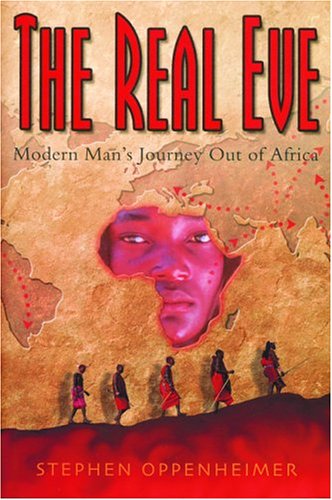
Review: "The Real Eve: Modern Man's Journey Out of Africa" By Stephen Oppenheimer
Dr. Stephen Oppenheimer's The Real Eve: Modern Man's Journey Out of Africa (2003) is absolutely one of the very best non-fiction books I've read in a few years! And I say this on several levels too. First, if you are at all interested in your own human origins, and what makes us human, you'll love this book. Second, if you're interested in paleoanthropology, and are interested in what happened after anatomically modern humans (i.e., Homo sapiens) appeared in Africa somewhere around 200,000 years ago and when did we actually become 'behaviorally modern' too, you'll love this book. Finally, if you're at all interested in how anatomically and behaviorally modern humans then spread out in the great diaspora about 80,000 years ago known as the "Out-of-Africa" dispersal, you'll love this book.
Much of this book is an incredibly compelling melding of the existing paleoanthropological, archaeological, and genetic evidence that, when combined with known ecological and climatological data, tells the story of these robust early modern humans that undertook this grand journey that completely changed the world we live in. Oppenheimer carefully presents and considers all of the available archaeological evidence and the conclusions drawn from it, and then compares it with the results of the now extensive amount of genetic research associated with maternal mitochondrial-DNA and male Y-chromosome analyses. Oppenheimer believes that we now have answers or, at a minimum, some pretty compelling hypotheses that go far in addressing questions about who these peoples were that trekked along the coasts colonizing the Near East, eastern and western Europe, India, southeast Asia and eventually even New Guinea, and Australia; while others continued 'coasting' up along the Asian-Pacific coast before turning inland and settling the hinterlands of the ice-age steppe tundra of Siberia and Mongolia. Finally, Oppenheimer addresses one of the most contentious issues in modern archaeology--that of the settling of the Americas. When did modern humans reach the Americas? Who were these early colonizers? Where did they come from? Did they come in a single wave following the end of the last ice-age, or were there multiple entries? And were the Clovis peoples really the first to arrive about 12,000 years ago?
The organization of this book in its seven chapters is simply superb too, in my opinion. Dr. Oppenheimer starts off with the fascinating discussion of our early modern human ancestors in Africa, and what it was that might have compelled them to leave Africa between 80,000 and 90,000 years ago. He then spends time describing the archaeological evidence associated with the potential routes of initial dispersal from Africa (i.e., a northern route through the Levant, or the southern route--the preferred alternative--via the Bab al Mandab at the bottom of the Red Sea and the Horn of Africa).
The second chapter is equally fascinating, and addresses the all-important question of when did anatomically modern humans become 'behaviorally modern'. This has been a vexing question to paleoanthropologists and archaeologists for some time now, and there is a considerable body of evidence out there that can be interpreted quite differently. Frankly though, I'm leaning toward agreement with Dr. Oppenheimer that the appearance of anatomically modern humans between 200,000 years and 170,000 years ago was largely concurrent with the appearance of our behavioral modernity as well. In contrast, there are many well-respected anthropologists, e.g., Richard G. Klein of Stanford University, who believe that Homo sapiens became behaviorally modern sometime around 50,000 years ago, the result of additional adaptations within the human brain. Oppenheimer and other geneticists have not yet ferreted out what this change might have been, nor does he believe that the archaeological evidence supports this theory. All in all, I found this a very thought-provoking chapter.
The remainder of the book's chapters (i.e., 3-7) focus on detailed archaeological and genetic discussions of the timing of the entries into the various regions of the world colonized by the mitochondrial 'Out-of-Africa Eve' and Y-chromosomal 'Out-of-Africa Adam' and their genetic descendants. Chapter Three describes the types of people and timing of the colonizing of eastern and western Europe. Chapter Four focuses on the colonization of India, southeast Asia and leading to humans reaching New Guinea and Australia by about 60,000 years ago (implication being you'd certainly have to have been 'behaviorally modern' to fabricate a craft that was capable of 'island-hopping' and crossing many tens of kilometers of open ocean to reach Australia!). Chapter Five looks at the types of peoples and the timing of the settling of the great interior regions of ice-age Asia and eastern Russia. Chapter Six tells the story of the impact of the last ice-age in the late-Pleistocene (i.e., the Last Glacial Maximum), that wreaked havoc on the small populations of humans scattered throughout Europe and Asia. The last chapter of the book is Oppenheimer's take on the peopling of the Americas. He's of the opinion--based upon archaeology and genetics--that the first 'Americans' arrived between 25,000 years and 22,000 years ago, and that this was followed by a re-expansion of peoples that had occupied Beringia (the huge continent that existed between 25,000-11,000 years ago and linked Asian Siberia with North American Alaska during the run up and through the Last Glacial Maximum).
'So,' you ask, 'having read this fascinating book, what's the upshot?' Well, first, I can categorically answer that we are all African! Second, I think the genetic evidence and its most parsimonious interpretations tend to validate and enhance the current "Out-of-Africa" hypothesis for the dispersal of Homo sapiens from eastern Africa around 80,000 years ago. Third, after reading this book you'll never look at another human being quite the same. You'll always be thinking about our remarkable kinship, yet more fully understanding the meaning of the differences that exist among the peoples of our world today. I think it is also important to point out that Dr. Oppenheimer has also very carefully sourced and documented the material he presents in the book with over 50 pages of end-notes. I strongly recommend reading each of the end-notes too, it made for an even more complete reading experience for me.
Dr. Oppenheimer's The Real Eve: Modern Man's Journey Out of Africa is a grand synthesis of a grand story--our own human origins and subsequent dispersal around the globe. This book is really the incredible story of how a very small group (1,000-2,000 individuals) from a total population of the approximately 20,000 Homo sapiens that occupied Africa about 80,000 years ago actually got up the gumption to strike out and explore and colonize the rest of the world over the next 40,000 years or so. Finally, don't be intimidated by the subject matter, Dr. Oppenheimer is an engaging writer and spends the time and effort to present the material in such a fashion as to be understandable by any reader. It includes loads of terrific maps and detailed charts illustrating and supporting the genetic evidence and conclusions presented in the book.
In closing, I do want to say that I consider myself more than just a casual student of topics in paleoanthropology and human origins and evolution. Over my entire adult life I have made a point of staying current with the latest information, via books and technical journal articles, on this intellectually challenging subject, and I can unhesitatingly say that I believe that this is one of the most important books that I've read associated with modern human origins. This was such a good book that I've gone ahead and found a hardcover edition for my paleoanthropology book collection, as I know that I will be diving into this book time and again in the future. I highly recommend this book, and feel entirely justified in giving this 'five stars'.
The Real Eve: Modern Man's Journey Out of Africa
By Stephen Oppenheimer
Softcover, 440 pp.
Carroll & Graf Publishing, 2004
ISBN 0-7867-1334-8
***
Much of this book is an incredibly compelling melding of the existing paleoanthropological, archaeological, and genetic evidence that, when combined with known ecological and climatological data, tells the story of these robust early modern humans that undertook this grand journey that completely changed the world we live in. Oppenheimer carefully presents and considers all of the available archaeological evidence and the conclusions drawn from it, and then compares it with the results of the now extensive amount of genetic research associated with maternal mitochondrial-DNA and male Y-chromosome analyses. Oppenheimer believes that we now have answers or, at a minimum, some pretty compelling hypotheses that go far in addressing questions about who these peoples were that trekked along the coasts colonizing the Near East, eastern and western Europe, India, southeast Asia and eventually even New Guinea, and Australia; while others continued 'coasting' up along the Asian-Pacific coast before turning inland and settling the hinterlands of the ice-age steppe tundra of Siberia and Mongolia. Finally, Oppenheimer addresses one of the most contentious issues in modern archaeology--that of the settling of the Americas. When did modern humans reach the Americas? Who were these early colonizers? Where did they come from? Did they come in a single wave following the end of the last ice-age, or were there multiple entries? And were the Clovis peoples really the first to arrive about 12,000 years ago?
The organization of this book in its seven chapters is simply superb too, in my opinion. Dr. Oppenheimer starts off with the fascinating discussion of our early modern human ancestors in Africa, and what it was that might have compelled them to leave Africa between 80,000 and 90,000 years ago. He then spends time describing the archaeological evidence associated with the potential routes of initial dispersal from Africa (i.e., a northern route through the Levant, or the southern route--the preferred alternative--via the Bab al Mandab at the bottom of the Red Sea and the Horn of Africa).
The second chapter is equally fascinating, and addresses the all-important question of when did anatomically modern humans become 'behaviorally modern'. This has been a vexing question to paleoanthropologists and archaeologists for some time now, and there is a considerable body of evidence out there that can be interpreted quite differently. Frankly though, I'm leaning toward agreement with Dr. Oppenheimer that the appearance of anatomically modern humans between 200,000 years and 170,000 years ago was largely concurrent with the appearance of our behavioral modernity as well. In contrast, there are many well-respected anthropologists, e.g., Richard G. Klein of Stanford University, who believe that Homo sapiens became behaviorally modern sometime around 50,000 years ago, the result of additional adaptations within the human brain. Oppenheimer and other geneticists have not yet ferreted out what this change might have been, nor does he believe that the archaeological evidence supports this theory. All in all, I found this a very thought-provoking chapter.
The remainder of the book's chapters (i.e., 3-7) focus on detailed archaeological and genetic discussions of the timing of the entries into the various regions of the world colonized by the mitochondrial 'Out-of-Africa Eve' and Y-chromosomal 'Out-of-Africa Adam' and their genetic descendants. Chapter Three describes the types of people and timing of the colonizing of eastern and western Europe. Chapter Four focuses on the colonization of India, southeast Asia and leading to humans reaching New Guinea and Australia by about 60,000 years ago (implication being you'd certainly have to have been 'behaviorally modern' to fabricate a craft that was capable of 'island-hopping' and crossing many tens of kilometers of open ocean to reach Australia!). Chapter Five looks at the types of peoples and the timing of the settling of the great interior regions of ice-age Asia and eastern Russia. Chapter Six tells the story of the impact of the last ice-age in the late-Pleistocene (i.e., the Last Glacial Maximum), that wreaked havoc on the small populations of humans scattered throughout Europe and Asia. The last chapter of the book is Oppenheimer's take on the peopling of the Americas. He's of the opinion--based upon archaeology and genetics--that the first 'Americans' arrived between 25,000 years and 22,000 years ago, and that this was followed by a re-expansion of peoples that had occupied Beringia (the huge continent that existed between 25,000-11,000 years ago and linked Asian Siberia with North American Alaska during the run up and through the Last Glacial Maximum).
'So,' you ask, 'having read this fascinating book, what's the upshot?' Well, first, I can categorically answer that we are all African! Second, I think the genetic evidence and its most parsimonious interpretations tend to validate and enhance the current "Out-of-Africa" hypothesis for the dispersal of Homo sapiens from eastern Africa around 80,000 years ago. Third, after reading this book you'll never look at another human being quite the same. You'll always be thinking about our remarkable kinship, yet more fully understanding the meaning of the differences that exist among the peoples of our world today. I think it is also important to point out that Dr. Oppenheimer has also very carefully sourced and documented the material he presents in the book with over 50 pages of end-notes. I strongly recommend reading each of the end-notes too, it made for an even more complete reading experience for me.
Dr. Oppenheimer's The Real Eve: Modern Man's Journey Out of Africa is a grand synthesis of a grand story--our own human origins and subsequent dispersal around the globe. This book is really the incredible story of how a very small group (1,000-2,000 individuals) from a total population of the approximately 20,000 Homo sapiens that occupied Africa about 80,000 years ago actually got up the gumption to strike out and explore and colonize the rest of the world over the next 40,000 years or so. Finally, don't be intimidated by the subject matter, Dr. Oppenheimer is an engaging writer and spends the time and effort to present the material in such a fashion as to be understandable by any reader. It includes loads of terrific maps and detailed charts illustrating and supporting the genetic evidence and conclusions presented in the book.
In closing, I do want to say that I consider myself more than just a casual student of topics in paleoanthropology and human origins and evolution. Over my entire adult life I have made a point of staying current with the latest information, via books and technical journal articles, on this intellectually challenging subject, and I can unhesitatingly say that I believe that this is one of the most important books that I've read associated with modern human origins. This was such a good book that I've gone ahead and found a hardcover edition for my paleoanthropology book collection, as I know that I will be diving into this book time and again in the future. I highly recommend this book, and feel entirely justified in giving this 'five stars'.
The Real Eve: Modern Man's Journey Out of Africa
By Stephen Oppenheimer
Softcover, 440 pp.
Carroll & Graf Publishing, 2004
ISBN 0-7867-1334-8
***
March 4, 2013
Review: "The First Human: The Race to Discover Our Earliest Ancestor" By Ann Gibbons
Ann Gibbons has written a very solid and fascinating account of the relative recent discoveries of several of our earliest human ancestors. Gibbons is a well known science writer and brings significant journalistic integrity to her story-telling, as well as significant knowledge of her subject matter. The First Human: The Race to Discover Our Earliest Ancestors (2006) is the story of the paleoanthropologists behind the incredibly important discoveries of hominin species that are currently some of the oldest yet found, and span a range of ages from 5.0 million years old to perhaps as much as 7.0 million years old.
Gibbons, in telling the story of these discoveries, necessarily focuses much of the book on the out-sized personalities (and, dare I say, egos) of the anthropologists leading the teams exploring various important fossil regions in Africa. The teams she primarily focuses on in the book include Tim White and his work in the Afar Depression of Ethiopia; Richard and Meave Leakey in the Lake Turkana region of Kenya; Martin Pickford and Brigitte Senut in the Tugen Hills of Kenya; and Michel Brunet and his team in the Djureb Desert of Chad. Each of these teams of highly professional specialists in their respective fields have significantly added to our general understanding and knowledge base associated with the very earliest hominin species found to date, including Australopithecus, Ardipithecus, and two newly identified species, Orrorin tugenensis and Sahelanthropus tchadensis.
Gibbons is quite even-handed in describing the tension and academic conflict that has arisen among some of these researchers associated with the interpretation and meaning of these important fossil discoveries and their role in understanding and explaining human evolution. Gibbons does a great job of not editorializing or letting her own emotions color the scenes she writes about, and simply factually recounts the stories of the fossil discoveries, the research science that followed, and the resultant back-and-forth academic squabbles that erupted as articles were published and discussed in various academic journals. As a serious amateur student of paleoanthropology and human evolution, I know that this is pretty much de rigueur, not only in anthropological circles, but among the scientific community as a whole. All in all, I think that a rigorous and scholarly debate is incredibly healthy and typically results in the advancement of scientific knowledge. Having said that though, and based upon my interpretation of what Gibbons presents in this book, it is my personal opinion that Martin Pickford--one of the co-discoverers of O. tugenensis--behaved simply deplorably in his much of his dealings with his peers in the academic community over many, many years.
If you're interested in reading about how scientists gear up and conduct scientific expeditions in some very inhospitable portions of the world in their on-going search for the proverbial "needle in the haystack", then I think you'll very much enjoy Ms. Gibbons, The First Human: The Race to Discover Our Earliest Ancestors. Additionally, if you're specifically interested in learning more about these new, and incredibly ancient, species that have been discovered (i.e., O. tugenensis and S. tchadensis you'll very much appreciate the detail and solid science that Ms. Gibbons provides in telling this fascinating story.
The First Human: The Race to Discover Our Earliest Ancestor
By Ann Gibbons
Softcover, 336 pp.
Anchor Books, 2006
ISBN 140007696X
***
Gibbons, in telling the story of these discoveries, necessarily focuses much of the book on the out-sized personalities (and, dare I say, egos) of the anthropologists leading the teams exploring various important fossil regions in Africa. The teams she primarily focuses on in the book include Tim White and his work in the Afar Depression of Ethiopia; Richard and Meave Leakey in the Lake Turkana region of Kenya; Martin Pickford and Brigitte Senut in the Tugen Hills of Kenya; and Michel Brunet and his team in the Djureb Desert of Chad. Each of these teams of highly professional specialists in their respective fields have significantly added to our general understanding and knowledge base associated with the very earliest hominin species found to date, including Australopithecus, Ardipithecus, and two newly identified species, Orrorin tugenensis and Sahelanthropus tchadensis.
Gibbons is quite even-handed in describing the tension and academic conflict that has arisen among some of these researchers associated with the interpretation and meaning of these important fossil discoveries and their role in understanding and explaining human evolution. Gibbons does a great job of not editorializing or letting her own emotions color the scenes she writes about, and simply factually recounts the stories of the fossil discoveries, the research science that followed, and the resultant back-and-forth academic squabbles that erupted as articles were published and discussed in various academic journals. As a serious amateur student of paleoanthropology and human evolution, I know that this is pretty much de rigueur, not only in anthropological circles, but among the scientific community as a whole. All in all, I think that a rigorous and scholarly debate is incredibly healthy and typically results in the advancement of scientific knowledge. Having said that though, and based upon my interpretation of what Gibbons presents in this book, it is my personal opinion that Martin Pickford--one of the co-discoverers of O. tugenensis--behaved simply deplorably in his much of his dealings with his peers in the academic community over many, many years.
If you're interested in reading about how scientists gear up and conduct scientific expeditions in some very inhospitable portions of the world in their on-going search for the proverbial "needle in the haystack", then I think you'll very much enjoy Ms. Gibbons, The First Human: The Race to Discover Our Earliest Ancestors. Additionally, if you're specifically interested in learning more about these new, and incredibly ancient, species that have been discovered (i.e., O. tugenensis and S. tchadensis you'll very much appreciate the detail and solid science that Ms. Gibbons provides in telling this fascinating story.
The First Human: The Race to Discover Our Earliest Ancestor
By Ann Gibbons
Softcover, 336 pp.
Anchor Books, 2006
ISBN 140007696X
***
Review: "The Neanderthal's Necklace: In Search of the First Thinkers" By Juan Luis Arsuaga (translated by Andy Katt)
Juan Luis Arsuaga's The Neanderthal's Necklace: In Search of the First Thinkers (2002) is an excellent and compelling addition to my collection of paleoanthropological books. Dr. Arsuaga is a Spanish anthropologist and has spent much of his career at the famous archaeological sites at the Sierra de Atapuerca. He and his team are known for discovering the largest collection of pre-Neandertal hominins--some 2,000 human fossils, comprising maybe as many as thirty-two individuals. According to Professor Arsuaga, all of these fossils are likely an ancestral species to both the Neandertals (Homo neanderthalensis) and anatomically modern humans (Homo sapiens), and are classified as either Homo heidelbergensis or Homo antecessor. This human species occupied the Iberian peninsula and other portions of western Europe for a very long period of time, from approximately 780,000 years before present to perhaps 130,000 years before present.
What Professor Arsuaga accomplishes in this book is to eloquently tell the history of the early human species that occupied western Europe, especially the Iberian peninsula from the Middle Paleolithic through the early Upper Paleolithic and the extinction of the Neandertals. What I particularly appreciated was Dr. Arsuaga's melding of the data associated with regional climatic and ecological conditions in telling the story of these early hominin species who occupied these habitats so many millenia in our past in Spain during those fluctuating periods of extreme world-wide glaciation and interglacials. Over the years that I have been reading books and technical papers about human origins, I have come to better understand and appreciate that data and information associated with the effects of global and regional climate change and regional ecological conditions are every bit as important as the fossil and genetic evidence.
Personally, I think Professor Arsuaga's book, The Neanderthal's Necklace: In Search of the First Thinkers, is an important book and goes far in helping fill in the details about our human origins between what we currently know about the dispersal of Homo erectus from Africa between approximately 1.5-1.2 million years ago, and the arrival of fully-functioning anatomically modern humans (Homo sapiens) in western Europe about 45,000 years ago. I also strongly suggest that Professor Arsuaga's book makes an excellent companion to Clive Finlayson's relatively recent (2010) book entitled, The Humans Who Went Extinct: Why Neanderthals Died Out and We Survived. In reading both of these books, the reader will come away with a clear understanding of the role of the early hominin species in western Europe and the role that climate change and ecological conditions played in ultimately reaching the point that only one human species--Homo sapiens--remained on the planet.
The Neanderthal's Necklace: In Search of the First Thinkers
By Juan Luis Arsuaga, translated by Andy Katt
Hardcover, 320 pp.
Basic Books, 2002
ISBN 1568581874
***
What Professor Arsuaga accomplishes in this book is to eloquently tell the history of the early human species that occupied western Europe, especially the Iberian peninsula from the Middle Paleolithic through the early Upper Paleolithic and the extinction of the Neandertals. What I particularly appreciated was Dr. Arsuaga's melding of the data associated with regional climatic and ecological conditions in telling the story of these early hominin species who occupied these habitats so many millenia in our past in Spain during those fluctuating periods of extreme world-wide glaciation and interglacials. Over the years that I have been reading books and technical papers about human origins, I have come to better understand and appreciate that data and information associated with the effects of global and regional climate change and regional ecological conditions are every bit as important as the fossil and genetic evidence.
Personally, I think Professor Arsuaga's book, The Neanderthal's Necklace: In Search of the First Thinkers, is an important book and goes far in helping fill in the details about our human origins between what we currently know about the dispersal of Homo erectus from Africa between approximately 1.5-1.2 million years ago, and the arrival of fully-functioning anatomically modern humans (Homo sapiens) in western Europe about 45,000 years ago. I also strongly suggest that Professor Arsuaga's book makes an excellent companion to Clive Finlayson's relatively recent (2010) book entitled, The Humans Who Went Extinct: Why Neanderthals Died Out and We Survived. In reading both of these books, the reader will come away with a clear understanding of the role of the early hominin species in western Europe and the role that climate change and ecological conditions played in ultimately reaching the point that only one human species--Homo sapiens--remained on the planet.
The Neanderthal's Necklace: In Search of the First Thinkers
By Juan Luis Arsuaga, translated by Andy Katt
Hardcover, 320 pp.
Basic Books, 2002
ISBN 1568581874
***
September 17, 2012
Battle of Antietam--September 17, 1862--150th Anniversary
![]() |
| Battle of Antietam, by Thure de Thulstrup, 1887 |
![]() |
| Dunkard Church |
After the Federal attacks in the northern sector of the field were repulsed, the fighting in this area became quiescent by mid-morning. True to character, McClellan then began feeding troops from two more Federal corps into the battle in the center portion of the field immediately east of the town of Sharpsburg. Again, the fighting was intense and brutal as Lee shuffled his troops to meet the new threats, and two farm roads along which much of the fighting occurred are now well known features of the battlefield--The Bloody Lane and The Sunken Road. Repeated Federal charges and Confederate repulses resulted in the dead and dying being stacked like cord-wood along these two roads. By mid-afternoon, the two more Federal corps were largely thrashed and the fighting slowly died down along the center.
![]() |
| Burnside's Bridge, by Edwin Forbes, 1862 |
Once the bridge was taken and successfully crossed, much of the IX Corps then poured across Antietam Creek and began advancing through the fields southeast of Sharpsburg towards Lee's main lines. It was at just this moment though that a division of Lee's army, under A.P. Hill, that had been tasked with capturing the Federal garrison at Harper's Ferry reached the field after a hard 17-mile forced march. Hill's men struck Burnside's left flank and threw most of them back almost to Antietam Creek. For all intents and purposes, the Battle of Antietam was over and combat across the field slowly died down.
Over the course of the day of battle, the Federals suffered 12,400 casualties, including 2,108 killed. The Confederate army suffered a total of 10,318 casualties, including 1,546 killed. McClellan lost about 25% of his total force during the battle, and Lee sustained losses approximating 31% of his total force. Bluntly put, more Americans died on this day (a total of 3,654 killed), 150 years ago, than on any other day in our country's military history. In fact, a soldier in the 9th New York, part of Burnside's IX Corps, wrote after the battle that--
The mental strain was so great that I saw at that moment the singular effect mentioned, I think, in the life of Goethe on a similar occasion--the whole landscape for an instant turned slightly red.Finally, I think it is important to point out that for much of the day Lee's army's entire position had been in dire straits, and had McClellan thrown his entire army forward in one concerted effort it is hard to imagine any other outcome other than the complete defeat of the rebel army. It didn't happen though, because all along McClellan just couldn't convince himself that he wasn't horribly outnumbered by Lee's army, and that his own army was near complete disaster itself. While McClellan was a good organizer of the Union army, he was essentially incapable of actually using the army to fight. McClellan was imbued with what Lincoln called "the slows". In fact, for several days after the battle McClellan, and his army, remained on the field near Sharpsburg, and had let Lee safely disengage his army and slip away back across the Potomac River unimpeded and into Virginia. President Lincoln was not impressed, to say the least, and finally relieved McClellan of his command of the Army of the Potomac on November 7, 1862.
If you are interested in reading more about the Battle of Antietam, I would offer the following suggestions--
The Gleam of Bayonets: The Battle of Antietam and Robert E. Lee's Maryland Campaign, September 1862
By James V. Murfin
Softcover, 472 pages
Louisiana State University Press, 1965 (reprinted 2004)
Landscape Turned Red: The Battle of Antietam
By Stephen W. Sears
Softcover, 464 pages
Mariner Books, 1985
The Maps of Antietam: An Atlas of the Antietam (Sharpsburg) Campaign, Including the Battle of South Mountain, September 2-20, 1862
By Bradley Gottfried
Hardcover, 326 pages
Savas Beatie, 2011
***
September 6, 2012
Review: "The Grand Design: Strategy and the U.S. Civil War" By Donald Stoker
As you can tell from my recent postings, I have immersed myself in reading and reviewing some really excellent books about the American Civil War. Being a history buff, especially an American history buff, I have always had an abiding passion for the political and military events associated with this momentous period in our republic's history. I often wonder if most people really realize just how close "the great American experiment" came to becoming a complete and abject failure? Reading books about the Civil War continues to remind me just how precious and fragile our great democracy really is, and that it has always taken great sacrifice and dedication to carefully protect and nurture it, and that remains so even today.
I also have a very personal connection to the American Civil War as my great-great grandfather served as a member of the 21st Massachusetts Volunteer infantry regiment. He started as a private and ultimately rose to the rank of 1st Lieutenant before being mustered out near the end of the war in 1865. The regiment was formed in Woburn, Massachusetts, and fought in Burnside's North Carolina coastal campaign (1862) and then many of the campaigns of the Union Army of the Potomac, including the Battle of Second Bull Run, Antietam, Fredericksburg, and Grant's Overland Campaign of 1864. My ancestor was actually badly wounded (shot through both legs) at the Battle of Antietam on September 17, 1862 at the fighting around Burnside's Bridge at the southern end of the battlefield.
With both my personal connection and my historical interest in the Civil War, I very much looked forward to reading Donald Stoker's relatively recent book, The Grand Design: Strategy and the U.S. Civil War in an effort to better understand how the rebellion was actually put down by the Union, and why the South wasn't able to reach its goal of independence. It is worth mentioning that Stoker is well-qualified to write about this subject as he is a Professor of Strategy and Policy for the U.S. Naval War College's program at the Naval Postgraduate School in Monterey, California. This well-written book guides the reader through the prosecution of the Civil War from secession through the surrender of the final Confederate armies in the field in May and June 1865.
I consider myself to be fairly knowledgeable about most of the major political and military battles fought during the war, as well as with all of the various personalities on both the Confederate and Union sides, but I can't say that I was all that familiar with the national and regional realities that shaped the development and implementation of the over-arching strategies used to prosecute the war. This book does a superb job of setting the stage and then walking the reader through the development of the national policies and decisions that led to the fashioning of national and regional operational strategies by the civilian political leaders and military high commands. There was a steep learning curve for leaders--political and military--on both sides during the first year or so of the war. Lincoln was perhaps more adept at drawing the bright line ensuring that military commanders didn't dabble in the political arena, but he was almost as guilty as Jefferson Davis when it came to meddling with day-to-day military matters. Many of the army commanders and their subordinates, on both sides, were graduates of the U.S. Army Military Academy at West Point, and many had years of field experience serving in the U.S. Army, including during the Mexican War (1846-1848). While many of the military commanders had solid resumes when it came to tactically leading troops into battle, most were not able to effectively develop and implement a larger-scale strategic vision. It would take a couple of years of hard fighting to weed out the more incompetent commanders and begin to identify those with strategic vision and that also shared the same strategic goals and objectives as their respective civilian authorities.
I think that there were two critically important themes that ran through this book that made all of the sense in the world to me once I stopped and considered them, including: (1) In order to develop an effective national strategy for winning the war, and then developing effective operational or theater strategies, it first required the identification of specific "centers-of-gravity"; and (2) meaningfully addressing the logistical issues associated with the movement and sustaining of large armies in the field became vitally important. The centers-of-gravity concept was an important one for me--as well as the generals and political leaders--to fully grasp and understand. For example, some of the primary Union centers-of-gravity, in the context of militarily suppressing the rebellion included the following:
Clearly, Federal manufacturing, transportation infrastructure, ability to raise and sustain armies and replace those killed or wounded far out-stripped that of the Confederacy. If the Confederate States were going to achieve victory it really had to have occurred early in the war, and needed to occur decisively. Once the Union implemented the naval blockade, exerted diplomatic pressure on other countries not to interfere, and then brought the full weight of the Federal war-making machine down upon the South it really just became a matter of time. Stoker's book brought home the point that the war may well have gone on even longer had not Lincoln finally found and entrusted prosecution of the war to generals like Ulysses S. Grant, William T. Sherman, George H. Thomas, and Philip Sheridan, and like-minded others. These military commanders understood that victory meant the absolute and utter destruction of not only the enemy's armies, but the will of the citizens to continue the fight. This was the "Total War" developed and so effectively implemented by Grant at Vicksburg, and then greatly expanded upon by Sherman as he marched across Georgia to the coast and then northward through the Carolinas. From mid-1864 to early-1865, Sherman and his armies literally ripped the guts out of the Confederacy whilst Grant pinned and pummeled Lee's Army of Northern Virginia outside of the gates of Richmond and during the siege of Petersburg. Logistics was the determinative factor in bringing to bear and sustaining Union power in its strategic contest with the Confederate armies and civilian populations.
Professor Stoker's book does a great job of describing all of the key decision-making that led to the battlefield victories or defeats, and how the civilian and military leadership, on both sides, was able to adapt, or not, to changing circumstances as they developed national and/or operational strategies. The political and military conduct of the war is largely arranged chronologically in the book, and at the end of each chapter he provides an interesting summation and analysis of what worked, or didn't, and why. Additionally, at the end of the book, the last chapter essentially provides a "report card" and grades the political and military leadership of both the Union and Confederacy, and it makes for great reading and pondering. There are several large-scale maps scattered throughout the book, and I think if I had one reasonable criticism it would be that I would have liked a few more maps at the regional or theater scale that might have helped to better support and understand some of the issues associated with the geographical or logistical issues for both sides.
Finally, I think this is actually an important book that will appeal not only to readers interested in American history and military history, but that it really should be required reading among senior non-commissioned officers and officers in the military, as well as our national civilian political leadership. This would seem to be particularly pertinent as the United States enters its eleventh year of counter-insurgency operations in Afghanistan and other regions around the world. Understanding the concept of centers-of-gravity and the development and design of appropriate strategies would seem to be a pretty important element in successfully prosecuting a war through to its conclusion.
***
The Grand Design: Strategy and the U.S. Civil War
By Donald Stoker
Hardcover, 512 pages
Oxford University Press, USA, 2010
I also have a very personal connection to the American Civil War as my great-great grandfather served as a member of the 21st Massachusetts Volunteer infantry regiment. He started as a private and ultimately rose to the rank of 1st Lieutenant before being mustered out near the end of the war in 1865. The regiment was formed in Woburn, Massachusetts, and fought in Burnside's North Carolina coastal campaign (1862) and then many of the campaigns of the Union Army of the Potomac, including the Battle of Second Bull Run, Antietam, Fredericksburg, and Grant's Overland Campaign of 1864. My ancestor was actually badly wounded (shot through both legs) at the Battle of Antietam on September 17, 1862 at the fighting around Burnside's Bridge at the southern end of the battlefield.
With both my personal connection and my historical interest in the Civil War, I very much looked forward to reading Donald Stoker's relatively recent book, The Grand Design: Strategy and the U.S. Civil War in an effort to better understand how the rebellion was actually put down by the Union, and why the South wasn't able to reach its goal of independence. It is worth mentioning that Stoker is well-qualified to write about this subject as he is a Professor of Strategy and Policy for the U.S. Naval War College's program at the Naval Postgraduate School in Monterey, California. This well-written book guides the reader through the prosecution of the Civil War from secession through the surrender of the final Confederate armies in the field in May and June 1865.
I consider myself to be fairly knowledgeable about most of the major political and military battles fought during the war, as well as with all of the various personalities on both the Confederate and Union sides, but I can't say that I was all that familiar with the national and regional realities that shaped the development and implementation of the over-arching strategies used to prosecute the war. This book does a superb job of setting the stage and then walking the reader through the development of the national policies and decisions that led to the fashioning of national and regional operational strategies by the civilian political leaders and military high commands. There was a steep learning curve for leaders--political and military--on both sides during the first year or so of the war. Lincoln was perhaps more adept at drawing the bright line ensuring that military commanders didn't dabble in the political arena, but he was almost as guilty as Jefferson Davis when it came to meddling with day-to-day military matters. Many of the army commanders and their subordinates, on both sides, were graduates of the U.S. Army Military Academy at West Point, and many had years of field experience serving in the U.S. Army, including during the Mexican War (1846-1848). While many of the military commanders had solid resumes when it came to tactically leading troops into battle, most were not able to effectively develop and implement a larger-scale strategic vision. It would take a couple of years of hard fighting to weed out the more incompetent commanders and begin to identify those with strategic vision and that also shared the same strategic goals and objectives as their respective civilian authorities.
I think that there were two critically important themes that ran through this book that made all of the sense in the world to me once I stopped and considered them, including: (1) In order to develop an effective national strategy for winning the war, and then developing effective operational or theater strategies, it first required the identification of specific "centers-of-gravity"; and (2) meaningfully addressing the logistical issues associated with the movement and sustaining of large armies in the field became vitally important. The centers-of-gravity concept was an important one for me--as well as the generals and political leaders--to fully grasp and understand. For example, some of the primary Union centers-of-gravity, in the context of militarily suppressing the rebellion included the following:
- Implementing and maintaining an effective blockade along the Confederate coast line, which prevented the South from receiving supplies and exporting its cotton and other commodities;
- Controlling and/or destroying the Confederate rail-road infrastructure, which limited the ability of the rebel armies to transport men and material, and allowed the Union to use the rail system for its own military purposes;
- Control of the rivers (especially the Mississippi River) and water-ways in rebel-held territories, which allowed the Union to deny the rebels the use of the rivers while using them as transportation corridors itself;
- Maintaining the focus on the capture and/or destruction of rebel armies (especially the Army of Northern Virginia and the Army of Tennessee); and
- Occupation and restoration of Union control within the State of Tennessee which was the 'heart' of the Confederate west and largely ensured that Kentucky didn't go south too.
Clearly, Federal manufacturing, transportation infrastructure, ability to raise and sustain armies and replace those killed or wounded far out-stripped that of the Confederacy. If the Confederate States were going to achieve victory it really had to have occurred early in the war, and needed to occur decisively. Once the Union implemented the naval blockade, exerted diplomatic pressure on other countries not to interfere, and then brought the full weight of the Federal war-making machine down upon the South it really just became a matter of time. Stoker's book brought home the point that the war may well have gone on even longer had not Lincoln finally found and entrusted prosecution of the war to generals like Ulysses S. Grant, William T. Sherman, George H. Thomas, and Philip Sheridan, and like-minded others. These military commanders understood that victory meant the absolute and utter destruction of not only the enemy's armies, but the will of the citizens to continue the fight. This was the "Total War" developed and so effectively implemented by Grant at Vicksburg, and then greatly expanded upon by Sherman as he marched across Georgia to the coast and then northward through the Carolinas. From mid-1864 to early-1865, Sherman and his armies literally ripped the guts out of the Confederacy whilst Grant pinned and pummeled Lee's Army of Northern Virginia outside of the gates of Richmond and during the siege of Petersburg. Logistics was the determinative factor in bringing to bear and sustaining Union power in its strategic contest with the Confederate armies and civilian populations.
Professor Stoker's book does a great job of describing all of the key decision-making that led to the battlefield victories or defeats, and how the civilian and military leadership, on both sides, was able to adapt, or not, to changing circumstances as they developed national and/or operational strategies. The political and military conduct of the war is largely arranged chronologically in the book, and at the end of each chapter he provides an interesting summation and analysis of what worked, or didn't, and why. Additionally, at the end of the book, the last chapter essentially provides a "report card" and grades the political and military leadership of both the Union and Confederacy, and it makes for great reading and pondering. There are several large-scale maps scattered throughout the book, and I think if I had one reasonable criticism it would be that I would have liked a few more maps at the regional or theater scale that might have helped to better support and understand some of the issues associated with the geographical or logistical issues for both sides.
Finally, I think this is actually an important book that will appeal not only to readers interested in American history and military history, but that it really should be required reading among senior non-commissioned officers and officers in the military, as well as our national civilian political leadership. This would seem to be particularly pertinent as the United States enters its eleventh year of counter-insurgency operations in Afghanistan and other regions around the world. Understanding the concept of centers-of-gravity and the development and design of appropriate strategies would seem to be a pretty important element in successfully prosecuting a war through to its conclusion.
***
The Grand Design: Strategy and the U.S. Civil War
By Donald Stoker
Hardcover, 512 pages
Oxford University Press, USA, 2010
September 2, 2012
Review: "The Darkest Days of the War--The Battles of Iuka and Corinth" By Peter Cozzens
Peter Cozzens is rapidly becoming one of my favorite Civil War authors, and The Darkest Days of the War: The Battles of Iuka and Corinth is just one good example of why. This a well-written, fast-paced historical accounting of a campaign and two sharply fought battles in the extreme northeastern corner of Mississippi in early fall 1862. There may be other accounts of the battles of Iuka and Corinth out there in the many thousands of Civil War books that have been written, but I'm betting that this really is one of the best, if not the best. It is a relatively fast read at something over 300 pages. It contains some terrific illustrations and some truly superb maps.
Corinth was important from a strategic perspective to both the Union and Confederate forces, as it was a relatively important rail junction that accessed the Mississippi valley (to the south and west), Tennessee (to the north), and connected with Chattanooga and Atlanta (both to the east). The Union needed to control the Corinth region in order to facilitate planned future movements towards both Vicksburg and Chattanooga. The bottom line was that Corinth was, in a sense, a magnet that drew the opposing forces to it; and if the war was going to be effectively prosecuted in the western theater, Corinth had to figure prominently in the plan and be controlled by one side or the other.
It was interesting to me that in reading this book I learned a lot about the early or formative periods, if you will, of Union Generals Ulysses S. Grant and William S. Rosecrans. While Grant had largely kind of stumbled into a major victory at Shiloh in early-April 1862, he really wasn't all that helpful or supportive of Rosecrans during the Corinth campaign described in this book. For his part, Rosecrans exhibited traits during both of the battles at Iuka and Corinth that should have had the Union high command sit up and take notice (and not in a good way!). Rosecrans seemed to have not handled stress well at all during the actual fighting phase of the battles he was involved in, and would become almost bizarrely disconnected and even panic-stricken.
Grant, following his experiences at Shiloh, would learn and steadily improve his performance as both an operational strategist and as an on-scene battle commander. Unfortunately, Rosecrans really didn't shake his bad habits, and later as the commander of the Army of the Cumberland he was badly beaten at the bloody Battle of Chickamauga (mid-September 1863). Also, the professional relationship between Grant and Rosecrans soured following the Battle of Corinth, and the two men never could effectively work together from that point forward. After the Corinth campaign, Grant moved on and conducted the brilliant Vicksburg campaign, and largely made himself indispensable to the Union cause. Meanwhile, Rosecrans again got lucky and barely eked out a victory at the bloody Battle of Stones River (Murfreesboro) in Tennessee on January 1, 1863. By the late-fall of 1863, Rosecrans was out of a job, and Grant was well on his way to eventually becoming the General-in-Chief of all Union forces in early 1864.
Intriguingly, the same sort of questionable leadership situation was sorting itself out on the Confederate side at Corinth too. The two rebel commanders, Major Generals Earl Van Dorn, and Sterling Price were largely way over their heads in trying to conduct this campaign, and it was only through utter ineptitude, particular on the part of Van Dorn and several of his subordinate division commanders, that Rosecrans wasn't decisively defeated at both Iuka and Corinth. The really tragic part of this story, and Cozzens tells it well in this book, is that because of the blunders of the commanders on both sides, a lot of good and patriotic men in butternut and blue were killed or horribly maimed.
Peter Cozzens has written several books about the Civil War in the western theater, and while I still think his masterpiece This Terrible Sound: The Battle of Chickamauga is one of the best (reviewed here), this book about the battles at Iuka and Corinth is an excellent account about a somewhat forgotten, but still quite important campaign. Finally, I think by reading Cozzens' books about the Battles of Iuka, Corinth, Stones River, Chickamauga, and Chattanooga the reader can't help but begin to better understand the strategic importance of the western theater and the commanders, on both sides, that had to fight for and defend these regions. Cozzens, through his books, wants us to understand that there was much, much more to the Civil War than just the theater of operations around Washington, D.C. and Richmond, Virginia, and that thousands upon thousands of men "gave the last full measure of devotion" on far-flung western battlefields, large and small, like those at Iuka and Corinth.
***
The Darkest Days of the War: The Battles of Iuka and Corinth
By Peter Cozzens
Hardcover, 389 pages
University of North Carolina Press, 1997
Corinth was important from a strategic perspective to both the Union and Confederate forces, as it was a relatively important rail junction that accessed the Mississippi valley (to the south and west), Tennessee (to the north), and connected with Chattanooga and Atlanta (both to the east). The Union needed to control the Corinth region in order to facilitate planned future movements towards both Vicksburg and Chattanooga. The bottom line was that Corinth was, in a sense, a magnet that drew the opposing forces to it; and if the war was going to be effectively prosecuted in the western theater, Corinth had to figure prominently in the plan and be controlled by one side or the other.
It was interesting to me that in reading this book I learned a lot about the early or formative periods, if you will, of Union Generals Ulysses S. Grant and William S. Rosecrans. While Grant had largely kind of stumbled into a major victory at Shiloh in early-April 1862, he really wasn't all that helpful or supportive of Rosecrans during the Corinth campaign described in this book. For his part, Rosecrans exhibited traits during both of the battles at Iuka and Corinth that should have had the Union high command sit up and take notice (and not in a good way!). Rosecrans seemed to have not handled stress well at all during the actual fighting phase of the battles he was involved in, and would become almost bizarrely disconnected and even panic-stricken.
Grant, following his experiences at Shiloh, would learn and steadily improve his performance as both an operational strategist and as an on-scene battle commander. Unfortunately, Rosecrans really didn't shake his bad habits, and later as the commander of the Army of the Cumberland he was badly beaten at the bloody Battle of Chickamauga (mid-September 1863). Also, the professional relationship between Grant and Rosecrans soured following the Battle of Corinth, and the two men never could effectively work together from that point forward. After the Corinth campaign, Grant moved on and conducted the brilliant Vicksburg campaign, and largely made himself indispensable to the Union cause. Meanwhile, Rosecrans again got lucky and barely eked out a victory at the bloody Battle of Stones River (Murfreesboro) in Tennessee on January 1, 1863. By the late-fall of 1863, Rosecrans was out of a job, and Grant was well on his way to eventually becoming the General-in-Chief of all Union forces in early 1864.
Intriguingly, the same sort of questionable leadership situation was sorting itself out on the Confederate side at Corinth too. The two rebel commanders, Major Generals Earl Van Dorn, and Sterling Price were largely way over their heads in trying to conduct this campaign, and it was only through utter ineptitude, particular on the part of Van Dorn and several of his subordinate division commanders, that Rosecrans wasn't decisively defeated at both Iuka and Corinth. The really tragic part of this story, and Cozzens tells it well in this book, is that because of the blunders of the commanders on both sides, a lot of good and patriotic men in butternut and blue were killed or horribly maimed.
Peter Cozzens has written several books about the Civil War in the western theater, and while I still think his masterpiece This Terrible Sound: The Battle of Chickamauga is one of the best (reviewed here), this book about the battles at Iuka and Corinth is an excellent account about a somewhat forgotten, but still quite important campaign. Finally, I think by reading Cozzens' books about the Battles of Iuka, Corinth, Stones River, Chickamauga, and Chattanooga the reader can't help but begin to better understand the strategic importance of the western theater and the commanders, on both sides, that had to fight for and defend these regions. Cozzens, through his books, wants us to understand that there was much, much more to the Civil War than just the theater of operations around Washington, D.C. and Richmond, Virginia, and that thousands upon thousands of men "gave the last full measure of devotion" on far-flung western battlefields, large and small, like those at Iuka and Corinth.
***
The Darkest Days of the War: The Battles of Iuka and Corinth
By Peter Cozzens
Hardcover, 389 pages
University of North Carolina Press, 1997
August 31, 2012
Review: "Cold Harbor: Grant and Lee, May 26--June 3, 1864" By Gordon C. Rhea
Cold Harbor: Grant and Lee, May 26-June3, 1864 is the final volume in Gordon Rhea’s brilliant series of four books describing the “Overland Campaign” of U.S. Grant and the Union Army of the Potomac conducted against Robert E. Lee’s Confederate Army of Northern Virginia during the spring and summer of 1864. This book picks up with the two armies maneuvering from their stand at the North Anna River crossings, and Grant’s efforts to continue to sidle south around Lee’s right flank and interpose the Union army between Lee and Richmond. Rhea masterfully describes the movements of the two armies as they come together again at the important road junction of Cold Harbor just nine or ten miles from the Confederate capital of Richmond. Much of the book then focuses on the particularly vicious and bloody fighting that occurred on June 1st and June 3rd during the Battle of Cold Harbor. Unfortunately, for Grant and the Federal army this is the continuing story of missed opportunities during the Overland Campaign, and just like during the Battles of the Wilderness and Spotsylvania Court House, those missed opportunities translate into great loss of life on both sides and the extension of the war by several months, if not longer.
Observations and what I learned reading this book and from Rhea’s series—
The Federal cavalry arm of the Army of the Potomac was now the master of the battlefield in the eastern theater. They had grown up, learned their lessons, and were now ruthlessly efficient and thoroughly professional. The days of pell-mell charges and saber-slinging were over, the Federal cavalry with their repeating carbines and well-fed horses were now being utilized as mobile infantry that, when they met their foes on the field of battle, generally dismounted and fought behind defensive protection or earthworks. While Federal cavalry units were now largely decisively defeating their Confederate counterparts when they met in combat, the primary problem associated with the Federal cavalry during the Overland Campaign revolved around the on-going feud between Army commander George Gordon Meade and the cavalry commander, Major General Philip Sheridan. Consequently, Meade typically wouldn’t ask for assistance from Sheridan (or even the tactically correct assistance), and Sheridan wouldn’t respond even when he did. Inexplicably, Grant could have stepped in and dealt with Sheridan’s insubordination, but never did. Worse yet, in my humble opinion, Grant never did utilize this professional cavalry corps as he should have—i.e., to effectively scout out Lee’s intentions, or use them as a blocking force, or to effectively determine the disposition of Lee’s forces on each of the battlefields, or even to use the cavalry to recon proposed Federal army corps movement routes. Again, in my opinion, this was one of a number of significant short-comings associated with Grant’s overall leadership of the Federal forces during this campaign.
In the context of the Battle of Cold Harbor, had Grant and Meade more efficiently or effectively utilized Sheridan’s troopers, they probably could have ‘sniffed’ out the inherent weaknesses in the southern portion of Lee’s lines near Cold Harbor early on June 1st. Lee’s right flank was more than ripe for turning and Grant could have opened him up like a tin-can and moved the Confederate army (or a portion thereof) out of its impregnable earthworks, and probably easily gotten himself between Lee and Richmond. This very well could have been the proverbial “straw that broke the back” of Lee’s army, but we’ll never know because at the time Grant and Meade hadn’t the foggiest idea of Lee’s positions and strengths along much of his Cold Harbor lines. Additionally, the Federal corps commanders weren’t any better at actively collecting or assessing information and then closely cooperating and coordinating with one another, or even passing that information on to Grant and Meade in a timely fashion. Ultimately, and tragically, the Battle of Cold Harbor really was nothing much more than a bunch of individual set-piece affairs of frontal assaults by brave Federal troops against Lee’s entrenched lines, and the results were all too familiar—bloody repulses and significant casualties.
Some of my observations about Grant vs. Lee that I picked up reading this series—
It probably goes without saying that the two commanders of the Federal and Confederate armies in the Overland Campaign—Ulysses S. Grant and Robert E. Lee—were the very best combat leaders on either side, and were mostly pretty evenly matched in skills. Both had a profoundly accurate sense of the overarching strategies required for prosecuting the war from both the Federal and Confederate perspectives. Maybe the nod goes to Grant in the sense that he and President Lincoln not only had a good working relationship, but he and Lincoln shared a firm grasp on the national strategy that involved ensuring that there was a combined and coordinated push by all Federal forces in all theaters of the war. This is something that Confederate President Jefferson Davis just wasn’t able to grasp; or, if grasped, just wasn’t able to effectively implement it with the resources he had available. Even Lee, to a large degree, was fixated and focused only on the strategic situation and potential tactical opportunities in the immediate theater surrounding Richmond and Washington, D.C. During the course of the Overland Campaign it very well may be that Lee knew that it really was just a matter of time before the Army of Northern Virginia was pinned, by Grant, with its back against Richmond; and that the best that he could do was try and hurt Grant and the Federal army enough to force a political solution that could lead to the independence of the Confederate states (i.e., through the defeat of Lincoln in the 1864 election by an anti-war candidate).
A lot has been made over the past 150 years of the notion that Grant was a “butcher” and needlessly wasted the lives of his men in senseless headlong assaults against Lee’s entrenched army. At first blush, this seems like an accurate assessment as Grant’s Overland Campaign cost something like 55,000 Federals killed, wounded or captured over a 45-day period (or, approximately 45% of the total number of men in his army). The Battle of Cold Harbor is always held up as the prime example of “Grant the butcher”. Frankly, in my opinion, the facts simply don’t warrant this conclusion. For example, at the North Anna River Grant and his corps commanders had tactically won some minor engagements, but he soon realized that the entrenched Confederate position was virtually unassailable and would lead to great bloodshed, and no material gain, if he attacked. Consequently, during the night he deftly withdrew three Federal army corps back across to the north side of the North Anna River and smartly maneuvered the entire army east and south again in an effort to turn Lee’s flank and engage him in open country.
Staying with this theme then, if any one general during the American Civil War is deserving of the moniker of “butcher” it perhaps could be fairly stated that it was Lee himself. For example, Lee, over the three days at Gettysburg, lost more men in battle than any other general, north or south. Another pertinent example is that Lee, during that horrific one day at Antietam in 1862, lost more men than any other general did during a single day. Finally, Lee’s combined losses during the 45-day period of the Overland Campaign were more than 33,000, or greater than 50% of the total strength of his vaunted Army of Northern Virginia. Bluntly put, once Lee’s blood was up he worshiped at the ‘Altar of Carnage’ with the best of them.
It is true that Grant’s army suffered significant losses while assaulting the Bloody Angle in The Muleshoe at Spotsylvania Court House, or during the frontal assaults at Cold Harbor, but these attacks were directly stimulated by the efforts of the Federals to exploit existing or perceived weaknesses in Lee’s lines during the heat of battle. I submit that most battlefield commanders would have made similar assaults given the facts at hand—witness Lee’s assault on the Federal center at Gettysburg on the third day, as he was confident that the center had been significantly weakened based upon the hard fighting that had occurred during the first two days of the battle.
Much has also been made that to Grant, Meade, and even Lincoln to some degree, the Overland Campaign was nothing more than a battle of attrition, and was just a numbers game. While in hindsight this is certainly true, and that at the time the Federal high command probably recognized it too, it certainly didn’t mean that Federal commanders were callous or negligent in their use of the troops at their disposal during the Overland Campaign. At best, the summer of 1864 was dicey period politically within the Union, and if it seemed that the war had simply turned into a blood-fest with no end in sight, it was clear that the President would likely not be reelected, and Grant and Meade, and even the Army itself, understood this probability well. Additionally, the Army of the Potomac could ill afford to ‘throw away’ any troops as it was bleeding strength anyway as a good number of regiments’ three-year enlistments were expiring and the existing conscription efforts simply couldn’t make up for the losses. More importantly, the three years of hard fighting had sapped the Army of the Potomac of many of its combat-hardened veterans. The new troops coming into the Federal army just weren’t of the same caliber as those who had fought their way through The Seven Days, Antietam, Fredericksburg, Chancellorsville, Second Bull Run, and Gettysburg. Having said all of this though, it was clear to both Grant and Lee that it was certainly easier for the Federals to replace their losses than it was for the Confederates. After four hard years of a war that had evolved into—as Sherman put it—a “Total War”, the Confederate ability to come up with additional troops, replace material, and even provide for the civilian population was becoming more and more limited with each passing day. It really was just a matter of time now.
Finally, I think Rhea’s books highlight the other significant element of Grant’s strategic vision that was critical to the long-term success of the Federal forces against Lee and the Confederacy and that was his management of the logistical issues for the Army of the Potomac once it moved south of the Rapidan River and began its relentless struggle with Lee’s Army of Northern Virginia. Up to this point in time, all other Federal commanders had swooped south and fought Lee, and then shifted back (normally in defeat) across the river to rest and refit. Grant was determined to latch on to Lee and his army and not let go. Therefore, he needed to utilize the existing road and rail network in this part of Virginia to ensure that he could efficiently receive supplies, transmit and receive communications, and transport reinforcements and wounded to and fro. His ability to work with the U.S. Army Quartermaster Corps and the U.S. Navy ensured that he could cut himself off completely and just focus on the task at hand—running Lee and the Army of Northern Virginia to ground. Grant kept his eyes on the prize, and he ultimately won the game because of this single-minded focus.
In writing these four volumes about the Overland Campaign of 1864, Gordon Rhea has performed an extremely valuable service for all who are interested in American history and especially those interested in the military history of the American Civil War. While each of the books are important in the detailed description of the tactical movements and outcomes on each of the battlefields, perhaps the real strength of the series is Rhea’s ability to continually review and update the strategic issues and realities from both the Union and Confederate perspectives. These four well-written volumes document and support Rhea’s assertion that it was not just the story of a series of independent battles—the Battle of the Wilderness, the Battle of Spotsylvania Court House, the North Anna River, or the Battle of Cold Harbor—it was the assertion that Grant set out and entered upon a coordinated campaign with the overarching goal being the absolute and utter destruction of Lee’s army. The movements of the troops led to the battles, and the battles led to next series of movements and the next battle, and so on. The point being that these battles and movements were clearly inter-related and inter-dependent from start to finish, and I think that when you have completed reading all four books you’ll agree that by the time the two armies settled into the siege at Petersburg, Lee’s Army of Northern Virginia was largely finished as an effective combat force of any significant power.
In conclusion, I highly recommend the entire series that Gordon Rhea has written about Grant's Overland Campaign of 1864. I guarantee that you won't be disappointed, as these four books are a superbly well-written "you are right there" military history of a campaign and set of battles that hasn't really received all that much attention by scholars in the past. These books would be a valuable addition to the library of any Civil War history aficionado.
***
Cold Harbor: Grant and Lee, May 26--June 3, 1864
By Gordon C. Rhea
Hardcover, 552 pages
Louisiana State University Press, 2002
Observations and what I learned reading this book and from Rhea’s series—
The Federal cavalry arm of the Army of the Potomac was now the master of the battlefield in the eastern theater. They had grown up, learned their lessons, and were now ruthlessly efficient and thoroughly professional. The days of pell-mell charges and saber-slinging were over, the Federal cavalry with their repeating carbines and well-fed horses were now being utilized as mobile infantry that, when they met their foes on the field of battle, generally dismounted and fought behind defensive protection or earthworks. While Federal cavalry units were now largely decisively defeating their Confederate counterparts when they met in combat, the primary problem associated with the Federal cavalry during the Overland Campaign revolved around the on-going feud between Army commander George Gordon Meade and the cavalry commander, Major General Philip Sheridan. Consequently, Meade typically wouldn’t ask for assistance from Sheridan (or even the tactically correct assistance), and Sheridan wouldn’t respond even when he did. Inexplicably, Grant could have stepped in and dealt with Sheridan’s insubordination, but never did. Worse yet, in my humble opinion, Grant never did utilize this professional cavalry corps as he should have—i.e., to effectively scout out Lee’s intentions, or use them as a blocking force, or to effectively determine the disposition of Lee’s forces on each of the battlefields, or even to use the cavalry to recon proposed Federal army corps movement routes. Again, in my opinion, this was one of a number of significant short-comings associated with Grant’s overall leadership of the Federal forces during this campaign.
In the context of the Battle of Cold Harbor, had Grant and Meade more efficiently or effectively utilized Sheridan’s troopers, they probably could have ‘sniffed’ out the inherent weaknesses in the southern portion of Lee’s lines near Cold Harbor early on June 1st. Lee’s right flank was more than ripe for turning and Grant could have opened him up like a tin-can and moved the Confederate army (or a portion thereof) out of its impregnable earthworks, and probably easily gotten himself between Lee and Richmond. This very well could have been the proverbial “straw that broke the back” of Lee’s army, but we’ll never know because at the time Grant and Meade hadn’t the foggiest idea of Lee’s positions and strengths along much of his Cold Harbor lines. Additionally, the Federal corps commanders weren’t any better at actively collecting or assessing information and then closely cooperating and coordinating with one another, or even passing that information on to Grant and Meade in a timely fashion. Ultimately, and tragically, the Battle of Cold Harbor really was nothing much more than a bunch of individual set-piece affairs of frontal assaults by brave Federal troops against Lee’s entrenched lines, and the results were all too familiar—bloody repulses and significant casualties.
Some of my observations about Grant vs. Lee that I picked up reading this series—
It probably goes without saying that the two commanders of the Federal and Confederate armies in the Overland Campaign—Ulysses S. Grant and Robert E. Lee—were the very best combat leaders on either side, and were mostly pretty evenly matched in skills. Both had a profoundly accurate sense of the overarching strategies required for prosecuting the war from both the Federal and Confederate perspectives. Maybe the nod goes to Grant in the sense that he and President Lincoln not only had a good working relationship, but he and Lincoln shared a firm grasp on the national strategy that involved ensuring that there was a combined and coordinated push by all Federal forces in all theaters of the war. This is something that Confederate President Jefferson Davis just wasn’t able to grasp; or, if grasped, just wasn’t able to effectively implement it with the resources he had available. Even Lee, to a large degree, was fixated and focused only on the strategic situation and potential tactical opportunities in the immediate theater surrounding Richmond and Washington, D.C. During the course of the Overland Campaign it very well may be that Lee knew that it really was just a matter of time before the Army of Northern Virginia was pinned, by Grant, with its back against Richmond; and that the best that he could do was try and hurt Grant and the Federal army enough to force a political solution that could lead to the independence of the Confederate states (i.e., through the defeat of Lincoln in the 1864 election by an anti-war candidate).
A lot has been made over the past 150 years of the notion that Grant was a “butcher” and needlessly wasted the lives of his men in senseless headlong assaults against Lee’s entrenched army. At first blush, this seems like an accurate assessment as Grant’s Overland Campaign cost something like 55,000 Federals killed, wounded or captured over a 45-day period (or, approximately 45% of the total number of men in his army). The Battle of Cold Harbor is always held up as the prime example of “Grant the butcher”. Frankly, in my opinion, the facts simply don’t warrant this conclusion. For example, at the North Anna River Grant and his corps commanders had tactically won some minor engagements, but he soon realized that the entrenched Confederate position was virtually unassailable and would lead to great bloodshed, and no material gain, if he attacked. Consequently, during the night he deftly withdrew three Federal army corps back across to the north side of the North Anna River and smartly maneuvered the entire army east and south again in an effort to turn Lee’s flank and engage him in open country.
Staying with this theme then, if any one general during the American Civil War is deserving of the moniker of “butcher” it perhaps could be fairly stated that it was Lee himself. For example, Lee, over the three days at Gettysburg, lost more men in battle than any other general, north or south. Another pertinent example is that Lee, during that horrific one day at Antietam in 1862, lost more men than any other general did during a single day. Finally, Lee’s combined losses during the 45-day period of the Overland Campaign were more than 33,000, or greater than 50% of the total strength of his vaunted Army of Northern Virginia. Bluntly put, once Lee’s blood was up he worshiped at the ‘Altar of Carnage’ with the best of them.
It is true that Grant’s army suffered significant losses while assaulting the Bloody Angle in The Muleshoe at Spotsylvania Court House, or during the frontal assaults at Cold Harbor, but these attacks were directly stimulated by the efforts of the Federals to exploit existing or perceived weaknesses in Lee’s lines during the heat of battle. I submit that most battlefield commanders would have made similar assaults given the facts at hand—witness Lee’s assault on the Federal center at Gettysburg on the third day, as he was confident that the center had been significantly weakened based upon the hard fighting that had occurred during the first two days of the battle.
Much has also been made that to Grant, Meade, and even Lincoln to some degree, the Overland Campaign was nothing more than a battle of attrition, and was just a numbers game. While in hindsight this is certainly true, and that at the time the Federal high command probably recognized it too, it certainly didn’t mean that Federal commanders were callous or negligent in their use of the troops at their disposal during the Overland Campaign. At best, the summer of 1864 was dicey period politically within the Union, and if it seemed that the war had simply turned into a blood-fest with no end in sight, it was clear that the President would likely not be reelected, and Grant and Meade, and even the Army itself, understood this probability well. Additionally, the Army of the Potomac could ill afford to ‘throw away’ any troops as it was bleeding strength anyway as a good number of regiments’ three-year enlistments were expiring and the existing conscription efforts simply couldn’t make up for the losses. More importantly, the three years of hard fighting had sapped the Army of the Potomac of many of its combat-hardened veterans. The new troops coming into the Federal army just weren’t of the same caliber as those who had fought their way through The Seven Days, Antietam, Fredericksburg, Chancellorsville, Second Bull Run, and Gettysburg. Having said all of this though, it was clear to both Grant and Lee that it was certainly easier for the Federals to replace their losses than it was for the Confederates. After four hard years of a war that had evolved into—as Sherman put it—a “Total War”, the Confederate ability to come up with additional troops, replace material, and even provide for the civilian population was becoming more and more limited with each passing day. It really was just a matter of time now.
Finally, I think Rhea’s books highlight the other significant element of Grant’s strategic vision that was critical to the long-term success of the Federal forces against Lee and the Confederacy and that was his management of the logistical issues for the Army of the Potomac once it moved south of the Rapidan River and began its relentless struggle with Lee’s Army of Northern Virginia. Up to this point in time, all other Federal commanders had swooped south and fought Lee, and then shifted back (normally in defeat) across the river to rest and refit. Grant was determined to latch on to Lee and his army and not let go. Therefore, he needed to utilize the existing road and rail network in this part of Virginia to ensure that he could efficiently receive supplies, transmit and receive communications, and transport reinforcements and wounded to and fro. His ability to work with the U.S. Army Quartermaster Corps and the U.S. Navy ensured that he could cut himself off completely and just focus on the task at hand—running Lee and the Army of Northern Virginia to ground. Grant kept his eyes on the prize, and he ultimately won the game because of this single-minded focus.
In writing these four volumes about the Overland Campaign of 1864, Gordon Rhea has performed an extremely valuable service for all who are interested in American history and especially those interested in the military history of the American Civil War. While each of the books are important in the detailed description of the tactical movements and outcomes on each of the battlefields, perhaps the real strength of the series is Rhea’s ability to continually review and update the strategic issues and realities from both the Union and Confederate perspectives. These four well-written volumes document and support Rhea’s assertion that it was not just the story of a series of independent battles—the Battle of the Wilderness, the Battle of Spotsylvania Court House, the North Anna River, or the Battle of Cold Harbor—it was the assertion that Grant set out and entered upon a coordinated campaign with the overarching goal being the absolute and utter destruction of Lee’s army. The movements of the troops led to the battles, and the battles led to next series of movements and the next battle, and so on. The point being that these battles and movements were clearly inter-related and inter-dependent from start to finish, and I think that when you have completed reading all four books you’ll agree that by the time the two armies settled into the siege at Petersburg, Lee’s Army of Northern Virginia was largely finished as an effective combat force of any significant power.
In conclusion, I highly recommend the entire series that Gordon Rhea has written about Grant's Overland Campaign of 1864. I guarantee that you won't be disappointed, as these four books are a superbly well-written "you are right there" military history of a campaign and set of battles that hasn't really received all that much attention by scholars in the past. These books would be a valuable addition to the library of any Civil War history aficionado.
***
Cold Harbor: Grant and Lee, May 26--June 3, 1864
By Gordon C. Rhea
Hardcover, 552 pages
Louisiana State University Press, 2002
Review: "To the North Anna River: Grant and Lee, May 13-25, 1864" By Gordon C. Rhea
Like two dueling grandmasters, Lee and Grant sat down over the 'chess-board' of the northern Virginia landscape that separated Washington, D.C. from Richmond, Virginia. For the first two weeks of May 1864, the two generals have been adroitly maneuvering their armies across the terrain and engaging in some of the most sustained, ferocious and horrific combat seen in the Civil War. It is spring 1864, and the Northern population is wearying of the war, and Lincoln and his administration are up for reelection in November. While the South may not be able to prevail any longer militarily on the battlefield, it is hoped that Lee can buy time for a political solution by conducting a careful and defensive campaign against Grant's much larger Army of the Potomac.
Rhea's third volume in his "Overland Campaign" series, To the North Anna River: Grant and Lee, May 13-25, 1864 is an incredibly fascinating story about the little-known period of time between the dreadfully bloody Battle of Spotsylvania Courthouse (see my review of Rhea's The Battles for Spotsylvania Court House and the Road to Yellow Tavern, May 7-12, 1864 below) and the impending slaughter at the Battle of Cold Harbor. Following the bloodbath at Spotsylvania Court House, Grant gingerly disengages his army from his lines fronting Lee and deftly begins to sidle south and east around Lee's right flank.
Grant's short-term strategic goal is to turn Lee out of his earthworks at Spotsylvania Court House and hopefully engage him in battle on more open ground. In fact, Grant even sends Hancock's Second Corps trundling off southward as 'bait' in an effort to draw Lee out. Lee doesn't fall for Grant's trick though, and rapidly shunts his army 25 miles due south to the banks of the North Anna River and devises an ingenious system of defensive earthworks, and awaits the approaching federals with a trap of his own.
Close on the heels of Lee's army, Grant and the Army of the Potomac move up to the North Anna River, and thinking that the Confederates have continued to retreat toward Richmond, move across the North Anna at two separate crossings that are a couple of miles apart. This has the effect of splitting the large Union army into two pieces separated by Lee's entrenched rebel army. In essence, with his interior lines, Lee can now attack each wing of the federal army and defeat them in detail.
Fate and Chance always seem to have a way of intervening on the battlefield, and it is no different here. Lee becomes very ill with dysentery and as he is bedridden he is really quite unable to aggressively lead the rebel army in these complicated maneuvers, and his subordinate command structure is unable to fill the void. Simultaneously, Grant does come to realize the predicament he is in and immediately has his army entrench and protect itself. With the opportunity to 'check-mate' one another now passed by, Grant is realistically left with just two options: (1) attack Lee's virtually impregnable position on the North Anna; or (2) disengage and sidle east or west of Lee's position and try and maneuver Lee out of his works toward Richmond. He chooses the latter option and determines to sidle easterly, and the two grandmasters continue their game of maneuver and probing for defensive weaknesses. In just a few days the two commanders and their armies will meet again on the field of battle near the tiny hamlet and road junction of Cold Harbor just nine miles from Richmond.
I really can't say enough about the quality of Rhea's writing and his ability to bring history alive. Somehow his story-telling manages to impart a real feeling of 'you are there as an eyewitness' so very effectively. While the decisions of the command structures of the two armies are certainly important to Rhea's narrative in the book, I think it is Rhea's attention to the stories of the common foot-soldiers, artillerymen, and cavalrymen that makes this book--and the entire series--so darned poignant and engaging. These books illustrate and describe accounts of patriotism, courage and extraordinary feats of heroism--on both sides of this bloody conflict--that are such an important part of the overall saga of the history of our American republic.
***
To the North Anna River: Grant and Lee, May 13-25, 1864
By Gordon C. Rhea
Hardcover, 472 pages
Louisiana State University Press, 2000
Rhea's third volume in his "Overland Campaign" series, To the North Anna River: Grant and Lee, May 13-25, 1864 is an incredibly fascinating story about the little-known period of time between the dreadfully bloody Battle of Spotsylvania Courthouse (see my review of Rhea's The Battles for Spotsylvania Court House and the Road to Yellow Tavern, May 7-12, 1864 below) and the impending slaughter at the Battle of Cold Harbor. Following the bloodbath at Spotsylvania Court House, Grant gingerly disengages his army from his lines fronting Lee and deftly begins to sidle south and east around Lee's right flank.
Grant's short-term strategic goal is to turn Lee out of his earthworks at Spotsylvania Court House and hopefully engage him in battle on more open ground. In fact, Grant even sends Hancock's Second Corps trundling off southward as 'bait' in an effort to draw Lee out. Lee doesn't fall for Grant's trick though, and rapidly shunts his army 25 miles due south to the banks of the North Anna River and devises an ingenious system of defensive earthworks, and awaits the approaching federals with a trap of his own.
Close on the heels of Lee's army, Grant and the Army of the Potomac move up to the North Anna River, and thinking that the Confederates have continued to retreat toward Richmond, move across the North Anna at two separate crossings that are a couple of miles apart. This has the effect of splitting the large Union army into two pieces separated by Lee's entrenched rebel army. In essence, with his interior lines, Lee can now attack each wing of the federal army and defeat them in detail.
Fate and Chance always seem to have a way of intervening on the battlefield, and it is no different here. Lee becomes very ill with dysentery and as he is bedridden he is really quite unable to aggressively lead the rebel army in these complicated maneuvers, and his subordinate command structure is unable to fill the void. Simultaneously, Grant does come to realize the predicament he is in and immediately has his army entrench and protect itself. With the opportunity to 'check-mate' one another now passed by, Grant is realistically left with just two options: (1) attack Lee's virtually impregnable position on the North Anna; or (2) disengage and sidle east or west of Lee's position and try and maneuver Lee out of his works toward Richmond. He chooses the latter option and determines to sidle easterly, and the two grandmasters continue their game of maneuver and probing for defensive weaknesses. In just a few days the two commanders and their armies will meet again on the field of battle near the tiny hamlet and road junction of Cold Harbor just nine miles from Richmond.
I really can't say enough about the quality of Rhea's writing and his ability to bring history alive. Somehow his story-telling manages to impart a real feeling of 'you are there as an eyewitness' so very effectively. While the decisions of the command structures of the two armies are certainly important to Rhea's narrative in the book, I think it is Rhea's attention to the stories of the common foot-soldiers, artillerymen, and cavalrymen that makes this book--and the entire series--so darned poignant and engaging. These books illustrate and describe accounts of patriotism, courage and extraordinary feats of heroism--on both sides of this bloody conflict--that are such an important part of the overall saga of the history of our American republic.
***
To the North Anna River: Grant and Lee, May 13-25, 1864
By Gordon C. Rhea
Hardcover, 472 pages
Louisiana State University Press, 2000
Review: "The Battles for Spotsylvania Court House and the Road to Yellow Tavern" By Gordon C. Rhea
"Out of the frying pan, and into the fire"--Out of the butchery of The Wilderness, and into the horrific carnage of The Muleshoe and Bloody Angle of Spotsylvania--this is the second entry in Gordon Rhea's masterful series describing the Overland Campaign of Ulysses S. Grant and the Union Army of the Potomac against Robert E. Lee's Army of Northern Virgina in the spring and summer of 1864. Following the inconclusive horror of two days of bloody fighting in the tangled forests of The Wilderness, Grant has sidled the Union Army to the southeast, hoping to turn Lee's right flank and put his army between the Confederates and their capital in Richmond, Virginia. Unfortunately, for the federals and Grant, Lee's army beats him by a step to the tiny hamlet of Spotsylvania Court House, and there behind superbly constructed defensive works repels numerous assaults made by the larger Union Army of the Potomac over the next week.
It was with riveting horror that I read of each of the attacks made against the rebel fortifications in what became known as "The Muleshoe"--a large salient that jutted out from the center of Lee's lines. The Muleshoe was nearly a half-mile in length and nearly as wide and was ably defended by Lee's Second Army Corps, commanded by Lt. General Dick Ewell. By the end of May 12th, at the conclusion of major fighting on this section of the battlefield, nearly 18,000 men had been killed, wounded, or captured (8,000 rebel, and almost 10,000 federal). It was carnage on a scale not seen before in the Civil War, and that the bulk of the fighting took place in the defensive earthworks ringing and within The Muleshoe, it portended the gruesome butchery that was to come in the trenches of the First World War just fifty years later.
Rhea is an excellent story-teller, and tells of these horrifying days and events through the use of the personal accounts (e.g., letters and diaries) of the officers and men that participated in the fighting. It is my understanding that perhaps William D. Matter's If It Takes All Summer: The Battle of Spotsylvania is an even better account of the Spotsylvania Campaign--that may be so, as I've yet to read it--but Rhea's is a gripping "you are there" account that is a page-turner from the very first to the last. The thirty maps that are included within the text are incredibly detailed, from both a strategic and tactical perspective, and perfectly complement Rhea's masterful prose and battle descriptions.
By the time one has finished this excellent book, one cannot help but completely agree with the conclusion reached in Rhea's epilogue--
***
The Battles for Spotsylvania Court House and the Road to Yellow Tavern
By Gordon C. Rhea
Hardcover, 512 pages
Louisiana State University Press, 1997
It was with riveting horror that I read of each of the attacks made against the rebel fortifications in what became known as "The Muleshoe"--a large salient that jutted out from the center of Lee's lines. The Muleshoe was nearly a half-mile in length and nearly as wide and was ably defended by Lee's Second Army Corps, commanded by Lt. General Dick Ewell. By the end of May 12th, at the conclusion of major fighting on this section of the battlefield, nearly 18,000 men had been killed, wounded, or captured (8,000 rebel, and almost 10,000 federal). It was carnage on a scale not seen before in the Civil War, and that the bulk of the fighting took place in the defensive earthworks ringing and within The Muleshoe, it portended the gruesome butchery that was to come in the trenches of the First World War just fifty years later.
Rhea is an excellent story-teller, and tells of these horrifying days and events through the use of the personal accounts (e.g., letters and diaries) of the officers and men that participated in the fighting. It is my understanding that perhaps William D. Matter's If It Takes All Summer: The Battle of Spotsylvania is an even better account of the Spotsylvania Campaign--that may be so, as I've yet to read it--but Rhea's is a gripping "you are there" account that is a page-turner from the very first to the last. The thirty maps that are included within the text are incredibly detailed, from both a strategic and tactical perspective, and perfectly complement Rhea's masterful prose and battle descriptions.
By the time one has finished this excellent book, one cannot help but completely agree with the conclusion reached in Rhea's epilogue--
"The Confederates were technically correct in considering May 10 and 12 as victories. After all, they had foiled Grant's assaults on each occasion. But a few more such victories would leave Lee's army in shambles. Eight days of fighting Grant had gutted the Army of Northern Virginia's capacity to go on the offensive. For the future, Lee had little choice but to continue his defensive tactics, hoping to thwart Grant's thrusts and to buy time for a political solution to the war."If anything, I enjoyed this second volume in Rhea's four-volume series about the Overland Campaign of 1864 even more than the first, and now it is on to the third book, To the North Anna River: Grant and Lee, May 13-25, 1864.
***
The Battles for Spotsylvania Court House and the Road to Yellow Tavern
By Gordon C. Rhea
Hardcover, 512 pages
Louisiana State University Press, 1997
Review: "The Battle of the Wilderness, May 5-6, 1864" By Gordon C. Rhea
Like two titans, Ulysses S. Grant and Robert E. Lee locked armies and ferociously grappled with each other over two days in early-May 1864 in a dense forbidding patch of terrain and landscape in northern Virginia known as "The Wilderness". At the conclusion of these two days of some of the most severest fighting of the entire Civil War, the two armies had lost a combined total of nearly 29,000 men killed, wounded, or captured.
Gordon Rhea's account of Grant's first battle as the Union Army Commander-in-Chief, is a well-written and very thorough description of The Battle of the Wilderness. Grant was determined to maneuver the Union Army of the Potomac between Robert E. Lee's Army of Northern Virginia and the Confederate capitol in Richmond, and in The Wilderness he very nearly succeeded. He started three extremely powerful Union Army Corps eastward down the Orange Plank Road and the Orange Turnpike and ran headlong into two Confederate Corps commanded by A.P. Hill and Dick Ewell. Unfortunately for the Federals, as the fighting started the corps and brigade commanders just couldn't maintain effective coordination and communication as the assaults progressed, and the out-numbered Confederate corps were able to beat back most of the Federal attacks at great cost to both attacker and defender.
The woods were so dense and disorienting that the attacking troops couldn't see but just a few yards in any directions, and unit movements became fragmented and went off-track almost immediately. The firing of muskets and artillery actually started numerous forest fires, which flared up among the troops as they moved through the woods, or lay wounded on the forest floor. The fighting was pretty much a unconstrained brawl between the two armies and just raged back and forth and up and down the turnpike and plank roads. Finally, after two days, the major fighting slowly sputtered out and the two armies were largely back in their original starting positions and just scowling at each other.
Rhea assesses the result of two days of battle in The Wilderness as, at best, a tactical victory for Lee and the Confederates, but a strategic victory for Grant and the Federal army. The bottom-line was that Grant was not going to leave--not even after nearly 18,000 Federal casualties--but was going to latch onto Lee's army like a pitbull, and not let up up until the war was over. This attitude for prosecution of the war was a sea-change compared to all of the previous commanders of the Union Army of the Potomac. Grant, in The Wilderness, tried to exercise the use of power in attacking Lee's army, as he did so successfully in his campaigns in the western theater. The problem was that his subordinate commanders (i.e., Meade, Hancock, Sedgewick, Burnside, et al.) and the Army of the Potomac just weren't up to the challenge yet. Both Grant and the Army of the Potomac needed to learn how to fight differently and fight 'together', and this first step in The Wilderness was clearly part of that learning process.
I can't begin to relate how much I learned about Grant's leadership qualities and The Battle of the Wilderness in this excellent book by Gordon Rhea, and how much I am looking forward to reading the next three books in his series about the Overland Campaign. The maps included in the book are truly quite superb and make much of the complicated maneuvering of the units during the battle much easier to follow and comprehend. As usual, I wish there were even more maps, but that's a common litany of mine. Every serious Civil War buff ought to have this book on their shelf.
***
The Battle of the Wilderness, May 5-6, 1864
By Gordon C. Rhea
Hardcover, 512 pages
Louisiana State University Press, 1994
Gordon Rhea's account of Grant's first battle as the Union Army Commander-in-Chief, is a well-written and very thorough description of The Battle of the Wilderness. Grant was determined to maneuver the Union Army of the Potomac between Robert E. Lee's Army of Northern Virginia and the Confederate capitol in Richmond, and in The Wilderness he very nearly succeeded. He started three extremely powerful Union Army Corps eastward down the Orange Plank Road and the Orange Turnpike and ran headlong into two Confederate Corps commanded by A.P. Hill and Dick Ewell. Unfortunately for the Federals, as the fighting started the corps and brigade commanders just couldn't maintain effective coordination and communication as the assaults progressed, and the out-numbered Confederate corps were able to beat back most of the Federal attacks at great cost to both attacker and defender.
The woods were so dense and disorienting that the attacking troops couldn't see but just a few yards in any directions, and unit movements became fragmented and went off-track almost immediately. The firing of muskets and artillery actually started numerous forest fires, which flared up among the troops as they moved through the woods, or lay wounded on the forest floor. The fighting was pretty much a unconstrained brawl between the two armies and just raged back and forth and up and down the turnpike and plank roads. Finally, after two days, the major fighting slowly sputtered out and the two armies were largely back in their original starting positions and just scowling at each other.
Rhea assesses the result of two days of battle in The Wilderness as, at best, a tactical victory for Lee and the Confederates, but a strategic victory for Grant and the Federal army. The bottom-line was that Grant was not going to leave--not even after nearly 18,000 Federal casualties--but was going to latch onto Lee's army like a pitbull, and not let up up until the war was over. This attitude for prosecution of the war was a sea-change compared to all of the previous commanders of the Union Army of the Potomac. Grant, in The Wilderness, tried to exercise the use of power in attacking Lee's army, as he did so successfully in his campaigns in the western theater. The problem was that his subordinate commanders (i.e., Meade, Hancock, Sedgewick, Burnside, et al.) and the Army of the Potomac just weren't up to the challenge yet. Both Grant and the Army of the Potomac needed to learn how to fight differently and fight 'together', and this first step in The Wilderness was clearly part of that learning process.
I can't begin to relate how much I learned about Grant's leadership qualities and The Battle of the Wilderness in this excellent book by Gordon Rhea, and how much I am looking forward to reading the next three books in his series about the Overland Campaign. The maps included in the book are truly quite superb and make much of the complicated maneuvering of the units during the battle much easier to follow and comprehend. As usual, I wish there were even more maps, but that's a common litany of mine. Every serious Civil War buff ought to have this book on their shelf.
***
The Battle of the Wilderness, May 5-6, 1864
By Gordon C. Rhea
Hardcover, 512 pages
Louisiana State University Press, 1994
Review: "The Maps of Chickamauga: An Atlas of the Chickamauga Campaign, Including the Tullahoma Operations, June 22-September 23, 1863" By David Powell & David Friedrichs
This beautiful atlas starts the story of this fascinating, but not all that well known, campaign in June 1863 with Union Major General William S. Rosecrans and his Army of the Cumberland in Murfreesboro, Tennessee. Just south of him is Confederate General Braxton Bragg and the Army of Tennessee in Tullahoma, Tennessee. Rosecrans moves south and over the course of the next couple of months maneuvers Bragg's army southeasterly all the way to Chattanooga, Tennessee. Finally, Bragg and the Army of Tennessee had enough and counter-punched, and counter-punched hard against Rosecrans in the long narrow valley through which Chickamauga Creek flowed. With the text and 126 full-color incredibly detailed maps, Powell tells the complete story of this frenzied and chaotic bloody battle. The maps and the text describe the movements of the units on the battlefield at the brigade and/or regimental level in increments of 15-30 minutes. With this book in hand it would easily be possible to absolutely walk the battlefield in step--minute-by-minute--with those combatants in butternut and blue from nearly 150 years ago.
Finally, I highly recommend a combined reading of this book with Peter Cozzens' This Terrible Sound: The Battle of Chickamauga (reviewed below) to get the full flavor of the vicious intensity of the combat at the Battle of Chickamauga on September 19-20, 1863, in that densely wooded valley in northwestern Georgia. Trust me, armchair Civil War historians, wargamers, and military history buffs are just gonna eat this book up! Once you pick this atlas up you'll find that a couple of hours has just flown by as you slowly page through the book. Big 'kudos' to Savas Beatie for the overall superb quality of the binding and printing of this book too, it'll last for years and years!
***
The Maps of Chickamauga: An Atlas of the Chickamauga Campaign
By David Powell & David Friedrichs
Hardcover, 319 pages
Savas Beatie, 2009
Review: "This Terrible Sound: The Battle of Chickamauga" By Peter Cozzens
One of the largest land battles fought on the North American continent, and second only to Gettysburg in the total number of casualties (a total of about 36,000 killed or wounded), the Battle of Chickamauga was a horrific brawl fought in the dense woods in extreme northwestern Georgia over a two-day period in mid-September 1863. I guess I can't really quite put my finger on exactly why the Battle of Chickamamauga has fascinated me most of my adult life, but it sure has. I had a direct ancestor who fought on the Union side (21st Massachusetts) with the Army of the Potomac (in Burnside's Ninth Corps) in the Virginia theater, and for a brief period of time around Knoxville, Tennessee, but not at Chickamauga. I guess it comes down to my assessment that a final and total victory in the Civil War ultimately favored the Union based upon the strategic and tactical results of the performances of Federal armies in the western theater. The Battle of Chickamauga is sort of anomalous as it was a resounding victory for the Confederate Army of Tennessee that had, throughout most of the Civil War, been beaten by various Federal armies, but had also been pretty badly used by its own high command.
While most battles fought during the American Civil War were generally won or lost based upon the decisions of the army and field commanders, Chickamauga was really one of the very few battles with an outcome that was largely determined by the soldiers on the ground. In spite of the leadership (or, lack thereof), this battle was a bloody testament to the tenacity of the fighting men in blue and grey as they engaged in this titanic two-day struggle.
In This Terrible Sound, Peter Cozzens has taken on the near-impossible task of trying to describe the completely confusing and chaotic fighting that occurred between the Union Army of the Cumberland, led by Major General William C. Rosecrans, and the Confederate Army of Tennessee, commanded by General Braxton Bragg. This two-day bloody affair was fought in a long narrow valley that was heavily vegetated with pine and oak woods, limiting visibility between the combatants, in most places, to just a few tens of yards at best. Most of the time intense combat flared up between the two armies as they blundered into each other in the dense woods up and down the valley. Brigade and Division commanders tried to respond to threats by feel and sound, and in many instances guessed wrong.
Cozzens goes into great detail describing the command structure and personalities of the leaders in the Confederate and Union armies, and while the Confederate Army eventually prevailed at the end of the day, it was not due to leadership qualities among the Confederate command structure. It was really much more the result of absolutely disastrous tactical decisions by Rosecrans and a few of his subordinates, and a hefty dose of just plain bad luck. Had it not been for the steadiness and dogged defense exhibited by Union Major General George H. Thomas at Snodgrass Hill, the entire Union army may very well have been decisively routed from the field of battle, or even completely destroyed in place. I was completely enthralled reading Cozzens' superb and detailed description about Thomas's day-long stand on the second day as he essentially bought time for the rest of the Union army to safely retreat from the Chickamauga battlefield and into defensive works in Chattanooga, Tennessee. It really was very nearly an utter and complete disaster for the Union Army of the Cumberland, and with his tenacious defense Thomas earned himself the sobriquet "The Rock of Chickamauga".
While the Battle of Chickamauga was clearly a tactical victory for Bragg and his Confederate Army of Tennessee, it ultimately turned out to be a strategic defeat for the Confederacy, as Bragg let the Union Army safely get away and regroup in Chattanooga. Eventually, Union General U.S. Grant came to Chattanooga and, replacing Rosecrans, he and Major General Thomas attacked and routed Bragg's army. This opened up the way for Sherman's campaign on Atlanta and his later "March to the Sea".
Cozzens' writing style is personal and descriptive. He gives you a very good feeling for the conditions on the battlefield, and for the experiences of the common soldiers in both armies as the battle raged back and forth. He has drawn liberally, not only from official Confederate and Union records and reports, but also from letters and diaries and first-person accounts related by the veterans themselves. This is a very compelling story about a battle that really receives little attention when it comes to discussions about the American Civil War, as most tend to focus on the campaigns and great battles that occurred in the eastern theater of the war.
While Cozzens has included twenty-five very detailed maps, it was still difficult to fully comprehend the complicated and chaotic movements and counter-movements of the brigades and regiments as the fighting surged up and down and back and forth across the valley over the entire two days of the battle. I was so glad to have, readily available, David A. Powell's The Maps of Chickamauga: An Atlas of the Chickamauga Campaign, Including the Tullahoma Operations, June 22 - September 23, 1863 (reviewed above). This is a "must-have" if you truly want to maximize your experience reading Cozzens' brilliant book. I really enjoyed them both, and if you're a Civil War or military history buff I think you will as well.
***
This Terrible Sound: The Battle of Chickamauga
By Peter Cozzens
Hardcover, 688 pages
University of Illinois Press, 1992
The Maps of Chickamauga: An Atlas of the Chickamauga Campaign, Including the Tullahoma Operations, June 22 - September 23, 1863
By David Powell & David Friedrichs
Hardcover, 319 pages
Savas Beatie, 2009
While most battles fought during the American Civil War were generally won or lost based upon the decisions of the army and field commanders, Chickamauga was really one of the very few battles with an outcome that was largely determined by the soldiers on the ground. In spite of the leadership (or, lack thereof), this battle was a bloody testament to the tenacity of the fighting men in blue and grey as they engaged in this titanic two-day struggle.
In This Terrible Sound, Peter Cozzens has taken on the near-impossible task of trying to describe the completely confusing and chaotic fighting that occurred between the Union Army of the Cumberland, led by Major General William C. Rosecrans, and the Confederate Army of Tennessee, commanded by General Braxton Bragg. This two-day bloody affair was fought in a long narrow valley that was heavily vegetated with pine and oak woods, limiting visibility between the combatants, in most places, to just a few tens of yards at best. Most of the time intense combat flared up between the two armies as they blundered into each other in the dense woods up and down the valley. Brigade and Division commanders tried to respond to threats by feel and sound, and in many instances guessed wrong.
Cozzens goes into great detail describing the command structure and personalities of the leaders in the Confederate and Union armies, and while the Confederate Army eventually prevailed at the end of the day, it was not due to leadership qualities among the Confederate command structure. It was really much more the result of absolutely disastrous tactical decisions by Rosecrans and a few of his subordinates, and a hefty dose of just plain bad luck. Had it not been for the steadiness and dogged defense exhibited by Union Major General George H. Thomas at Snodgrass Hill, the entire Union army may very well have been decisively routed from the field of battle, or even completely destroyed in place. I was completely enthralled reading Cozzens' superb and detailed description about Thomas's day-long stand on the second day as he essentially bought time for the rest of the Union army to safely retreat from the Chickamauga battlefield and into defensive works in Chattanooga, Tennessee. It really was very nearly an utter and complete disaster for the Union Army of the Cumberland, and with his tenacious defense Thomas earned himself the sobriquet "The Rock of Chickamauga".
While the Battle of Chickamauga was clearly a tactical victory for Bragg and his Confederate Army of Tennessee, it ultimately turned out to be a strategic defeat for the Confederacy, as Bragg let the Union Army safely get away and regroup in Chattanooga. Eventually, Union General U.S. Grant came to Chattanooga and, replacing Rosecrans, he and Major General Thomas attacked and routed Bragg's army. This opened up the way for Sherman's campaign on Atlanta and his later "March to the Sea".
Cozzens' writing style is personal and descriptive. He gives you a very good feeling for the conditions on the battlefield, and for the experiences of the common soldiers in both armies as the battle raged back and forth. He has drawn liberally, not only from official Confederate and Union records and reports, but also from letters and diaries and first-person accounts related by the veterans themselves. This is a very compelling story about a battle that really receives little attention when it comes to discussions about the American Civil War, as most tend to focus on the campaigns and great battles that occurred in the eastern theater of the war.
While Cozzens has included twenty-five very detailed maps, it was still difficult to fully comprehend the complicated and chaotic movements and counter-movements of the brigades and regiments as the fighting surged up and down and back and forth across the valley over the entire two days of the battle. I was so glad to have, readily available, David A. Powell's The Maps of Chickamauga: An Atlas of the Chickamauga Campaign, Including the Tullahoma Operations, June 22 - September 23, 1863 (reviewed above). This is a "must-have" if you truly want to maximize your experience reading Cozzens' brilliant book. I really enjoyed them both, and if you're a Civil War or military history buff I think you will as well.
***
This Terrible Sound: The Battle of Chickamauga
By Peter Cozzens
Hardcover, 688 pages
University of Illinois Press, 1992
The Maps of Chickamauga: An Atlas of the Chickamauga Campaign, Including the Tullahoma Operations, June 22 - September 23, 1863
By David Powell & David Friedrichs
Hardcover, 319 pages
Savas Beatie, 2009
August 7, 2012
Review: "Gettysburg: The Second Day" By Harry Pfanz
This is a superb tactical analysis of the fighting that occurred late in the day on July 2, 1863, on the federal left and the Confederate right at the Battle of Gettysburg. Pfanz, a former historian for the National Park Service at Gettysburg National Military Park, describes this hellish several hours of vicious combat in great detail and down to the regimental and even company level. Most of the fighting is focused on the area of the Federal line held by the Third Army Corps commanded by Major General Daniel Sickles. Sickles had moved his Corps forward off of the stronger Cemetery Ridge line out to the Emmitsburg Road. This brought most his brigades into the range of Confederate artillery batteries, and placed his men directly in the path of most of Confederate Lt. General Longstreet's Corps as it mounted a concerted attack on the Federal left.
While Pfanz describes the ferocious fighting at the extreme left of the Federal line at the Round Tops, and particularly the storied repulse of the Confederate attack at Little Round Top by Vincent's Brigade and the 20th Maine, most of the book focuses on the combat along the Emmitsburg Road, through the Peach Orchard and Wheatfield, and up Plum Run into the Devil's Den. General Longstreet described this as some of the hardest several hours of fighting that he'd ever seen. The Confederates certainly enjoyed early successes during the fighting on the second day, but the end result was that they, in effect, hammered the Federal forces back from their initially exposed positions and up into a position of greater defensive strength on Cemetery Ridge. This would have disastrous consequences for Lee's Army of Northern Virginia the next day--July 3rd--when Lee ordered the massive charge against the Federal center (i.e., Pickett's and Pettigrew's Charge).
Pfanz is an engaging writer, and definitely brings a historian's scholarly perspective to bear in his book with loads of personal and eye-witness accounts backed up with nearly 100 pages of end-notes. While the maps included in the text are very good, I have to say that I still found myself to be somewhat confused by all of the complex maneuvering between the Federal and Confederate units as the fighting raged back-and-forth across the southern end of the battlefield. I found that utilizing Bradley Gottfried's sterling The Maps Of Gettysburg: An Atlas Of The Gettysburg Campaign, June 3--July 13, 1863 really enhanced my understanding of the combat that occurred on this section of the battlefield. If you're interested in more fully understanding this pivotal battle of the American Civil War, I strongly urge readers to seek out and read the detailed battlefield tactical monographs by both Harry Pfanz and David G. Martin. Pfanz has written three volumes that cover the Battle of Gettysburg (i.e., The First Day, The Second Day, and Culp's Hill and Cemetery Hill). Martin's Gettysburg, July 1 is truly excellent and is reviewed below.
***
Gettysburg: The Second Day
By Harry Pfanz
University of North Carolina Press, 1987
Hardcover, 601 pages
While Pfanz describes the ferocious fighting at the extreme left of the Federal line at the Round Tops, and particularly the storied repulse of the Confederate attack at Little Round Top by Vincent's Brigade and the 20th Maine, most of the book focuses on the combat along the Emmitsburg Road, through the Peach Orchard and Wheatfield, and up Plum Run into the Devil's Den. General Longstreet described this as some of the hardest several hours of fighting that he'd ever seen. The Confederates certainly enjoyed early successes during the fighting on the second day, but the end result was that they, in effect, hammered the Federal forces back from their initially exposed positions and up into a position of greater defensive strength on Cemetery Ridge. This would have disastrous consequences for Lee's Army of Northern Virginia the next day--July 3rd--when Lee ordered the massive charge against the Federal center (i.e., Pickett's and Pettigrew's Charge).
Pfanz is an engaging writer, and definitely brings a historian's scholarly perspective to bear in his book with loads of personal and eye-witness accounts backed up with nearly 100 pages of end-notes. While the maps included in the text are very good, I have to say that I still found myself to be somewhat confused by all of the complex maneuvering between the Federal and Confederate units as the fighting raged back-and-forth across the southern end of the battlefield. I found that utilizing Bradley Gottfried's sterling The Maps Of Gettysburg: An Atlas Of The Gettysburg Campaign, June 3--July 13, 1863 really enhanced my understanding of the combat that occurred on this section of the battlefield. If you're interested in more fully understanding this pivotal battle of the American Civil War, I strongly urge readers to seek out and read the detailed battlefield tactical monographs by both Harry Pfanz and David G. Martin. Pfanz has written three volumes that cover the Battle of Gettysburg (i.e., The First Day, The Second Day, and Culp's Hill and Cemetery Hill). Martin's Gettysburg, July 1 is truly excellent and is reviewed below.
***
Gettysburg: The Second Day
By Harry Pfanz
University of North Carolina Press, 1987
Hardcover, 601 pages
Review: "Gettysburg, July 1" By David G. Martin
On July 1-3, 2013, it will have been 150 years--the sesquicentennial--since the largest and bloodiest land battle on the North American continent was fought at the little rural Pennsylvania town of Gettysburg. As I have mentioned in previous posts, combined with the fall of Vicksburg, Mississippi to Grant's Federal forces (on July 4, 1863), the Confederate defeat at Gettysburg really was the turning point in the American Civil War. In my opinion, it was now simply a matter of time before the Union would prevail and end the rebellion.
David Martin's Gettysburg, July 1 is a fascinating account of the fighting that occurred on the first day on the ridges and fields west and north of Gettysburg between elements of Confederate forces led by Corps commanders A.P. Powell and Richard Ewell and the Federal First and Eleventh Corps commanded by John Reynolds and Oliver Howard, as well as the two Federal cavalry brigades brilliantly managed by John Buford.
Typically, when the fighting at Gettysburg is discussed, the focus is always on the action at the extreme left of the Federal line at Little Round Top on the second day, or the horrific carnage associated with the Confederate charge upon the Federal center on the third day by Pickett's and Pettigrew's divisions. Martin's account is solely focused on the fighting of July 1st, and the convergence of the two armies upon the field near Gettysburg. This is the story of an uncommonly ferocious stand-up slug-fest that profoundly affected the final outcome of the battle. It is also the story of command leadership that was both brilliant and inept, with heroism and courage exhibited time-and-again by the individual soldiers under some of the most harrowing circumstances. The description of the fighting on McPherson and Seminary Ridges, both north and south of the Chambersburg Pike, involving the First Corps' First Division made up of Cutler's Brigade and the Iron Brigade was simply riveting. Martin's use of numerous personal accounts of the combat made for very compelling reading.
Above all though, Martin's account is an incredibly detailed tactical analysis that swings back and forth between the Federal First Corps west of Gettysburg and the Federal Eleventh Corps north of town. Ultimately, at the end of the day these two large Federal Army corps were shattered and forced back to a superb defensive position atop Cemetery Ridge just south of Gettysburg where they awaited the coming up of the rest of the Union Army of the Potomac. It simply cannot be overstated how important it was that Federal battlefield commanders recognized the value of Cemetery Ridge and rallied their divisions and brigades to hold the high ground.
What became apparent to me as I read this book was that the first day of fighting at Gettysburg really was a coming of age for the Army of the Potomac. Even though these two corps (i.e., the First and Eleventh) were significantly out-numbered, driven back and suffered significant casualties, they went toe-to-toe with the Confederates and stubbornly resisted (particularly the First Corps) and bought time for the rest of the Army to make its way up to the battlefield. While Martin's book provides the detailed tactical analysis of the fighting, the end result is that Federal losses on the first day actually facilitated the huge Federal victories that followed on the second and third days.
This is really the story of the Federal Army of the Potomac and how its battle leaders and troops had finally become a fighting force that was no longer particularly intimidated by Confederate General Robert E. Lee and the Army of Northern Virginia. The Federal commanders were, in the main, now as good as their Confederate counterparts, but most importantly the troops themselves believed that they could give as good as they got. The victory at Gettysburg--begun on that critical first day--was the beginning of the end of any opportunity for Confederate military success in the Virginia theater of the Civil War. It was now just a matter of time.
If you're a student of the Battle of Gettysburg, the American Civil War, or military history I highly recommend David G. Martin's account of the first day of fighting at Gettysburg. While the maps included in the book are quite good, I found it very helpful to also have Bradley Gottfried's The Maps Of Gettysburg: An Atlas Of The Gettysburg Campaign, June 3--July 13, 1863 on hand to refer to periodically.
***
Gettysburg, July 1
David G. Martin
Combined Publishing, Revised Edition, 1996
Hardcover, 732 pages
David Martin's Gettysburg, July 1 is a fascinating account of the fighting that occurred on the first day on the ridges and fields west and north of Gettysburg between elements of Confederate forces led by Corps commanders A.P. Powell and Richard Ewell and the Federal First and Eleventh Corps commanded by John Reynolds and Oliver Howard, as well as the two Federal cavalry brigades brilliantly managed by John Buford.
Typically, when the fighting at Gettysburg is discussed, the focus is always on the action at the extreme left of the Federal line at Little Round Top on the second day, or the horrific carnage associated with the Confederate charge upon the Federal center on the third day by Pickett's and Pettigrew's divisions. Martin's account is solely focused on the fighting of July 1st, and the convergence of the two armies upon the field near Gettysburg. This is the story of an uncommonly ferocious stand-up slug-fest that profoundly affected the final outcome of the battle. It is also the story of command leadership that was both brilliant and inept, with heroism and courage exhibited time-and-again by the individual soldiers under some of the most harrowing circumstances. The description of the fighting on McPherson and Seminary Ridges, both north and south of the Chambersburg Pike, involving the First Corps' First Division made up of Cutler's Brigade and the Iron Brigade was simply riveting. Martin's use of numerous personal accounts of the combat made for very compelling reading.
Above all though, Martin's account is an incredibly detailed tactical analysis that swings back and forth between the Federal First Corps west of Gettysburg and the Federal Eleventh Corps north of town. Ultimately, at the end of the day these two large Federal Army corps were shattered and forced back to a superb defensive position atop Cemetery Ridge just south of Gettysburg where they awaited the coming up of the rest of the Union Army of the Potomac. It simply cannot be overstated how important it was that Federal battlefield commanders recognized the value of Cemetery Ridge and rallied their divisions and brigades to hold the high ground.
What became apparent to me as I read this book was that the first day of fighting at Gettysburg really was a coming of age for the Army of the Potomac. Even though these two corps (i.e., the First and Eleventh) were significantly out-numbered, driven back and suffered significant casualties, they went toe-to-toe with the Confederates and stubbornly resisted (particularly the First Corps) and bought time for the rest of the Army to make its way up to the battlefield. While Martin's book provides the detailed tactical analysis of the fighting, the end result is that Federal losses on the first day actually facilitated the huge Federal victories that followed on the second and third days.
This is really the story of the Federal Army of the Potomac and how its battle leaders and troops had finally become a fighting force that was no longer particularly intimidated by Confederate General Robert E. Lee and the Army of Northern Virginia. The Federal commanders were, in the main, now as good as their Confederate counterparts, but most importantly the troops themselves believed that they could give as good as they got. The victory at Gettysburg--begun on that critical first day--was the beginning of the end of any opportunity for Confederate military success in the Virginia theater of the Civil War. It was now just a matter of time.
If you're a student of the Battle of Gettysburg, the American Civil War, or military history I highly recommend David G. Martin's account of the first day of fighting at Gettysburg. While the maps included in the book are quite good, I found it very helpful to also have Bradley Gottfried's The Maps Of Gettysburg: An Atlas Of The Gettysburg Campaign, June 3--July 13, 1863 on hand to refer to periodically.
***
Gettysburg, July 1
David G. Martin
Combined Publishing, Revised Edition, 1996
Hardcover, 732 pages
Subscribe to:
Posts (Atom)