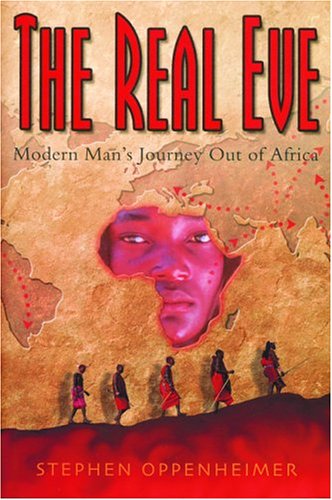
Dr. Stephen Oppenheimer's The Real Eve: Modern Man's Journey Out of Africa (2003) is absolutely one of the very best non-fiction books I've read in a few years! And I say this on several levels too. First, if you are at all interested in your own human origins, and what makes us human, you'll love this book. Second, if you're interested in paleoanthropology, and are interested in what happened after anatomically modern humans (i.e., Homo sapiens) appeared in Africa somewhere around 200,000 years ago and when did we actually become 'behaviorally modern' too, you'll love this book. Finally, if you're at all interested in how anatomically and behaviorally modern humans then spread out in the great diaspora about 80,000 years ago known as the "Out-of-Africa" dispersal, you'll love this book.
Much of this book is an incredibly compelling melding of the existing paleoanthropological, archaeological, and genetic evidence that, when combined with known ecological and climatological data, tells the story of these robust early modern humans that undertook this grand journey that completely changed the world we live in. Oppenheimer carefully presents and considers all of the available archaeological evidence and the conclusions drawn from it, and then compares it with the results of the now extensive amount of genetic research associated with maternal mitochondrial-DNA and male Y-chromosome analyses. Oppenheimer believes that we now have answers or, at a minimum, some pretty compelling hypotheses that go far in addressing questions about who these peoples were that trekked along the coasts colonizing the Near East, eastern and western Europe, India, southeast Asia and eventually even New Guinea, and Australia; while others continued 'coasting' up along the Asian-Pacific coast before turning inland and settling the hinterlands of the ice-age steppe tundra of Siberia and Mongolia. Finally, Oppenheimer addresses one of the most contentious issues in modern archaeology--that of the settling of the Americas. When did modern humans reach the Americas? Who were these early colonizers? Where did they come from? Did they come in a single wave following the end of the last ice-age, or were there multiple entries? And were the Clovis peoples really the first to arrive about 12,000 years ago?
The organization of this book in its seven chapters is simply superb too, in my opinion. Dr. Oppenheimer starts off with the fascinating discussion of our early modern human ancestors in Africa, and what it was that might have compelled them to leave Africa between 80,000 and 90,000 years ago. He then spends time describing the archaeological evidence associated with the potential routes of initial dispersal from Africa (i.e., a northern route through the Levant, or the southern route--the preferred alternative--via the Bab al Mandab at the bottom of the Red Sea and the Horn of Africa).
The second chapter is equally fascinating, and addresses the all-important question of when did anatomically modern humans become 'behaviorally modern'. This has been a vexing question to paleoanthropologists and archaeologists for some time now, and there is a considerable body of evidence out there that can be interpreted quite differently. Frankly though, I'm leaning toward agreement with Dr. Oppenheimer that the appearance of anatomically modern humans between 200,000 years and 170,000 years ago was largely concurrent with the appearance of our behavioral modernity as well. In contrast, there are many well-respected anthropologists, e.g., Richard G. Klein of Stanford University, who believe that Homo sapiens became behaviorally modern sometime around 50,000 years ago, the result of additional adaptations within the human brain. Oppenheimer and other geneticists have not yet ferreted out what this change might have been, nor does he believe that the archaeological evidence supports this theory. All in all, I found this a very thought-provoking chapter.
The remainder of the book's chapters (i.e., 3-7) focus on detailed archaeological and genetic discussions of the timing of the entries into the various regions of the world colonized by the mitochondrial 'Out-of-Africa Eve' and Y-chromosomal 'Out-of-Africa Adam' and their genetic descendants. Chapter Three describes the types of people and timing of the colonizing of eastern and western Europe. Chapter Four focuses on the colonization of India, southeast Asia and leading to humans reaching New Guinea and Australia by about 60,000 years ago (implication being you'd certainly have to have been 'behaviorally modern' to fabricate a craft that was capable of 'island-hopping' and crossing many tens of kilometers of open ocean to reach Australia!). Chapter Five looks at the types of peoples and the timing of the settling of the great interior regions of ice-age Asia and eastern Russia. Chapter Six tells the story of the impact of the last ice-age in the late-Pleistocene (i.e., the Last Glacial Maximum), that wreaked havoc on the small populations of humans scattered throughout Europe and Asia. The last chapter of the book is Oppenheimer's take on the peopling of the Americas. He's of the opinion--based upon archaeology and genetics--that the first 'Americans' arrived between 25,000 years and 22,000 years ago, and that this was followed by a re-expansion of peoples that had occupied Beringia (the huge continent that existed between 25,000-11,000 years ago and linked Asian Siberia with North American Alaska during the run up and through the Last Glacial Maximum).
'So,' you ask, 'having read this fascinating book, what's the upshot?' Well, first, I can categorically answer that we are all African! Second, I think the genetic evidence and its most parsimonious interpretations tend to validate and enhance the current "Out-of-Africa" hypothesis for the dispersal of Homo sapiens from eastern Africa around 80,000 years ago. Third, after reading this book you'll never look at another human being quite the same. You'll always be thinking about our remarkable kinship, yet more fully understanding the meaning of the differences that exist among the peoples of our world today. I think it is also important to point out that Dr. Oppenheimer has also very carefully sourced and documented the material he presents in the book with over 50 pages of end-notes. I strongly recommend reading each of the end-notes too, it made for an even more complete reading experience for me.
Dr. Oppenheimer's The Real Eve: Modern Man's Journey Out of Africa is a grand synthesis of a grand story--our own human origins and subsequent dispersal around the globe. This book is really the incredible story of how a very small group (1,000-2,000 individuals) from a total population of the approximately 20,000 Homo sapiens that occupied Africa about 80,000 years ago actually got up the gumption to strike out and explore and colonize the rest of the world over the next 40,000 years or so. Finally, don't be intimidated by the subject matter, Dr. Oppenheimer is an engaging writer and spends the time and effort to present the material in such a fashion as to be understandable by any reader. It includes loads of terrific maps and detailed charts illustrating and supporting the genetic evidence and conclusions presented in the book.
In closing, I do want to say that I consider myself more than just a casual student of topics in paleoanthropology and human origins and evolution. Over my entire adult life I have made a point of staying current with the latest information, via books and technical journal articles, on this intellectually challenging subject, and I can unhesitatingly say that I believe that this is one of the most important books that I've read associated with modern human origins. This was such a good book that I've gone ahead and found a hardcover edition for my paleoanthropology book collection, as I know that I will be diving into this book time and again in the future. I highly recommend this book, and feel entirely justified in giving this 'five stars'.
The Real Eve: Modern Man's Journey Out of Africa
By Stephen Oppenheimer
Softcover, 440 pp.
Carroll & Graf Publishing, 2004
ISBN 0-7867-1334-8
***
pro se = L. "for oneself."
prose = L. 'prosa.' the ordinary language people use is speaking or writing: a prosaic style, quality, or condition.
The Journal of My Travels through the World's Great Literature
Showing posts with label human origins. Show all posts
March 10, 2013
Review: "The Real Eve: Modern Man's Journey Out of Africa" By Stephen Oppenheimer
March 4, 2013
Review: "The First Human: The Race to Discover Our Earliest Ancestor" By Ann Gibbons
Ann Gibbons has written a very solid and fascinating account of the relative recent discoveries of several of our earliest human ancestors. Gibbons is a well known science writer and brings significant journalistic integrity to her story-telling, as well as significant knowledge of her subject matter. The First Human: The Race to Discover Our Earliest Ancestors (2006) is the story of the paleoanthropologists behind the incredibly important discoveries of hominin species that are currently some of the oldest yet found, and span a range of ages from 5.0 million years old to perhaps as much as 7.0 million years old.
Gibbons, in telling the story of these discoveries, necessarily focuses much of the book on the out-sized personalities (and, dare I say, egos) of the anthropologists leading the teams exploring various important fossil regions in Africa. The teams she primarily focuses on in the book include Tim White and his work in the Afar Depression of Ethiopia; Richard and Meave Leakey in the Lake Turkana region of Kenya; Martin Pickford and Brigitte Senut in the Tugen Hills of Kenya; and Michel Brunet and his team in the Djureb Desert of Chad. Each of these teams of highly professional specialists in their respective fields have significantly added to our general understanding and knowledge base associated with the very earliest hominin species found to date, including Australopithecus, Ardipithecus, and two newly identified species, Orrorin tugenensis and Sahelanthropus tchadensis.
Gibbons is quite even-handed in describing the tension and academic conflict that has arisen among some of these researchers associated with the interpretation and meaning of these important fossil discoveries and their role in understanding and explaining human evolution. Gibbons does a great job of not editorializing or letting her own emotions color the scenes she writes about, and simply factually recounts the stories of the fossil discoveries, the research science that followed, and the resultant back-and-forth academic squabbles that erupted as articles were published and discussed in various academic journals. As a serious amateur student of paleoanthropology and human evolution, I know that this is pretty much de rigueur, not only in anthropological circles, but among the scientific community as a whole. All in all, I think that a rigorous and scholarly debate is incredibly healthy and typically results in the advancement of scientific knowledge. Having said that though, and based upon my interpretation of what Gibbons presents in this book, it is my personal opinion that Martin Pickford--one of the co-discoverers of O. tugenensis--behaved simply deplorably in his much of his dealings with his peers in the academic community over many, many years.
If you're interested in reading about how scientists gear up and conduct scientific expeditions in some very inhospitable portions of the world in their on-going search for the proverbial "needle in the haystack", then I think you'll very much enjoy Ms. Gibbons, The First Human: The Race to Discover Our Earliest Ancestors. Additionally, if you're specifically interested in learning more about these new, and incredibly ancient, species that have been discovered (i.e., O. tugenensis and S. tchadensis you'll very much appreciate the detail and solid science that Ms. Gibbons provides in telling this fascinating story.
The First Human: The Race to Discover Our Earliest Ancestor
By Ann Gibbons
Softcover, 336 pp.
Anchor Books, 2006
ISBN 140007696X
***
Gibbons, in telling the story of these discoveries, necessarily focuses much of the book on the out-sized personalities (and, dare I say, egos) of the anthropologists leading the teams exploring various important fossil regions in Africa. The teams she primarily focuses on in the book include Tim White and his work in the Afar Depression of Ethiopia; Richard and Meave Leakey in the Lake Turkana region of Kenya; Martin Pickford and Brigitte Senut in the Tugen Hills of Kenya; and Michel Brunet and his team in the Djureb Desert of Chad. Each of these teams of highly professional specialists in their respective fields have significantly added to our general understanding and knowledge base associated with the very earliest hominin species found to date, including Australopithecus, Ardipithecus, and two newly identified species, Orrorin tugenensis and Sahelanthropus tchadensis.
Gibbons is quite even-handed in describing the tension and academic conflict that has arisen among some of these researchers associated with the interpretation and meaning of these important fossil discoveries and their role in understanding and explaining human evolution. Gibbons does a great job of not editorializing or letting her own emotions color the scenes she writes about, and simply factually recounts the stories of the fossil discoveries, the research science that followed, and the resultant back-and-forth academic squabbles that erupted as articles were published and discussed in various academic journals. As a serious amateur student of paleoanthropology and human evolution, I know that this is pretty much de rigueur, not only in anthropological circles, but among the scientific community as a whole. All in all, I think that a rigorous and scholarly debate is incredibly healthy and typically results in the advancement of scientific knowledge. Having said that though, and based upon my interpretation of what Gibbons presents in this book, it is my personal opinion that Martin Pickford--one of the co-discoverers of O. tugenensis--behaved simply deplorably in his much of his dealings with his peers in the academic community over many, many years.
If you're interested in reading about how scientists gear up and conduct scientific expeditions in some very inhospitable portions of the world in their on-going search for the proverbial "needle in the haystack", then I think you'll very much enjoy Ms. Gibbons, The First Human: The Race to Discover Our Earliest Ancestors. Additionally, if you're specifically interested in learning more about these new, and incredibly ancient, species that have been discovered (i.e., O. tugenensis and S. tchadensis you'll very much appreciate the detail and solid science that Ms. Gibbons provides in telling this fascinating story.
The First Human: The Race to Discover Our Earliest Ancestor
By Ann Gibbons
Softcover, 336 pp.
Anchor Books, 2006
ISBN 140007696X
***
May 3, 2012
Review: "The Human Career: Human Biological and Cultural Origins" by Richard G. Klein
This review is associated with the 3rd Edition of Richard G. Klein's The Human Career: Human Biological and Cultural Origins (2009)--Wow! Nearly one month later I have actually come to the end of this most amazing book. My hat is off to Dr Klein, as The Human Career: Human Biological and Cultural Origins is arguably the most thorough and comprehensive, yet eminently readable, treatise associated with paleoanthropology, archaeology and human evolution that I've yet to encounter. While the book was primarily written to serve as a textbook in a university environment, its organization and explanation of the material makes it completely approachable and understandable by even the casual layperson. If you like history with a liberal dose of good science thrown in, you just might find yourself as enchanted as I was.
The nearly 800 pages of actual text is organized into eight solidly fascinating chapters, including--
1. Evolution, Classification, and NomenclatureThe presentation and organization of the material allows the reader to easily grasp the important concepts and salient details. Whether it is an in-depth discussion of anatomical details, archaeological artifact assemblages, habitat usage or cyclical climate-change records, speculations or observations in behavioral psychology, or even the latest important genetics information, Dr. Klein's explanations and descriptions of the relevant data and information in each of the chapters was always engaging, very well written, and always quite thought-provoking. I consider myself a fairly well-educated amateur, but very enthusiastic, paleoanthropologist, and I learned something new on virtually every page of this book.
2. The Geologic Time frame
3. The Primate Background
4. The Australopiths and Homo habilis
5. Evolution of the Genus Homo
6. The Neanderthals and Their Contemporaries
7. Anatomically Modern Humans
8. Synopsis: Anatomy, Behavior, and Modern Human Origins
I do need to point out that it is abundantly clear that Dr. Klein is largely (if not firmly) a proponent of the "Out-of-Africa" model associated with modern human origins. But he is also quite candid and forthcoming in describing the few shortcomings of the hypothesis that cannot currently be reconciled with existing data and/or the fossil evidence. Additionally, Dr. Klein spends a good bit of the last three chapters building the case not only for the Out-of Africa model of modern human origins and dispersal, but also the cultural explosion--the result of a new type of modern human behavior--that occurred about 50,000 years ago, and quite likely provided the impetus for the mass-migration from eastern Africa and out across Eurasia, into western Europe, to Australia, across Asia and Siberia and finally into the Americas. While I have been generally pretty familiar with much of this information, it was only through reading this book that I was able to put the whole picture together; starting with the Australopiths, and then into the Genus Homo, concluding with the stark fact that of all the human species we are the last one, Homo sapiens. The synthesis and synopsis provided in the last chapter was simply astounding, and was so damned interesting I read it twice. In sum, Dr. Klein tells a story in this book that is both deeply compelling and fascinating.
Finally, I also want to highly recommend the system of references and bibliographic citations that Dr. Klein has provided associated with the material in this book. At the end of each section within each of the chapters, Dr. Klein provides a brief compendium of the source material for each of the subjects discussed in that section. One can then refer to the extensive, nearly 200 pages, of references at the end of the book. Trust me, this system works well, and the extensive references are certainly 'worth the price of admission' on their own. Dr. Klein also provides a comprehensive Site Index that allows the interested reader to specifically look up an archaeological site. He has also provided a Reference Index (by author/researcher) as well as the obligatory Subject Index. As I said at the beginning, this is a comprehensive reference and resource, and I'm very glad to have this on my bookshelf now.
***
Reviews: "Masters of the Planet" and "The Fossil Trail" by Ian Tattersall
Within this posting I am including my reviews of two superb books by Ian Tattersall, a curator at the American Museum of Natural History. The book reviews include: Masters of the Planet:The Search for Our Human Origins (2012), and The Fossil Trail: How We Know What We Think We Know about Human Evolution (2nd Edition, 2009).
Masters of the Planet: The Search for Our Human Origins
Ian Tattersall's new book, Masters of the Planet, is an eloquently and well-written story of our human origins. While much of the material included in this book was familiar to me, I have to say that Dr. Tattersall's organization and presentation makes this book the perfect gift for someone looking for a thorough but easily understandable first exposure to human evolution. Tattersall's love of systematics, anatomy and taxonomy shines through brightly as he uses the narrative to carefully document, explain and interpret the important fossils and archaeological evidence associated with many of our hominin ancestors.
This anthropological and archaeological detective story begins some 5-6 million years ago and culminates with the origin of anatomically modern humans (i.e., Homo sapiens) in Africa nearly 200,000 years ago, and subsequent dispersal through much of the rest of world starting about 60,000 years ago. This is the elegantly told story of--to borrow a phrase--"bones, stones, and molecules" that provides Tattersall's synthesis and interpretations of the current state-of-knowledge associated with the fossil evidence, the stone-tool traditions, and the latest genetic data. Finally, for those who are interested, Tattersall has provided twenty pages of detailed notes and bibliographic source citations for each chapter at the end of the book. I really enjoyed reading Masters of the Planet: The Search for Our Human Origins, and unhesitatingly recommend it for those interested in the natural and biological sciences.
***
While much of this material was also thoroughly covered in Richard Klein's huge third edition of his relatively recent book The Human Career: Human Biological and Cultural Origins (2009) which I just finished reading recently, I have to say that I very much enjoyed the approach taken by Tattersall--ever the anatomist and taxonomist--in presenting and discussing the fossils in the order that they were discovered, and how they have been viewed and interpreted over time. As the book moves along, Tattersall comes back and revisits certain fossils and presents the new way of interpreting it and its proper placement in the on-going telling of the story of our human origins.
Interestingly, I am actually beginning to recognize and remember many of these fossils by the catalog and/or 'nicknames' that have been given to each of them (e.g., KNM-WT 15000, also known as "Turkana Boy" a very nearly complete skeleton of a young Homo ergaster boy), and this makes reading this book, as well as other technical journal articles and books even more meaningful to me now. Additionally, this book is liberally illustrated, with superbly detailed line drawings of just about each of the fossils that are described in the book. In conclusion, this book is well worth the read, especially if you're at all interested in the history of these amazing fossil discoveries and the evolution, over time, of the interpretation of the of these extinct species and their ultimate role in the search for the complete story associated with the origin of anatomically modern humans--Homo sapiens.
***
Masters of the Planet: The Search for Our Human Origins
Ian Tattersall's new book, Masters of the Planet, is an eloquently and well-written story of our human origins. While much of the material included in this book was familiar to me, I have to say that Dr. Tattersall's organization and presentation makes this book the perfect gift for someone looking for a thorough but easily understandable first exposure to human evolution. Tattersall's love of systematics, anatomy and taxonomy shines through brightly as he uses the narrative to carefully document, explain and interpret the important fossils and archaeological evidence associated with many of our hominin ancestors.
This anthropological and archaeological detective story begins some 5-6 million years ago and culminates with the origin of anatomically modern humans (i.e., Homo sapiens) in Africa nearly 200,000 years ago, and subsequent dispersal through much of the rest of world starting about 60,000 years ago. This is the elegantly told story of--to borrow a phrase--"bones, stones, and molecules" that provides Tattersall's synthesis and interpretations of the current state-of-knowledge associated with the fossil evidence, the stone-tool traditions, and the latest genetic data. Finally, for those who are interested, Tattersall has provided twenty pages of detailed notes and bibliographic source citations for each chapter at the end of the book. I really enjoyed reading Masters of the Planet: The Search for Our Human Origins, and unhesitatingly recommend it for those interested in the natural and biological sciences.
***
The Fossil Trail: How We Know What We Think We Know about Human Evolution
This is a superb history of the discovery of most of the important hominin fossils and interpretations and integration of these fossils into the overarching story of the origins of humans. Ian Tattersall has spent most, if not all, of his illustrious career carefully exploring and considering the fossil evidence and developing a logical hypothesis for the evolution of human species, which he has thoughtfully laid out in the second edition of this important book. Tattersall has also done a very good job of incorporating and explaining the latest scientific data and information related to genetics, geochronology, paleoclimatology and paleoecology that tend to bolster his thesis and specific interpretations.While much of this material was also thoroughly covered in Richard Klein's huge third edition of his relatively recent book The Human Career: Human Biological and Cultural Origins (2009) which I just finished reading recently, I have to say that I very much enjoyed the approach taken by Tattersall--ever the anatomist and taxonomist--in presenting and discussing the fossils in the order that they were discovered, and how they have been viewed and interpreted over time. As the book moves along, Tattersall comes back and revisits certain fossils and presents the new way of interpreting it and its proper placement in the on-going telling of the story of our human origins.
Interestingly, I am actually beginning to recognize and remember many of these fossils by the catalog and/or 'nicknames' that have been given to each of them (e.g., KNM-WT 15000, also known as "Turkana Boy" a very nearly complete skeleton of a young Homo ergaster boy), and this makes reading this book, as well as other technical journal articles and books even more meaningful to me now. Additionally, this book is liberally illustrated, with superbly detailed line drawings of just about each of the fossils that are described in the book. In conclusion, this book is well worth the read, especially if you're at all interested in the history of these amazing fossil discoveries and the evolution, over time, of the interpretation of the of these extinct species and their ultimate role in the search for the complete story associated with the origin of anatomically modern humans--Homo sapiens.
***
April 13, 2012
Review: "The Last Human: A Guide to Twenty-Two Species of Extinct Humans" by G.J. Sawyer, et al.
This is an amazing book! First, I have to say that as the "Chief-Resident" nerd in our family, that I am an inveterate collector of field guides--field guides to birds, trees, flowers, rocks--well, you get the picture. This beautiful book--The Last Human: A Guide to Twenty-Two Species of Extinct Humans--is perhaps best characterized as a naturalist's 'Field Guide' to the history of the evolution of human species (i.e., the hominins). The authors present a relatively detailed synopsis of the current state-of-knowledge associated with each of the 22 hominin species portrayed in the book, starting with Sahelanthropus tchadensis and Ororrin tugenensis at about 6 million years ago, and then finish up with anatomically modern humans, or Homo sapiens.
For most of the species represented in the book, the authors briefly describe and discuss the following: (1) Fossil sites and locations; (2) Age of the species; (3) Tool Use; (4) Appearance; (5) Growth and Development; (6) Differences between males and females; (7) Animals and habitats; (8) Climate; (9) Classification; and (10) Historical notes. It really is wonderfully organized, and serves as an excellent reference source as one reads about these species in the available literature.
The real value of this book-at least to me--is that the authors have supplied beautifully reconstructed images of what these individuals may have looked like in the habitats they are thought to have occupied. They have taken casts of the fossils and added tendons, muscles, flesh, skin, and hair. The results are simply astounding. As just one superb example, the cover of the book is their rendition of the famous Australopith, "Lucy", the fossil of the little female Australopithecus afarensis discovered by Donald Johanson in 1974. It takes your breath away just to look into her face and realize that she and her kind represent something like 800,000-900,000 years in the several million year old history of the human species. This is a book that one can spend hours with every time you take it from the shelf, and learn something new each time too. Absolutely a must have for your library!
***
For most of the species represented in the book, the authors briefly describe and discuss the following: (1) Fossil sites and locations; (2) Age of the species; (3) Tool Use; (4) Appearance; (5) Growth and Development; (6) Differences between males and females; (7) Animals and habitats; (8) Climate; (9) Classification; and (10) Historical notes. It really is wonderfully organized, and serves as an excellent reference source as one reads about these species in the available literature.
The real value of this book-at least to me--is that the authors have supplied beautifully reconstructed images of what these individuals may have looked like in the habitats they are thought to have occupied. They have taken casts of the fossils and added tendons, muscles, flesh, skin, and hair. The results are simply astounding. As just one superb example, the cover of the book is their rendition of the famous Australopith, "Lucy", the fossil of the little female Australopithecus afarensis discovered by Donald Johanson in 1974. It takes your breath away just to look into her face and realize that she and her kind represent something like 800,000-900,000 years in the several million year old history of the human species. This is a book that one can spend hours with every time you take it from the shelf, and learn something new each time too. Absolutely a must have for your library!
***
Review: The Humans Who Went Extinct: Why Neanderthals Died Out and We Survived" by Clive Finlayson
This is a terrific book, and one that I highly recommend. Let me see if I can do the book any justice with my efforts at producing a meaningful review. I work with endangered species and degraded riparian ecosystems along a large river system in the American Southwest, and I very much appreciated Clive Finlayson's incorporation of the environmental and ecological aspects associated with his portrayal and description of human origins. In Finlayson's The Humans Who Went Extinct: Why Neanderthals Died Out and We Survived he takes great care to deftly weave together the latest information about paleoclimate conditions, the paleoecologies, and the paleoenvironments of the regions that were occupied by our hominin ancestors. Broadly speaking, Finlayson's tale is an "Out-of-Africa" story, and that is as it should be in my humble opinion. The Out-of-Africa model associated with modern human origins really does seem to make the most sense when held up to the existing fossil, archaeological, environmental, biological, and genetic evidence and data that is so aptly described by Finlayson in this fascinating account.
The important take-away for me upon finishing this excellent book was two-fold. First, we--modern humans--are incredibly lucky to even be here today. Little differences here or there over the past 75,000 years and it is very likely that Homo sapiens would be just as extinct as other human species, like the Neanderthals (Homo neanderthalensis). Second, climate-change was the big game-changer over the six or seven million years of human evolution, and it was the ability to rapidly react and adapt to these swings in climate and ecological conditions that made it possible for some human populations to ultimately succeed while many others did not. This is a lesson that we need to pay careful attention to now. Just because humans occupy the planet now really is no guarantee that we will still be here twenty millenia from now.
There's a lot of information in this book, and much of it is quite thought-provoking. I can honestly say that I am just a little bit sad too, that our incredibly long-lived close cousins--the Neanderthal peoples--are extinct. Somehow I think the planet is just a little bit lonelier without those people who lived here for hundreds of thousands of years in great harmony with their environment. It seems simply amazing to imagine that there was a fairly long period of time where Neanderthal peoples and modern humans actually occupied the same regions and probably even competed for the same resources in the day-to-day struggle to survive. This is a great and grand story, and in my continuing quest to more fully understand my own human origins I am so glad to have encountered and read Finlayson's superb book, and to now have it on my shelf to go back to periodically.
***
The important take-away for me upon finishing this excellent book was two-fold. First, we--modern humans--are incredibly lucky to even be here today. Little differences here or there over the past 75,000 years and it is very likely that Homo sapiens would be just as extinct as other human species, like the Neanderthals (Homo neanderthalensis). Second, climate-change was the big game-changer over the six or seven million years of human evolution, and it was the ability to rapidly react and adapt to these swings in climate and ecological conditions that made it possible for some human populations to ultimately succeed while many others did not. This is a lesson that we need to pay careful attention to now. Just because humans occupy the planet now really is no guarantee that we will still be here twenty millenia from now.
There's a lot of information in this book, and much of it is quite thought-provoking. I can honestly say that I am just a little bit sad too, that our incredibly long-lived close cousins--the Neanderthal peoples--are extinct. Somehow I think the planet is just a little bit lonelier without those people who lived here for hundreds of thousands of years in great harmony with their environment. It seems simply amazing to imagine that there was a fairly long period of time where Neanderthal peoples and modern humans actually occupied the same regions and probably even competed for the same resources in the day-to-day struggle to survive. This is a great and grand story, and in my continuing quest to more fully understand my own human origins I am so glad to have encountered and read Finlayson's superb book, and to now have it on my shelf to go back to periodically.
***
Review: "The Dawn of Human Culture: A bold new theory on what sparked the "big bang" of human culture" by Richard G. Klein and Blake Edgar
The Dawn of Human Culture can probably be fairly characterized as Professor Klein's 2002 synthesis and condensed version of his monumental textbook, The Human Career: Human Biological and Cultural Origins . This book was clearly written for both the interested amateur as well as for anthropological professionals. In my opinion, this book is really well-written, incredibly fascinating, and lavishly illustrated with numerous superb drawings by Kathryn Cruz-Uribe.
For me, the story of the genus Homo and of the individual species that ultimately leads to us--Homo sapiens--is nothing short of amazing, and Klein's book exhibits that same enthusiasm and wonder that I still feel. Even though this survey of the paleoanthropological state-of-knowledge was published in 2002, it is really mostly still quite up-to-date and relevant. I also very much appreciated Professor Klein's in-depth and even-handed portrayal and treatment of the various positions and opposing or even controversial hypotheses associated with our human origins. When you're done with this book, and you want to find out more about your human origins, I highly recommend getting yourself a copy of the Third Edition of Professor Klein's The Human Career: Human Biological and Cultural Origins (University of Chicago Press, 3rd Ed., 2009).
***
For me, the story of the genus Homo and of the individual species that ultimately leads to us--Homo sapiens--is nothing short of amazing, and Klein's book exhibits that same enthusiasm and wonder that I still feel. Even though this survey of the paleoanthropological state-of-knowledge was published in 2002, it is really mostly still quite up-to-date and relevant. I also very much appreciated Professor Klein's in-depth and even-handed portrayal and treatment of the various positions and opposing or even controversial hypotheses associated with our human origins. When you're done with this book, and you want to find out more about your human origins, I highly recommend getting yourself a copy of the Third Edition of Professor Klein's The Human Career: Human Biological and Cultural Origins (University of Chicago Press, 3rd Ed., 2009).
***
Review: "Lone Survivors: How We Came to Be the Only Humans on Earth" by Christopher Stringer
Chris Stringer's Lone Survivors: How We Came to be the Only Humans on Earth comes along some sixteen or seventeen years after his ground-breaking book African Exodus: The Origins of Modern Humanity (Henry Holt, 1996). Stringer is one of the principal architects and proponents of the "Out-of-Africa" (OOA) hypothesis associated with the origin and dispersal of anatomically modern humans, i.e., Homo sapiens. According to Stringer and the OOA hypothesis, anatomically modern humans evolved in Africa nearly 200,000 years ago, and then 'something' happened about 50,000 years ago that resulted in essentially the relatively rapid spread of our species into much of Eurasia, eastern Asia, Indonesia and Australia, and into western Europe over a period of about 10,000 years! What is even more remarkable is that it now appears that there were other populations of archaic Homo species that we coexisted and/or competed with for a time, likely including Homo erectus, Homo neanderthalensis, and the newly discovered little people of the Indonesian island of Flores, Homo floresiensis.
In just under 280 pages, Chris Stringer takes the reader through the history of our human origins with the fossil evidence. He synthesizes the latest advances in knowledge associated with paleoclimatology, geochronological dating methods, and geology and plate tectonics. Most importantly, Stringer spends much of the book talking about the evolution of human behavior (e.g., developing and utilizing technology, use of symbolism, developing survival and coping strategies, burial of dead, etc.). The evolutionary steps leading to Homo sapiens wasn't a given. It was really a very near run thing, and without the ability to rapidly adapt and respond to changing climate conditions and subsequent changed ecological conditions modern humans could quite likely have become extinct just as our close cousins, the Neanderthals, did about 30,000 years ago. For example, the massive supervolcanic eruption of Toba on the island of Java was very nearly a game-changer for all human species about 73,000 years ago. Finally, over the past decade or so, much of the OOA hypothesis has been validated and bolstered with the results of numerous studies and analyses of mitochondrial DNA and Y-chromosome DNA. In other words, we really and truly are all African.
While all of this discussion of fossils, paleoconditions, and genetics may sound a bit daunting, complicated, or even off-putting, Dr. Stringer does a sterling job of leading the reader--whether layperson or specialist--through the data and evidence with his well-written and entertaining prose. I've kind of come to realize that Stringer and his peers--paleoanthropologists--are really much akin to detectives hot on the trail to better understand when we became who we are, and how we became who we are, and perhaps even be able to answer why. This book will definitely help you get your arms (and brain) around the critical issues and questions associated with what makes us human
In closing, it is my opinion that Chris Stringer's incredibly thought-provoking Chapter 8 of the book, "Making A Modern Human" ought to be required reading by all of us. I don't know that I have underlined more passages or made more marginalia notes in a book since I left college in the mid-1980s. Reading this book, and Chapter 8 in particular, has stimulated a desire in me to chase down a lot of the technical references and journal articles that Dr. Stringer has provided in the book's extensive bibliography. This is a subject that profoundly fascinates me, and I am committed to educate myself and better understand my human origins, and have nothing but admiration and gratitude to Chris Stringer for inspiring me toward this end. All I can say is read Lone Survivors, it really is one of the most comprehensive overviews of the current state-of-knowledge associated with our human origins that I've read.
In just under 280 pages, Chris Stringer takes the reader through the history of our human origins with the fossil evidence. He synthesizes the latest advances in knowledge associated with paleoclimatology, geochronological dating methods, and geology and plate tectonics. Most importantly, Stringer spends much of the book talking about the evolution of human behavior (e.g., developing and utilizing technology, use of symbolism, developing survival and coping strategies, burial of dead, etc.). The evolutionary steps leading to Homo sapiens wasn't a given. It was really a very near run thing, and without the ability to rapidly adapt and respond to changing climate conditions and subsequent changed ecological conditions modern humans could quite likely have become extinct just as our close cousins, the Neanderthals, did about 30,000 years ago. For example, the massive supervolcanic eruption of Toba on the island of Java was very nearly a game-changer for all human species about 73,000 years ago. Finally, over the past decade or so, much of the OOA hypothesis has been validated and bolstered with the results of numerous studies and analyses of mitochondrial DNA and Y-chromosome DNA. In other words, we really and truly are all African.
While all of this discussion of fossils, paleoconditions, and genetics may sound a bit daunting, complicated, or even off-putting, Dr. Stringer does a sterling job of leading the reader--whether layperson or specialist--through the data and evidence with his well-written and entertaining prose. I've kind of come to realize that Stringer and his peers--paleoanthropologists--are really much akin to detectives hot on the trail to better understand when we became who we are, and how we became who we are, and perhaps even be able to answer why. This book will definitely help you get your arms (and brain) around the critical issues and questions associated with what makes us human
In closing, it is my opinion that Chris Stringer's incredibly thought-provoking Chapter 8 of the book, "Making A Modern Human" ought to be required reading by all of us. I don't know that I have underlined more passages or made more marginalia notes in a book since I left college in the mid-1980s. Reading this book, and Chapter 8 in particular, has stimulated a desire in me to chase down a lot of the technical references and journal articles that Dr. Stringer has provided in the book's extensive bibliography. This is a subject that profoundly fascinates me, and I am committed to educate myself and better understand my human origins, and have nothing but admiration and gratitude to Chris Stringer for inspiring me toward this end. All I can say is read Lone Survivors, it really is one of the most comprehensive overviews of the current state-of-knowledge associated with our human origins that I've read.
Review: "African Exodus: The Origins of Modern Humanity" by Christopher Stringer and Robin McKie
Christopher Stringer's book, African Exodus: The Origins of Modern Humanity (Henry Holt, 1996) is a thoughtful, very well-written and detailed presentation of the prevailing model associated with modern human origins known as "The Out-of-Africa" hypothesis. Stringer is not only an incredibly articulate advocate for the model, but he is generally thought of as one of the principal architects of the hypothesis. Stringer's book, while written in the mid-1990s, provides the reader with an excellent synopsis and overview of the fossil, biological, cultural, and genetic evidence and information associated with the hominin species that occupied portions of our planet over the past five-million years.
If you're new to human origins and anthropology, or if you're looking for a good 'refresher' to the topic and the areas of controversy, then this is the book for you. While the "Out-of-Africa" hypothesis has morphed and has really become more complex over the past decade or so, the basic tenets of the model still hold. Finally, if you read this book you'll certainly want to follow it up with Chris Stringer's new book, Lone Survivors: How We Came to Be the Only Humans on Earth (Henry Holt and Co., Inc.), that was published in mid-March 2012. This book, written some 16 years later, provides an in-depth overview of the current state-of-the-knowledge associated with modern human origins. I recently read it and highly recommend it too, and I've posted my review of the book above.
Busy Little Bee!
![]() |
| (c) Christopher Furlong, 2011 |
I realize that it has been a goodly amount of time since I last posted to this blog, i.e., something like a skosh more than three months. Yikes! Well, I sorta do have an excuse, I guess. I have been super-insanely busy at work, and we are desperately short-handed to boot. As the acting director of my agency, I have had to assume a significant amount of additional responsibilities, and much of it involves traveling to and fro to meetings across much of the southwestern United States. The downside? Lots of traveling. The upside? Lots of time to read!
So far, in 2012, I have cranked out something like 30 books, with another 10-15 in the immediate to-be-read queue. I'm actually having a ball and reading some really interesting stuff too. I am getting ready to start a group-read of Charles Dickens' fourth novel, The Old Curiosity Shop (1841) with my chums in "The Readers Review" on Goodreads in late-April. Also, for the past couple of months I have been re-immersing myself in the latest state-of-knowledge associated with paleoanthropology and human origins.
As some of you may know, I am a geologist by education, and I guess you could say that I have always been a seriously interested amateur archaeologist and anthropologist. Ever since I was a child, and able to read, I've always been fascinated with the accounts of the archaeologists discovering fossils and physical evidence of early humans that have been found across Africa, Eurasia, and the Americas. With today's access to on-line resources, I am now able to not only read the books that are published, but I can also delve into some of the more technical journal articles that are available on-line. I actually feel like I am actually enrolled in a graduate seminar, and I'm loving every moment of it!
Like most sciences, anthropology and archaeology and the state-of-knowledge associated with human origins changes rapidly, almost daily it seems. The integration and synthesis of data and research associated with geology, paleoclimatology, new methods of dating fossils, and particularly the advances in genetics has led to a significant increase in what we now know about our human ancestors and our biological and cultural origins. Combined with the relatively recent discovery of some important new fossils, we now have a pretty good picture of human history that reaches back some 6-7 million years!Not to put too fine a point on it, but Amazon and I are 'hooking up' on just about a daily basis. My incredibly tolerant wife indulges my book-buying addiction with nary a reproachful word, bless her dear heart. Anyway, my 'Mount TBR' continues to grow, as nearly each day the USPS is dropping off another new tome via my Amazon orders. So, I've lots to read, lots to review, and lots of postings to add here. I'd best get busy!
I hope Spring has sprung in your area, and that the trees are leafing out and flowers blooming. Cheers!
Subscribe to:
Posts (Atom)


