January 14, 2013

Review: "The Graveyard Book" By Neil Gaiman

I loved this little book!  What a wonderful reimagination of Rudyard Kipling's The Jungle Book.  Neil Gaiman is just a born story-teller, and The Graveyard Book is such a terrific example of his talents.  While there is a touch of horror and macabre in the book, it is very much a book that should appeal to young readers as well as adults.  It is also lavishly illustrated by the author-artist Audrey Niffenegger which adds ever so much to the tale.

The premise of The Graveyard Book is of a mysterious man who slays three members of a family, but the fourth member--an 18-month old little baby boy--toddles off in the night and ends up in an old graveyard.  He is adopted by the 'residents'--all dead themselves--who range in age from Roman times up to the present.  He is taken in and 'raised' by a couple, Mr. and Mrs. Owens, who've been dead for something like 300 years, and is named "Nobody Owens" (nick-named "Bod").  Bod also has a living caretaker, 'Silas', that provides for his material needs whilst keeping him safe as he lives and grows up on the grounds of the cemetery.  Bod is in the unique position of being able to essentially cross-walk, if you will, between the land of the living and that of those dead and residing in the cemetery.  Bod is given a basic education from former teachers who are now permanent residents in the cemetery.  His teachers send him out to practice his reading of English and Latin by studying the plethora of headstones in the cemetery.  Bod also learns some nifty little survival tactics, like how to haunt and fade, from all of his dead 'family' and 'friends', and this serves him very well as the mysterious man is still earnestly looking for Bod in order to finish the job.  Bod also begins to learn more about his protectors Silas and Miss Lupescu.

Like much of Gaiman's fiction this is a quick read, but the plot and the writing are immensely satisfying.  There are all sorts of allusions and references to fairy tales and bits of folklore scattered throughout the book that, taken together, truly cements Gaiman's reputation as a master story-teller in our modern age.  The Graveyard Book is a story that I'd love to see somebody (i.e., like Tim Burton, maybe?) endeavor to bring to the 'big screen', as it such a wonderful, wonderful story from start-to-finish.

The Graveyard Book
By Neil Gaiman
Harper Collins, Hardcover, 2008
312 pp.
ISBN 0060530928

***

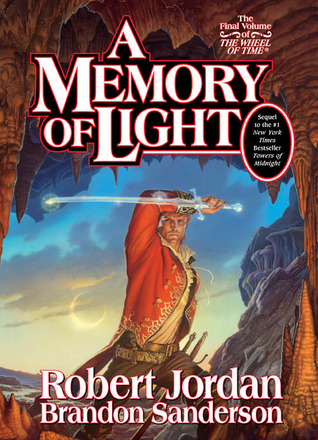
Review: "A Memory of Light" By Robert Jordan & Brandon Sanderson

As I turned the last pages of A Memory of Light so many things were racing through my mind.  First, it struck me that this is the end of an era, as I have been religiously reading and rereading this series for over 20 years (23 to be precise!).  Second, this is absolutely one of the best fantasy series I have ever read, and I am profoundly and utterly amazed and astonished at the quality of the writing, and complexity of the plotting and characterization from the first volume to this, the fourteenth volume, A Memory of Light.  Finally, I don't know that I have ever read one single book that has run me through the emotional 'ringer' the way that A Memory of Light has; and like Life, there are moments of great joy and happiness as well as deep sadness and grief.  I cannot begin to tell you how many times while reading this book I simply stopped reading and quietly wept for a few moments.  It was, all in all, a simply glorious reading experience! 

I am not going to give one word away about how A Memory of Light wraps up this grand journey that all of us have been on for nearly two decades.  Suffice it to say that A Memory of Light is nearly 1,000 pages of near perfection, and we should all stand up and bellow at the top of our lungs, Tai'shar Jordan! Tai'shar Sanderson!, as they have given us a grand story and an ending for the ages.  Obviously, much of A Memory of Light revolves around 'Tarmon Gai'don' (The Last Battle), and the battle scenes are riveting and make the book incredibly difficult to put down.

As any devoted 'Wheel of Time' fan, I went into A Memory of Light with just a tiny bit of trepidation.  After all, this series has finally come to an end, and how it ended was very important to me.  Now that I've finished my first reading of A Memory of Light, I have to say that I really don't know what I was worried about.  Robert Jordan and Brandon Sanderson have crafted a finale that is emotionally powerful and so intellectually satisfying that it very nearly belies words.  Oh, I'm sure that there will be those that will want to change this or that, but not me.  I really do think that the series has ended just as it should, and I honestly don't think I'd change a thing.  I can't wait to reread A Memory of Light again soon, as I'm sure that upon a more careful second reading it will become an even more meaningful experience for me.

For something over twenty years this series has been a meaningful part of my literary life.  At first it was really just great fun--a wonderfully complex and complicated bit of fantasy fiction to enjoy as each installment came out.  Now, however, I am beginning to realize that just as Tolkien was inspired through his fiction and poetry to work on developing a mythology for the English peoples, I think Robert Jordan challenged himself to craft a mythology for an American time.  Nation-building, economic and environmental pressures, political machinations, faith and belief systems, cultural diversity, it is all there.  Mostly the 'Wheel of Time' is the story of men and women and the human condition and the choices we make.  Seriously folks, this series is right up there, in my humble opinion, with Steven Erikson's "The Malazan Book of the Fallen", George R.R. Martin's "A Song of Ice and Fire", and J.R.R. Tolkien's "The Lord of the Rings"--it really is that good!
There are no endings, and never will be endings, to the turning of the Wheel of Time.

But it was an ending.
 
A Memory of Light
By Robert Jordan & Brandon Sanderson
Tor Books, Hardcover, 2013
909 pp.
ISBN 0765325950

***

Review: "The Child Thief" By Brom

I am now an unabashed fan of the artwork and writing of Brom.  I recently finished reading Brom's The Child Thief, a dark--and very much adult--retelling of J.M. Barrie's Peter Pan.  Frankly, based upon this novel, I'm willing to suggest that Brom is America's answer to British author Neil Gaiman, with the ability to take the folklore and fairy tales of the ages and give them a thoroughly modern spin.  Even setting aside Brom's gorgeous art that graces this novel, the tale itself is a sophisticated amalgam of elements from Celtic mythology, Arthurian legend, and American history, and it really, really works well.  Having said this, this is not the 'Peter Pan' of your youth, and most certainly is not the 'Peter Pan' and 'Tinkerbelle' of the Disney cartoon.  Nope, this is some seriously dark stuff that continually tugs at the heart-strings, horrifies, and even amuses as it deals with things like friendship, loyalty, belief and faith, and love.  Something tells me that J.M. Barrie would very much approve of Brom's interpretation and retelling of 'Peter Pan' in this book.  I really need to see if I can find a hardcover edition of The Child Thief, as this is a book to cherish and reread, and add to my growing collection of the tales of mythology and faerie.  This gets a solid five out of five stars from me, a genuine favorite.

The Child Thief
By Brom
Harper Voyager, Trade Paperback, 2009
476 pp.
ISBN 0061671339

***

January 9, 2013

Review: "Great North Road" By Peter F. Hamilton

In reading Peter F. Hamilton's Great North Road I certainly stepped out of my reading 'box', but then I've been doing that a lot over the past few years.  This massive tome--nearly 1,000 pages--is a rock-solid and riveting example of the sub-genre of science fiction known as 'space opera', and I have to say that I enjoyed every moment reading this book.  I had never read anything by Hamilton before, but I am quite sure that I'll be looking at some of his other fiction in the near future.

Simply put, Great North Road is a tale that takes place approximately 150 years in the future, and is a wonderful combination of a police-procedural murder mystery and the story of a military expedition and exploration on the new and strange world of St. Libra, an Earth-like planet, orbiting the Sirius star system (about 8 light years from our own Solar System).  St. Libra is a planet that is mostly covered with water, but with several large land masses that contain a dense and virtually impenetrable jungle.  St. Libra also happens to be the location of a large "bioil" facility that manufactures petroleum products created from algae that is 'farmed' in large paddies.  This oil is then transported through a "trans-spacial connection", or gateway, back to Earth where it is used by European countries in what is now known as "Grande Europe" (a nod to the current European Union, I'm guessing).

Much of the police procedural elements of the novel are centered on the city of Newcastle in England, where there is a corresponding 'gateway' that allows instantaneous travel and transportation of people and equipment from Earth to St. Libra.  Many countries around the world have also established gateways to other worlds and have either created quasi-Utopian settlements, or have engaged in economic- or ethnic-cleansing and have transported their undesirables to these new worlds (i.e., much like the English used to transport criminals, and others, to penal colonies in Australia in the early 19th century).  Additionally, there is the added tension throughout much of the novel of the risk of invasion and attack by a truly horrific alien life-form, the "Zanthswarm", which has attacked and destroyed several of the human settlements on other worlds with millions of human casualties.  The Human Defense Alliance (HDA) exists to protect all humans (and the gateways) from alien threats, and kind of reminded me of our NATO alliance today, or even the U.S. Homeland Security Department.

Hamilton's world-building and his information-dumps are well handled through the use of a timeline that hops back and forth over a span of a century or more, and seen through multiple points-of-view of the various characters in the novel.  There are also some really well thought out notions associated with human cloning, and gene modification (if you have the money) that slows and even reverses the effects of aging, some seriously cool and advanced medical procedures.  I also really found fascinating Hamilton's vision of how artificial intelligence (AI) and information technology is used in this novel.  People are essentially hard-wired into the 'world-wide-web' and can pull up and utilize their own personal 'net' to communicate and access and process all kinds of information and technology--pretty much all 'virtual reality'.  Obviously, this technology allows the police to accomplish some pretty amazing things when it comes to trying to solve crimes, and the soldiers on St. Libra to coordinate and stay linked together as they search for a dangerous alien entity that may, or may not, be involved in the murder that occurred back on Earth.

While some readers may balk a bit at the slightly ponderous pace of the first third of the novel--mostly involving the murder mystery and the Newcastle police--I encourage readers to stay with it as the pace picks up dramatically as characters and plot-lines begin to converge, and then one finds oneself fully engaged as the book roars to its very satisfying conclusion.  I have to say that I was mightily impressed at the overall tone and tenor of the novel and its subtle, and sometimes not-so-subtle, moral messages that invite the reader to periodically stop and reflect upon a whole of host of issues, including things like population and emigration/immigration control, medical and bio-ethics, control and use of nuclear and biological weapons, and environmental stewardship and the harvesting and utilization of natural resources.  Without being 'preachy' in the novel, I think Hamilton wants his reader to think about these issues and the moral and ethical responsibilities that humans--as an intelligent species--have, and that as we move forward in exploring our Solar System that we do so in a thoughtful, deliberate, and responsible fashion.

The Great North Road is an excellent novel on many levels, and I unhesitatingly recommend reading it.  If you like scifi you'll probably love the book; and even if you don't, the plot and science elements in Great North Road are still close enough to our time frame such that it makes sense and isn't too abstract.  For me, Great North Road is a solid four out of five stars.  A good read indeed!

Great North Road
By Peter F. Hamilton
Del Rey/Ballantine Books, 2012
948 pp.
ISBN 978-0-345-52666-3 

***


January 5, 2013

Review: "Red Country" By Joe Abercrombie

Wow!  Joe Abercrombie's Red Country is one of the first books that I've read in 2013, and I'll wager that it ends up being one of the best I've read this year.  I found the dark gritty fiction of Abercrombie a few years ago when I read his First Law trilogy (2006-2008), and then followed it up with his brilliant, and my favorite, novel, The Heroes (2011).  Red Country is right up there with The Heroes and is somehow an incredibly clever blend of cinematic gorefest ala Sam Peckinpah and the unrelenting violence and pathos of the writing of Cormac McCarthy; and while Red Country is a fantasy novel of the first order, it reads and feels like a western.

The plot is really quite simple.  Farms in the hinterlands have been burned, people brutally killed, and a lot of children have been captured and kidnapped by a gang of desperadoes.  The novel's primary protagonists are all a group of misfits and deeply flawed characters that have come together to trek across a brutal landscape, some in search of the missing children, others in pursuit of gold, and others just trying to find themselves and start new lives.  'Shy South' and 'Lamb', a father-figure to Shy and her younger siblings, are in pursuit of the kidnapped children.  And if you've read any of Abercrombie's earlier novels you'll be delighted as you encounter a goodly number of rogues who reappear in Red Country.  Additionally, there is a whole group of fascinating new characters that range from utterly monstrous and despicable to some that are honorable and good-hearted.  Having said that though, it is amazing to me that at times it is still hard to sort out who is really good and who is really bad, and that is solely a function of the quality of Abercrombie's plotting and writing.

Abercrombie has a way with words and can truly turn a phrase.  One thing I've come to expect when reading his fiction is the earthy and pithy philosophical one- or two-liners from his characters.  They're really quite priceless, and I've taken to marking them as I encounter them whilst reading.  Here's a sampler of Abercrombie witticisms--
My old commander Sazine once told me you should laugh every moment you live, for you'll find it decidedly difficult afterward.
'Severed heads,'Cosca was explaining, 'never go out of fashion.  Used sparingly and with artistic sensibility, they can make a point a great deal more eloquently than those still attached.'
There is no bad living, and no good death.
The bottle's a shifty banker--it might lend you courage but it's apt to call the debt in sudden.
'Death loves me.' Lamb smiled, black-eyed, wet-eyed, and the smile was worse even than the snarl had been. 'All the work I done for him? The crowds I've sent his way? He knows he ain't got no better friends.'
'Why does everyone pout so over children?' Cosca called after him. 'They'll turn out just as old and disappointing as the rest of us.'
'Men are animals.  Conscience is a burden we choose to bear.  Morality is the lie we tell ourselves to make its bearing easier.'
Well, you get the picture.  Abercrombie sure can write, and Red Country is a relentless torrent of words and writing that simply compels you to keep reading and turning pages, one after the other until you reach the immensely satisfying conclusion.  This is a great book with awesome characters that is sure to please any reader encountering Abercrombie for the first time.  If you've had the pleasure of reading any of Abercrombie's other books, oh are you in for a hell of a delightful surprise.  Finally, even if you're the type of reader who swears they don't like fantasy fiction, give Red Country a try, I'm gonna bet that you're gonna find Abercrombie's fiction is well worth it and in the 'wheel-house' of many, many readers.  Red Country gets a solid five out of five stars from me.

Red Country
By Joe Abercrombie
Orbit Books, 2012
453 pp.
ISBN 9780316187213

***

Review: "Something Red" By Douglas Nicholas

Every once in a great while you just happen upon a book and author that you absolutely know nothing about, but you take a chance and take it home with you and you are simply blown away at what you've discovered.  Something Red, by Douglas Nicholas, is just such a book and is really a stunning little novel.  This dark and grim story revolves around a small troupe of travelers on a journey through a rugged wild portion of northern England during a bleak and cold winter in the 13th Century.  During the course of their trip the horror and terror mounts until the explosive climax near the end of the book.

The author of Something Red, Douglas Nicholas, in my opinion, is a writer of great promise.  Not only can he spin a great yarn, but his prose is gorgeous and verges on the poetic at times; which actually makes sense as Nicholas is apparently a well known published poet from the Hudson Valley of New York state.  The characters in Something Red are interesting and well wrought, and his use of magic and mythology is deft and sure-footed and works well in the plot.  I have to say that more times than not this dark tale reminded me of the early Anglo-Saxon alliterative epic poem, Beowulf (especially Seamus Heaney's brilliant translation). Also, it is actually quite hard to pigeon-hole this book as horror, fantasy, mystery, or medieval historical fiction--as it really is all of the above.  Mostly though, this is just one damn good book that I had a hard time putting down until I'd read the last page.  I ain't gonna say anymore, other than to urge you to read this superb and riveting debut novel from Douglas Nicholas.  This received five out of five stars from me, as it really was a most excellent novel, and one that I will surely read again sometime soon.

Something Red
By Douglas Nicholas
Emily Bestler Books/ATRIA Books, 2012 
315 pp.
ISBN 978-1-4516-6007-4

***

January 1, 2013

Review: "The Road" By Cormac McCarthy

I just finished rereading this spare, but intensely powerful, little book.  There's an almost intoxicating quality to the writing of Cormac McCarthy, and The Road is an excellent example of his mastery of the craft.  I swear that there is simply not one extraneous word, and that his brief--almost painfully brief--prose somehow majestically morphs into an elegy that becomes a song of sorrow about the last vestiges of human existence on a shattered Earth. 

The Road is both relentlessly sad and horrifying as the reader follows the struggles of the 'man' and the 'boy' as they slowly journey on the road across the ash-covered and tortured landscape.  But as painful as this book is to read, it is also at the same time the story of a beautiful love between a father and his son.

The Road is, at some level I think, a retelling of the Myth of Prometheus.  Prometheus, as you may recall, was the Titan that created humankind from clay and then gifted them with fire.  For defying Zeus and providing humans with fire, he was chained to a mountain-top where each day an eagle swooped down and devoured his liver.  In The Road, the man and boy travel down the road trying to be the "good guys" and "carrying the fire" in a world that has obviously been, and continues to be, brutally ravaged by fire (whether it was by nuclear holocaust, an asteroid strike, or environmental catastrophe is not made clear, nor is it particularly relevant).

In my opinion, McCarthy's prose in The Road rises to the level of the apocalyptic poetic visions of William Blake, William Wordsworth, or even T.S. Eliot, and is richly loaded with allegory, metaphor, and symbology.  And while The Road is grim, dark, and utterly bleak, it is entirely consistent with much of the rest of McCarthy's oeuvre.  Like many of McCarthy's earlier works, The Road is the story of an epic journey and the relationship between a father and son (or older man and younger man).  Think about, for example, Blood Meridian ("The Judge" and "The Kid"); No Country for Old Men (the Sheriff and his Uncle); and then each of the books in The Border Trilogy, and some of his earlier "Appalachian" works like The Orchard Keeper, Suttree, and Outer Dark.

Some how, some way, McCarthy, while exploring the dark side of humanity in his fiction also always manages to find the spark of goodness in some of his characters--and yet Hope always remains an elusive and sketchy notion.  For me, what makes McCarthy's vision of Hell so goddamned terrifying is that there is a palpable sense of doubt in the validity of Hope and Grace in his fiction.  In The Road it is the 'glimmer' of Hope that carries the scent of salvation and keeps the reader going page after page, paragraph after paragraph, and spare sentence after spare sentence. 

When you read Cormac McCarthy you quickly come to realize that really bad things can happen to decent people and that walking 'the road' of life is a difficult proposition at best. Tough stuff to read, but oh so worth it.

***

December 31, 2012

Review: "World War Z" By Max Brooks

I didn't include this book in my list of favorite reads in my "2012--My Year In Review" list that I posted, but I probably should have.  It must be something about the time and age that we live in that the zombie apocalypse has become something of a cult phenomenon--witness all of the zombie books being published and read, and AMC's remarkably popular TV series "The Walking Dead"--and I must confess that I am a 'card-carrying' member of the zombie cult too (which, on its face, is perhaps the most ridiculous thing I've said in months ;-).  Anyway, World War Z was a morbidly fascinating and well-written fictional account that purports to provide an 'oral history' of the efforts of the world's living to contain and eradicate the world's undead.  Max Brooks (Mel Brooks' son) wrote this book as a collection of interviews among the survivors of the horrific war against the zombies, and certainly pays an extraordinary amount of homage to the late Studs Terkel. 

As crazy as it sounds, this was an easy and entertaining book to read, largely because of Brooks' organization of the novel.  It starts with a chapter describing the initial outbreak and spread of the virus that leads to the 'zombification' of billions of humans across the entire globe.  The remaining chapters include the personal accounts of the survivors as they try and combat the horror of the mounting threat of the zombie hordes, and then the formulation and implementation of a global strategy to reclaim the planet from the undead hoards. 

Personally, I liked the use of the personal interview and vignettes of story-telling rather than focusing on a first- or second-person accounting of this horrific tale.  And while the notion of zombies taking over the world may seem a bit far-fetched (I hope?), there was plenty of 'food-for-thought' about the way governments and individuals might react if there were global threats associated with nuclear or biological terrorism, or even the short- and long-term effects associated with global climate change.  The human propensity for inhumanity to other humans is well known, and is maybe even more terrifying than that of the zombies described in Brooks' World War Z.  I'll be interested to see how the upcoming blockbuster movie starring Brad Pitt handles the material in the book when it is released during summer 2013.  World War Z, the book, gets four out of a possible five stars from me.

***

December 29, 2012

Reviews: A Neil Gaiman Cornucopia

2012 found me discovering, or rediscovering, the British author Neil Gaiman, and I am so glad that I did.  A few years ago I read his novel American Gods, and I was really not all that impressed.  However, after my most recent experiences with Gaiman's fiction I must confess that I am prepared to give American Gods another chance at some point.  Anyway, over the past couple of months I've read Stardust, Neverwhere, and Coraline.  Here are my brief thoughts about each of them--

Stardust is an elegant and poignant little novel, and is truly one of the very best books that I've read this year.  Gaiman is a brilliant story-teller, and this is a tale for the ages.  Stardust is a story that has the feel and threads of a fairytale that has been handed down and greatly loved through the generations.  There is something in this beautiful and compelling story that re-galvanizes one's faith in the good-heartedness of most people, and that Fate and Chance can also work for good.

You'll note that I am not sharing one jot about the plot of this tale, as I don't want to influence you other than to simply say that it is my humble wish that each and every person read Stardust at some point during their lives, and maybe bring a little extra Magic and Love into their hearts and souls.  Upon finishing this lovely little story you simply can't help but look at the world around you just a little differently, and that'll be a mighty fine thing, I think.

***

I finished Neverwhere over a three-day period while on Christmas vacation, and loved every moment and every word.  In my humble opinion, Neil Gaiman is the undisputed master of the 'modern British fairytale'.  He is a sorcerer with words as he successfully weaves new twists and turns into the fables and fairytales that we've all probably encountered over the course of our lives.  Neverwhere is a brilliant story that looks at the 'other' world below modern London--the world of abandoned 'Tube' stations, trains from odd places and going odd places, ancient sewer systems and its denizens--in other words, the 'Land of Faerie' in an urban setting. 

The story's protagonist, Richard Mayhew, falls through the cracks and emerges into this other London, and is immediately thrust into an epic adventure with a Dickensian cast of characters.  The adventure rapidly turns into a titanic struggle between the forces of Good and Evil (and the Evil forces are really quite horrifyingly awful).  Like most, if not all, of Gaiman's protagonists, Richard Mayhew has to dig deep within himself to find his courage, but once he commits himself he is a stolid and reliable friend to the young woman, Door, who is in desperate need of his help.  Again, I dare not say more about the plot, other than I loved this book immensely and I simply loved the ending--it was perfect! Neverwhere is a marvelous, marvelous novel.

***

I loved Coraline!  This beautiful little book can, and should, appeal to readers of all ages, including my precocious and intelligent seven year-old grandson (who, by the bye, is reading The Hobbit right now).  This little fairytale is all about the notion of "the grass is not always greener on the other side"; courage and fidelity to one's beliefs; the love of family and friends; and most importantly perhaps, that one must stand up and fight injustice whenever it is encountered.  Little Coraline does all of this in spades.  In short, this little girl is my hero.

As a bit of a sidenote, something else that I've noticed is that Gaiman has a thing for doors, doesn't he?  Hmmm...Think about it.  In his novel Stardust there is a gate to Faerie; and in Neverwhere the young woman, Door, is able to find, open, and pass through doors that are portals to other planes and places; and then our own Coraline and the 'fourteenth' door in her parents' flat that opens upon the alternate world of her "other Mother" and "other Father" and some other creepy doings.

Being the father of two beautiful daughters, this little tale cast me back to the days of watching their inquisitive natures and insatiable curiosities as they began exploring the world around them and the people they encountered. So, while there are some superb moral lessons for children in this book, there are an equal number of lessons for the parents and grandparents of children too.  Foremost is to pay attention to and unconditionally love our children, and in so doing that is likely enough to prevent them from seeking out or, worse yet, actually finding a set of "other parents" behind the "fourteenth door".

Coraline is a wonderful little book to pass around to all of the adults and children in your life.

***

Neil Gaiman is certainly one of my great literary discoveries of 2012, and I'm so glad to have most of his fiction sitting on my bookshelf now.  Both Stardust and Coraline made my "Year In Review" list too.  Finally, I have Gaiman's The Graveyard Book sitting in the queue on my TBR shelf.  I can't wait!

December 28, 2012

2012--My Year in Review

"It was the best of times, it was the worst of times..."

I know that I have been extremely remiss in posting to ProSe over the past couple of months, but there's been a lot--a great lot--going on in my life of late.  This posting, while some of you may find it of interest, is probably written more for my own edification than anything else.

In early-August 2012, my oldest daughter received her Ph.D. in English from the University of Nebraska in Lincoln, Nebraska.  I cannot begin to tell you how proud all of us are for the hard work she has put in over the years to achieve this significant milestone.  I was extremely honored to have been asked by her to read and review her dissertation prior to it being finalized and submitted to her committee.  She is still teaching at UNL while she begins the task of trying to find a full-time teaching position at a four-year institution.  I am sure that a good school will snap her up soon.

My very elderly mother passed away after a long struggle with amyotrophic lateral sclerosis (ALS, or "Lou Gehrig's Disease") on November 7, 2012.  She died quite peacefully in the morning with family and friends surrounding her in the sun-room of my parents' house in southern Arizona.  I was able to spend a lot of quality time with her over the past couple of years, and for that I shall always be eternally grateful.  ALS is a terrible and miserable disease, and my heart simply goes out to any who have a family member struggling and endeavoring to cope with it.  I also want to give a huge 'shout-out' to the magnificent angels who involve themselves in all aspects of home hospice care.  I think having my mom in her own home surrounded by her own possessions and memories, her cat, her friends, and my father--in short, her Life--made the struggle so much easier for her to bear.  I also want to say that my father is really doing very well, and that my younger brother has moved in with him to lend a helping hand.  We all miss you, Mom!

Concurrent with my mother's passing, my wife and I found out that our oldest son (my stepson, my wife's son) had been selected to attend the U.S. Army's Warrant Officer Career College at Fort Rucker, Alabama.  He has been in the Army for 14 years and has been deployed to both Iraq and Afghanistan over the past few years.  He was a Sergeant First Class when selected to become a Warrant Officer, which is a hugely positive career move.  At the same time that he was off to Warrant Officer school, his wife (our daughter-in-law) was deployed to the large U.S. military base in Doha, Qatar, in the Persian Gulf.  She is active-duty Army too, and began her year-long deployment in early November.  So, "Grammie" (my wonderful wife) and I have taken in their two children--a wonderful seven year-old boy, and a sweet little two-and-a-half year-old girl.  We set up one of our guest rooms for the kids, and are now back to being full-time parents, running kids hither and yon.  I am 56 years old, and I can absolutely attest to the fact that raising young children is most assuredly a young person's "sport"!  At the same time, it really is kinda like riding a bicycle, you really don't forget how to do it.  Depending upon the needs of the Army, the kids could be with us through July 2013, or as long as November 2013.

Early November 2012 also saw the President being reelected, and I was profoundly relieved that the American people saw fit to give his administration another four years.  Personally, I do believe the country is moving in the right direction under his leadership.  I just wish that there was some of way of stepping back from the extreme polarization and partisanship that seems to have overtaken the two political parties.  I am cautiously optimistic that President Obama can use his second term in trying to find a way to bridge the gulf--more like a chasm--between the parties and get the Congress back to doing the Nation's business.

From a literary perspective, 2012 was a very good year for me.  I read over 110 books this year, and I've still a few days left! Of the books I read, some were 'old friends' that I was revisiting, and others were brand new to me.  While I read a lot of fiction, 2012 was also a year in which I read a lot more non-fiction than is typical in a given year, as I explored the latest books associated with human origins and anthropology, and a whole raft of relatively recent military history books about the American Civil War.  I thought it might be fun to share "My Best Books of 2012"--

Best of Non-Fiction
Lone Survivors: How We Came to Be the Only Humans on Earth, by Chris Stringer (Science/Anthropology)
Hardy: A Biography, by Martin Seymour-Smith (Biography)

Best of Military History
The Battle of The Wilderness, May 5-6, 1864, by Gordon C. Rhea
The Battles for Spotsylvania Court House and the Road to Yellow Tavern, by Gordon C. Rhea
This Terrible Sound: The Battle of Chickamauga, by Peter Cozzens
Gettysburg: A Testing of Courage, by Noah Andre Trudeau

Best of Historical Fiction, Fantasy, or Horror
Hide Me Among the Graves, by Tim Powers(Historical Fiction/Fantasy/Horror, and my review here)
11/22/63, by Stephen King (Fantasy)
World War Z: An Oral History of the Zombie War, by Max Brooks (Fantasy/Horror)
Stardust, by Neil Gaiman (Fantasy)
Coraline, by Neil Gaiman (Fantasy)
The Fall of Troy, by Peter Ackroyd (Historical Fiction)
Something Red, by Douglas Nicholas (Historical Fiction/Fantasy/Horror)
Morality Play, by Barry Unsworth (Historical Fiction/Mystery)
The Road, by Cormac McCarthy (Post Apocalyptic and a re-read for me)
The Forge of Darkness, by Steven Erikson (Fantasy)

Best of Classic Fiction
Far From the Madding Crowd, by Thomas Hardy (A re-read for me)
The Return of the Native, by Thomas Hardy (A re-read for me)
Bleak House, by Charles Dickens (A re-read for me)

Best Poetry
The Oresteia, by Aeschylus (Translated by Peter Meinick)
The Lays of Beleriand, by J.R.R. Tolkien
The Iliad, by Homer (Translated by Anthony Verity)
Beowulf: A Dual-Language Edition, Translated by Howell D. Chickering, Jr.

Special 'Kudos' to Neil Gaiman's Stardust, Douglas Nicholas' Something Red, and Tim Powers' Hide Me Among the Graves.  These three books may very well be my favorite new reads of the year, and I highly recommend them to readers. I'd have to give an 'Honorable Mention' to Stephen King's new novel, 11/22/63 as well.

Finally, the book that I am really looking forward to reading is the final volume in the monumental "Wheel of Time" series of fantasy fiction that was started by the late Robert Jordan, and is being finished up by Brandon Sanderson.  The fourteenth and final book, A Memory of Light, is being released on January 8, 2013, and I can hardly wait.  I have been reading this series for over twenty years, and it really is some of the very best fantasy fiction out there.

A very Happy New Year to each of you as we ready ourselves to leave 2012 and begin 2013.  I look forward to stopping by and visiting each of your blogs and sharing our love of all things literary as we start a new year.  Cheers!

***